Qantara is presented, an end-to-end JEPA whose joint training objective pairs a Brownian-bridge interpolant between consecutive clean latents on the state axis with noise-to-data flow matching on the action axis, and these results move JEPA world models from single-paradigm planners to multi-paradigm controllers.
Abstract
Joint-Embedding Predictive Architectures (JEPAs) underpin a growing family of latent world models for control from raw pixels, but every existing JEPA world model commits at training time to a single inference paradigm: either trajectory optimisation in a learned dynamics model, or direct behaviour cloning. A single checkpoint that serves both would defer this choice to inference, when deployment constraints (rollout cost, observation accessibility) determine which path wins. We present Qantara, an end-to-end JEPA whose joint training objective pairs a Brownian-bridge interpolant between consecutive clean latents on the state axis with noise-to-data flow matching on the action axis. The same checkpoint serves three inference paradigms without retraining: latent planning, behaviour-cloning action sampling, and inverse dynamics, which we query through a video-inverse composition that first predicts the next latent without action conditioning, then extracts the action. Training concentrates mass on the edges of the (action-time, state-time) noise square, where inference queries the predictor: replacing it with uniform interior sampling drops Push-T planning from 90.1 to 53.3 SR at matched compute. On the LeWM control suite, Qantara reaches a 91.2 SR three-train-seed average and sets new SOTA on OGBench-Cube (+7.7 SR over DINO-WM, +19.7 over LeWM). From the same weights, the behaviour-cloning and video-inverse paths reach 82-83 SR on Push-T and 71-73 SR on Cube. These results move JEPA world models from single-paradigm planners to multi-paradigm controllers.
Contrastive inverse dynamics thus provides a distribution-free anti-collapse signal that requires no target network, stop-gradient, pretrained encoder, or reconstruction objective, and it is argued that the anti-collapse pressure can instead come from the transition data itself.
Branch-JEPA is introduced, which replaces this point-valued transition with a context-weighted finite set of latent successors, and preserves more distinct futures, while full-set scoring improves the quality of the resulting predictive distribution.
Zhi Song, Ximing Xing, Zhenchao Tang et al.· 0 citations
Action-Conditioned Predictive Consistency (ACPC), a diagnostic that measures how far a clean history and a visually perturbed view of it diverge after being rolled forward under the same action sequence, is introduced and it is proved that this divergence bounds the perturbation-induced change in multi-step prediction...
Guo An, Zijing Wu, Hongzhuang Dong et al.· 3 citations
This work presents LeFlow, which learns a reusable latent trajectory prior operating directly in the latent dynamics space from the world model, and argues that latent world models should support not only prediction but reusable planning priors.
Hsiang-Wei Huang, Jian-Xu Shangguan, Junbin Lu et al.· 5 citations
JEPA-WAM, a latent WAM built in a pretrained V-JEPA space, which couples latent transition prediction with continuous action generation through a shared predictor, predicts a spatially structured joint current-future target that captures task-shared visual temporal structure between current and future observations, whi...
Yi-Han Lin, Jia-Wei He, Shi-Feng Bao et al.· 12 citations· ⚡1
InternVLA-A1.5 is presented, which builds the policy on a native VLM backbone that keeps training on VQA and subtask prediction, and attaches a lightweight unified expert for continuous action generation, and achieves the best overall results on all six simulation benchmarks.
Exploring how generative AI could make machine vision more accessible to businesses. The post GenEye in a Box: Making Machine Vision Something You Can Just Ask For appeared first on GPT-Lab.
Microsoft Research Blog· microsoft.comAug 11, 2026
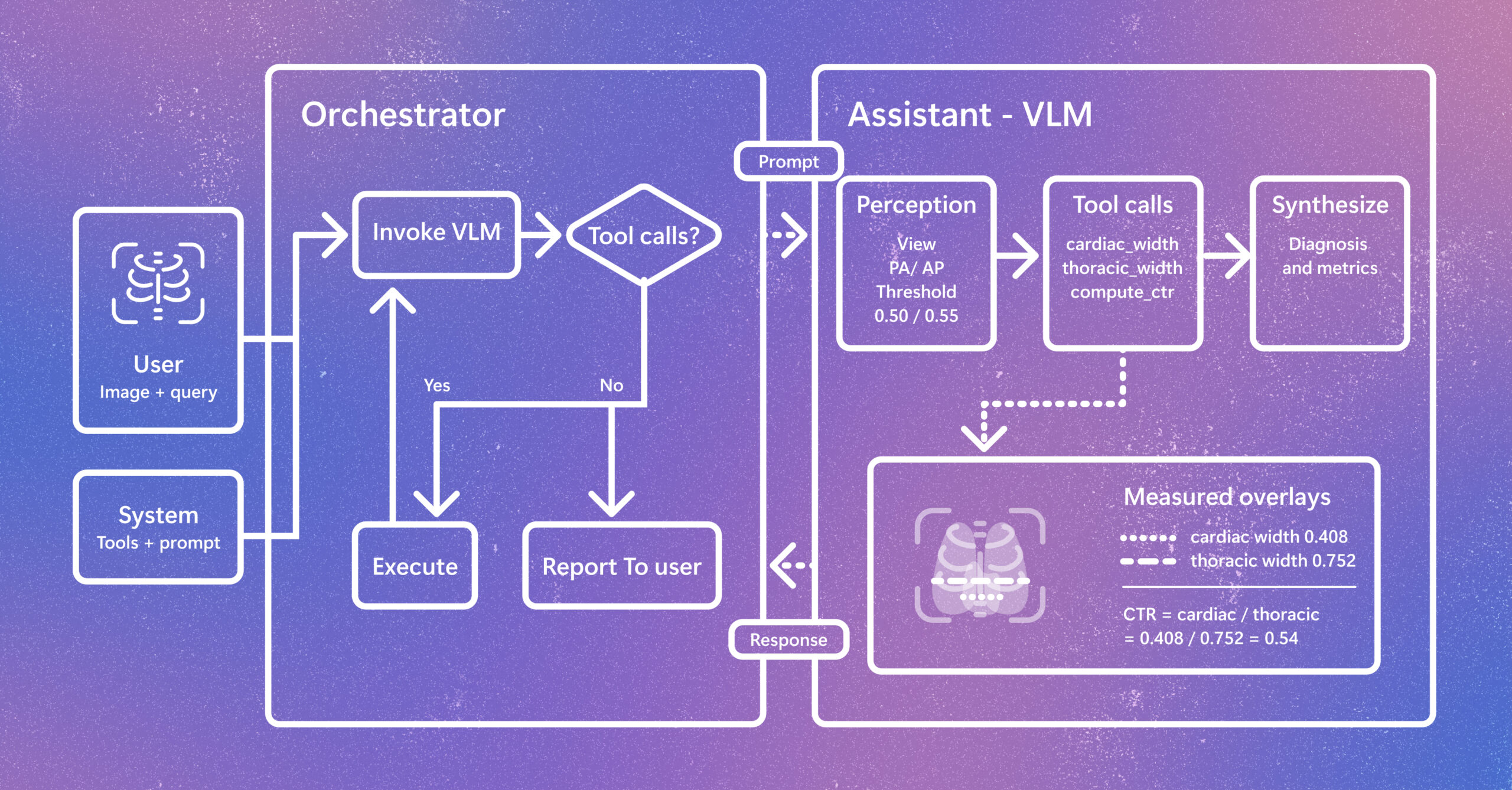
Radiology AI is evolving beyond report generation. CARE-X explores a unified approach that combines flexible reasoning, calibrated predictions, and measurement-based tools for chest X-ray interpretation. The post Introducing CARE-X: Towards Clinically Useful Radiology VLMs with Auxiliary Supervision, Reward-Aligned Learning, and Tool-Augmented Measurement appeared first on Microsoft Research.