Skip to content

Operational Abstractions of Neural Network Concepts via Topological Representations

Oct 2026 · 0 citations · 59 references
Computer Science

TL;DR

This work introduces Topological Concept Representations (TCR), a post-hoc operational abstraction that jointly characterizes the concepts encoded in a learned representation and their relationships and compactly encodes its organization through topology.

Abstract

Concept-based methods provide a semantic level for interpreting and manipulating learned representations, but existing editing approaches are typically specialized to particular interventions and do not provide a common and editable representation of concept organization. To achieve this, we introduce Topological Concept Representations (TCR), a post-hoc operational abstraction that jointly characterizes the concepts encoded in a learned representation and their relationships. TCR constructs an intermediate concept space from concept recoverability and interaction scores, and compactly encodes its organization through topology. Interventions are expressed through modifications of this abstraction that are propagated back to the underlying learned representation. This allows different concept-level operations to share the same optimization framework and separates the desired concept organization from the mechanism to achieve it. We establish stability and reparameterization-invariance properties of TCR and its connections to existing concept-editing formulations. We use TCR to disentangle concepts as a preprocessing step for existing erasure methods, improving worst-group accuracy by 21.89 on average at comparable concept leakage. We further use TCR to transfer concepts from teacher to student models, improving concept recoverability by up to 5.54 while also improving or maintaining competitive test top-1 accuracy.

View source

Similar papers

#natural language process... Preprint Oct 2026

Concept Representations in Vector Space: Quantifying Sharedness and Idiosyncrasy of Meaning

Concepts are the basic units through which we navigate the world and communicate meaning. But do you and I really mean the same thing when we think or speak about a concept? The present study develops a measurement framework for modeling and analyzing interindividual variation in concept representations through sentenc...

Simon Josef Durstewitz, D. Buehler · 0 citations
Open access Oct 2026

Representing biological concepts as directions in foundation model embeddings

Biological foundation models encode rich information about protein structure, function, and cellular state in high-dimensional embeddings, but accessing specific biological properties typically relies on additional, task-specific prediction models. Here, we show that diverse biological properties can be mapped to inter...

Ahmad Shamail, Claire D. McWhite · 0 citations
Preprint Sep 2026

"World Knowledge"in the Weights: Reading Concept Circuits of Vision Transformers

Vision transformers (ViTs) have achieved remarkable generalization across visual domains, yet little is known about how they internally represent the structure of the world. To address this gap, we use Cross-Layer Transcoders (CLTs) to read concept circuits from ViTs: directed graphs whose nodes correspond to sparse, i...

Yan-Lin Chen, Li Tang, Peng Xi · 1 citation
#artificial intelligence Preprint Oct 2026

A Structural Theory of Cognitive Representation and Problem Solving,Contexts, Invariance, and the Knowledge Space

Learning and problem solving depend critically on the structure of internal representations. While many modern data-driven artificial systems achieve strong predictive performance, their learned representations often lack explicit structure for expressing abstraction, invariance, and task-relevant regularities. We prop...

A. Jakovác, András Telcs · 1 citation
Preprint Aug 2026

Structured Learning on Mapper Representations

This work develops a framework for learning over Mapper induced structured representations, and studies mathematical properties of these representations, including invariance under relabeling, a distance functional on the space of Mapper representations, structural complexity of multiscale decompositions, and learning...

G. Babus, Farzana Nasrin · 0 citations

Related blog posts

MIT News · Artificial Intelligence Sep 29, 2026

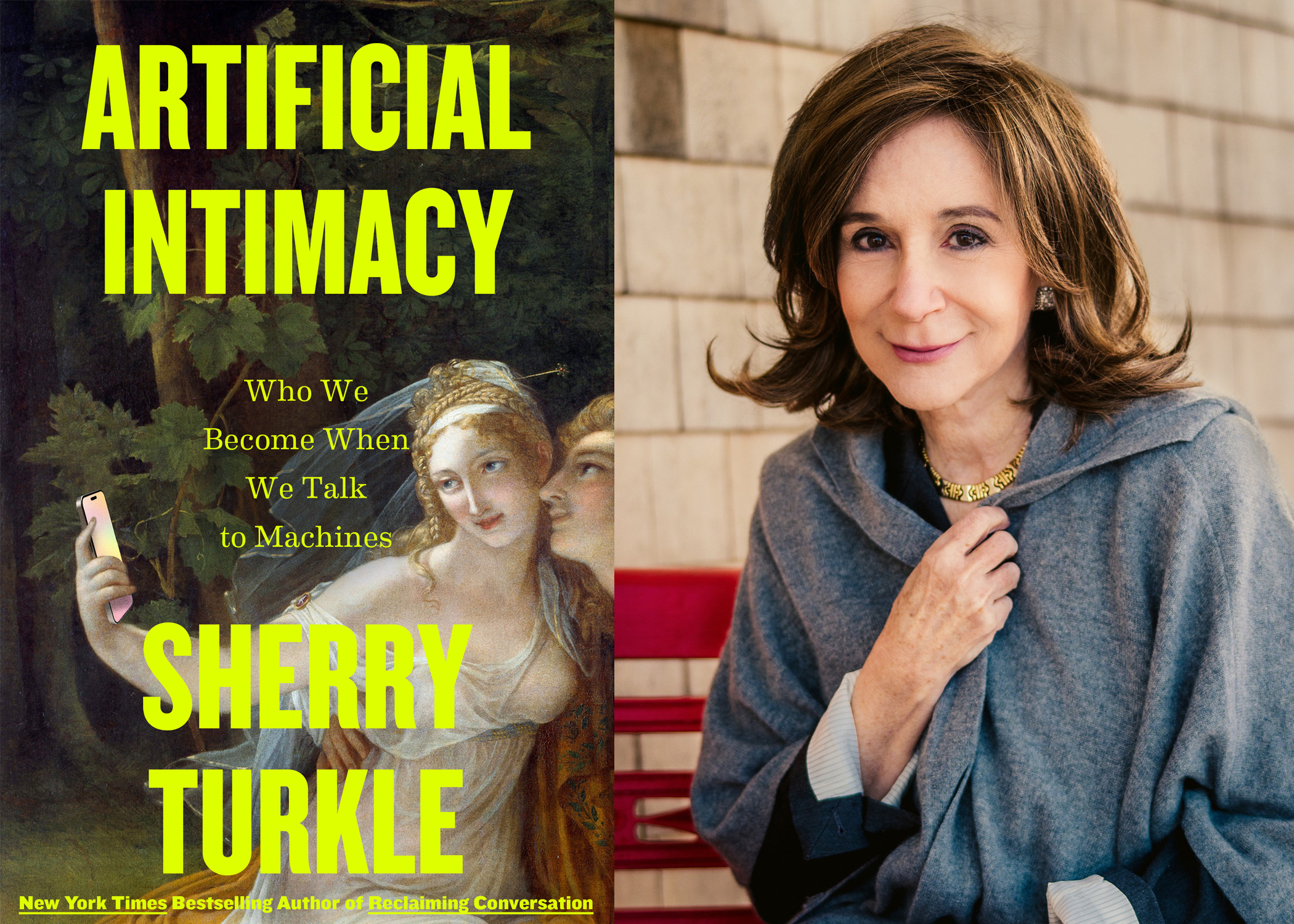
Who we become when we talk to machines

Professor Sherry Turkle’s new book, “Artificial Intimacy,” offers a withering critique of chatbots and the antisocial dynamics she believes they encourage.

We use cookies to run the site and, with your consent, for analytics and to show ads. See our Cookie Policy.