Skip to content

Hierarchical Reinforcement Learning for Collision-Free Locomotion of an Underactuated Biped

Oct 2026 · 0 citations · 21 references
Computer Science Engineering

Abstract

A bipedal robot cannot deviate from its path to avoid an obstacle without disturbing its balance, and this coupling is most severe on underactuated platforms such as the biped considered here, which has four actuated joints per leg and no hip or ankle roll. This paper presents a Hierarchical Reinforcement Learning (HRL) framework in which a High-Level (HL) policy observes the robot pose, 36 raycast proximity measurements, moving-obstacle states, and a receding-horizon local goal, and outputs a body-velocity command $(v_x, v_y, \omega_{yaw})$ every ten control steps, while a velocity-conditioned Low-Level (LL) policy tracks each command through PD-controlled joint targets. Both policies are trained jointly with Soft Actor-Critic (SAC). Because the converged gait is task-agnostic, it is frozen and driven by classical planners over the same command interface, yielding three controlled baselines: SAC+A*, SAC+RRT*, and SAC+APF. Across 100 evaluation trials per method in randomized PyBullet environments, the proposed method reaches the goal in 98.0% of static and 88.0% of dynamic trials, against at most 78.0% and 68.0% for the planner hybrids, with path lengths within 4% of the A* reference, and ablations confirm that each observation channel and reward term contributes materially to this performance.

View source

Similar papers

#artificial intelligence Preprint Jul 2024

The Llama 3 Herd of Models

It is found that Llama 3 delivers comparable quality to leading language models such as GPT-4 on a plethora of tasks, and performs competitively with the state-of-the-art on image, video, and speech recognition tasks.

Aaron Grattafiori, Abhimanyu Dubey, Abhinav Jauhri et al. · 21,082 citations · ⚡3,832
#artificial intelligence Conference Open access Jun 2018

Gibson Env: Real-World Perception for Embodied Agents

This paper investigates developing real-world perception for active agents, proposes Gibson Environment for this purpose, and showcases a set of perceptual tasks learned therein.

F. Xia, Amir Zamir, Zhi-Yang He et al. · 1,069 citations · ⚡112
#computer vision Review Sep 2017

Agile Software Development Methods: Review and Analysis

This publication proposes a definition and a classification of agile software development approaches and analyses ten software development methods that can be characterized as being "agile" against the defined criterion.

P. Abrahamsson, O. Salo, Jussi Ronkainen et al. · 727 citations · ⚡54
#computer vision Jun 2008

The impact of agile practices on communication in software development

The study shows that agile practices improve both informal and formal communication, but indicates that, in larger development situations involving multiple external stakeholders, a mismatch of adequate communication mechanisms can sometimes even hinder the communication.

M. Pikkarainen, Jukka Haikara, O. Salo et al. · 401 citations · ⚡48
#machine learning Review Open access Oct 2014

Software development in startup companies: A systematic mapping study

The results indicate that software engineering work practices are chosen opportunistically, adapted and configured to provide value under the constrains imposed by the startup context.

Nicolò Paternoster, Carmine Giardino, M. Unterkalmsteiner et al. · 394 citations · ⚡54

Related blog posts

MIT News · Artificial Intelligence Nov 13, 2026

Helping robots fit into the human workplace

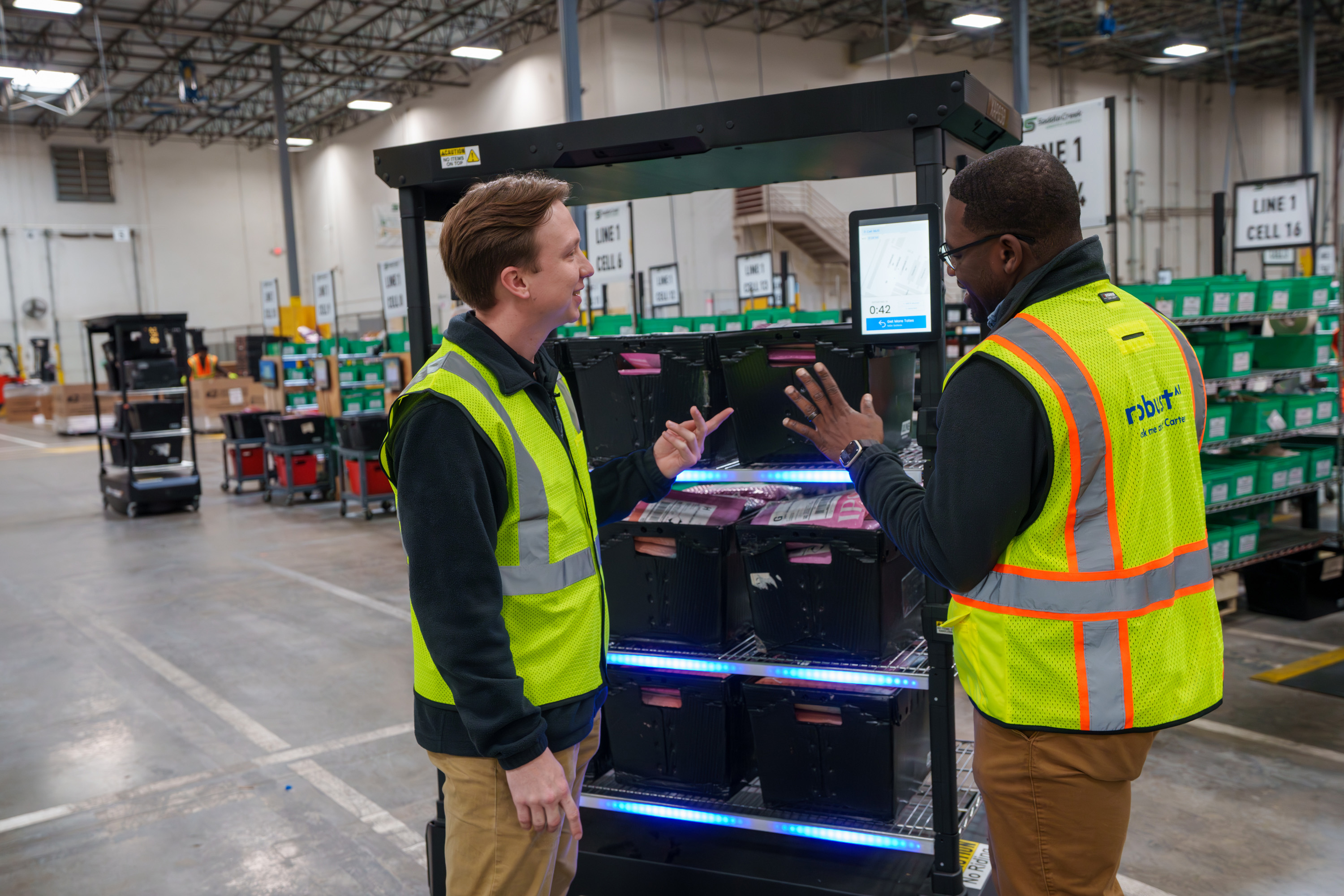
Founded by Anthony Jules ’92, SM ’92 and Professor Emeritus Rodney Brooks, Robust AI’s robots are designed to collaborate with humans in factories and warehouses.

We use cookies to run the site and, with your consent, for analytics and to show ads. See our Cookie Policy.