Skip to content
#robotics #human-computer interaction Preprint Open access

Traversability-Aware Cooperative Path Planning for Human-UGV Casualty Evacuation

Kristian Dalland Prithvi Poddar Souma Chowdhury Karthik Dantu Ehsan T. Esfahani
Oct 2026
Robotics Human-computer Interaction

Abstract

Heterogeneous multi-robot path planning is a well-studied problem in which agents with disparate kinematic and dynamic models must coordinate to achieve shared objectives. These formulations, however, treat all agents as robotic-their cost models are mechanical and their traversability is sensor-derived. In human-robot teaming, the human partner remains relegated to command and supervisory roles rather than being modeled as a physical co-navigator with distinct mobility constraints and dynamic energy reserves. This work investigates joint path planning for a two-agent human-UGV team in search-and-rescue casualty retrieval scenarios. We model the human agent using the Pandolf-Santee metabolic cost model with fatigue-modulated speed, and the UGV using a rolling-resistance energy model with terrain-dependent speed limits. By exploiting the complementary traversability of each agent-the human's ability to traverse dense vegetation and shallow water versus the UGV's superior speed on open terrain and roads-we optimize casualty transfer locations, termed switch points, to minimize total mission time. Evaluated across multiple synthetic 1km2 environments with procedurally generated elevation and land-cover data, the optimized strategy reduces mean mission time by 5.3% relative to a human-only baseline and by 7.0% relative to a naive human-UGV strategy without switch point optimization, while reducing human energy expenditure by 17.8% relative to baseline. Notably, the naive strategy reduces human energy expenditure by a larger margin (22.4%) but incurs a 2% increase in mission time relative to baseline, illustrating that switch point optimization is necessary to realize time savings from human-UGV teaming.

View source

Similar papers

#artificial intelligence Conference Open access Jun 2018

Gibson Env: Real-World Perception for Embodied Agents

This paper investigates developing real-world perception for active agents, proposes Gibson Environment for this purpose, and showcases a set of perceptual tasks learned therein.

F. Xia, Amir Zamir, Zhi-Yang He et al. · 1,069 citations · ⚡112
#computer vision Review Sep 2017

Agile Software Development Methods: Review and Analysis

This publication proposes a definition and a classification of agile software development approaches and analyses ten software development methods that can be characterized as being "agile" against the defined criterion.

P. Abrahamsson, O. Salo, Jussi Ronkainen et al. · 727 citations · ⚡54
#computer vision Jun 2008

The impact of agile practices on communication in software development

The study shows that agile practices improve both informal and formal communication, but indicates that, in larger development situations involving multiple external stakeholders, a mismatch of adequate communication mechanisms can sometimes even hinder the communication.

M. Pikkarainen, Jukka Haikara, O. Salo et al. · 401 citations · ⚡48
#machine learning Review Open access Oct 2014

Software development in startup companies: A systematic mapping study

The results indicate that software engineering work practices are chosen opportunistically, adapted and configured to provide value under the constrains imposed by the startup context.

Nicolò Paternoster, Carmine Giardino, M. Unterkalmsteiner et al. · 394 citations · ⚡54

Related blog posts

Microsoft Research Blog Nov 5, 2026

Formally verifying agent-written full-stack web apps with PDD Kit

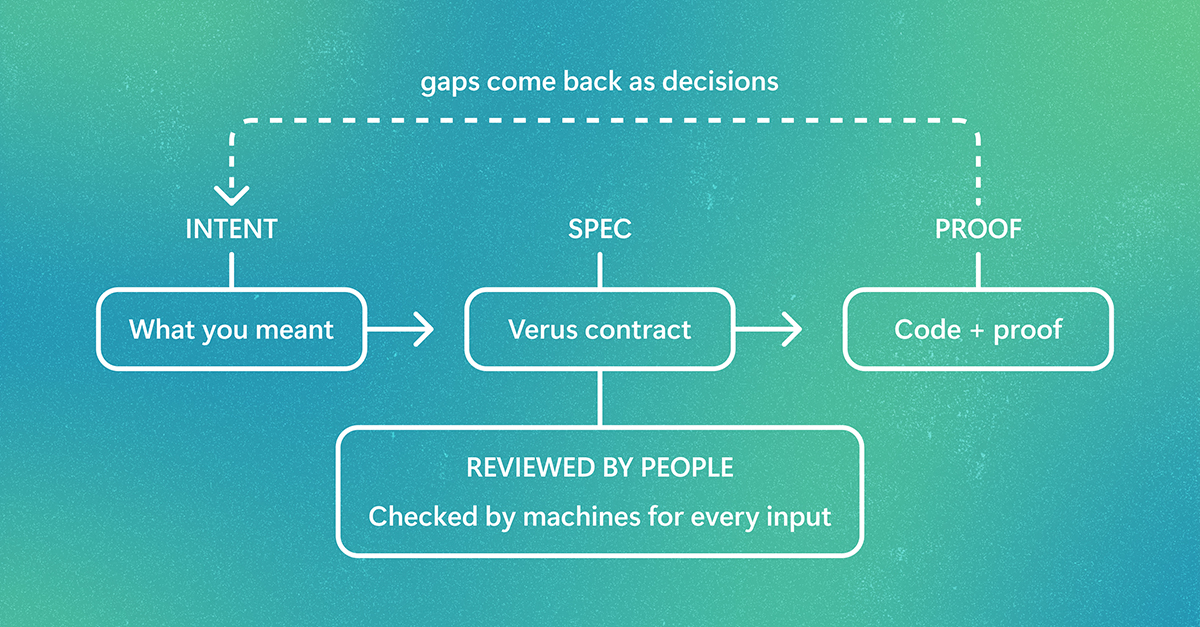
AI agents can generate code at a scale that’s hard for humans to review line-by-line. PDD Kit helps ensure the code is doing what the developer intended by creating formal specifications and testing against them. It converts developer intent into a Verus specification, proves AI-generated code meets it for every input, and uses tests where proofs aren't practical. Developers review intent, not every line. The post Formally verifying agent-written full-stack web apps with PDD Kit appeared first o…

MIT News · Artificial Intelligence Nov 5, 2026

Clearing up a robot’s fuzzy memory

A new system identifies and corrects unreliable object descriptions stored in a robot’s memory, improving the robot’s ability to interact with its environment.

We use cookies to run the site and, with your consent, for analytics and to show ads. See our Cookie Policy.

