The sharp bound of $n(n-1)$ vertices for $n\ge2$ is proved, answering Rote's rotation-assignment open problem, and assignment-based bounds extend the approach to three-dimensional rotations and partial matching at a supplied translation through branch-and-bound.
Abstract
Procrustes-Wasserstein alignment jointly estimates a matching and rotation without supplied correspondences, but alternating minimization can stop at suboptimal solutions. Rubix solves the equally weighted planar problem globally under squared Euclidean loss. Each matching $\sigma$ of two centered $n$-point sets defines a complex correlation $z_\sigma=\sum_i\bar x_i y_{\sigma(i)}$. Their convex hull is the permutation polygon: supporting vertices give optimal matchings at fixed rotations, and the farthest vertex gives the global alignment. We prove the sharp bound of $n(n-1)$ vertices for $n\ge2$, answering Rote's rotation-assignment open problem. In exact arithmetic, assignment queries recover the polygon in $\mathcal O(n^5)$ operations. Assignment-based bounds extend the approach to three-dimensional rotations and partial matching at a supplied translation through branch-and-bound. On timed MPEG-7 shape pairs, Rubix attains every numerical reference value in 12 ms on average, 50 times faster than a rotation grid at the same accuracy. Its distances improve gravity-aligned matching of real 3D scans, shape retrieval and noisy crystal classification over alternating minimization.

The sphere covering problem has broad applications in science however, exact solutions are computationally infeasible on curved, high-dimensional manifolds because distances must be evaluated using a position-dependent metric. We present $\texttt{isobank}$, a normalizing flow that learns an approximately isometric coor...
Alexandra Wernersson, Jessica Irwin, Melissa Lopez et al.· 0 citations
Five methods---ordinary STA, STA--WMC, the hybrid, standalone NWP, and entropic Nesterov acceleration---on convex-hull queries derived from 14 public benchmark datasets and on 204 controlled synthetic inputs are compared.
We study the first-order oracle complexity of finding a queried point with small gradient in $\ell_p$ geometry, with particular attention to the information needed to adapt the unknown smoothness and distance scales. In the strict counted local value--gradient model, no finite complexity bound can depend only on $LR/\e...
This work addresses the inverse problem of matched score queries at noise scales $\sigma$ and $\lambda\sigma$ using matched subtraction to establish a perturbation bound and a conditional kernel-density-estimation rate.
In this paper, we study the minimum-cost bipartite matching with penalties problem in metric spaces with bounded doubling dimension: Given two disjoint sets $R, B$ in a metric space $\mathcal{M}$ with $|R|+|B|=n$ and a penalty function $p \colon R \cup B \to \mathbb{R}_{\ge 0}$, the goal is to select a set of pairs in...
Eunjin Oh, Seongbin Park, Chan-Ho Song· 0 citations
Moser's worm problem asks for a planar region of minimum area containing a congruent copy of every rectifiable planar arc of length one. We study the Bellman's lost-in-a-forest problem escape path for the isosceles triangle \[ T=\text{conv}\{(-c,0),(c,0),(0,s)\},\qquad s=\frac{766}{\sqrt{625565}},\qquad c=\frac{197}{\s...
Zhi-Peng Deng· 2 citations
Related blog posts
MIT News · Artificial Intelligence· news.mit.eduOct 28, 2026
Professor Paris Smaragdis develops computers with superhuman hearing for applications like speech recognition, music understanding, and environmental monitoring.
Exploring how generative AI could make machine vision more accessible to businesses. The post GenEye in a Box: Making Machine Vision Something You Can Just Ask For appeared first on GPT-Lab.
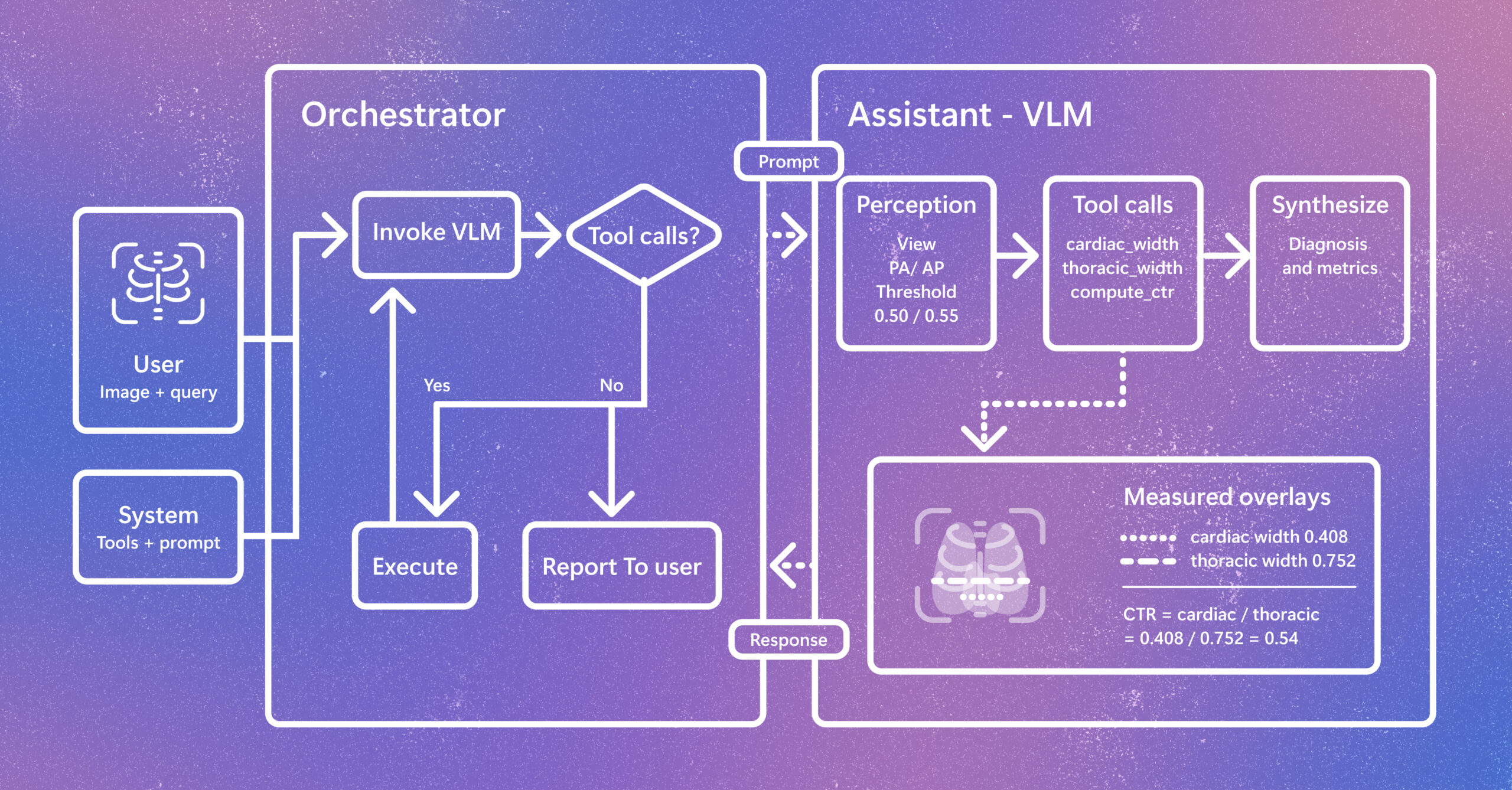
Radiology AI is evolving beyond report generation. CARE-X explores a unified approach that combines flexible reasoning, calibrated predictions, and measurement-based tools for chest X-ray interpretation. The post Introducing CARE-X: Towards Clinically Useful Radiology VLMs with Auxiliary Supervision, Reward-Aligned Learning, and Tool-Augmented Measurement appeared first on Microsoft Research.
We use cookies to run the site and, with your consent, for analytics and to show ads.
See our Cookie Policy.