The results do not support the view that AI assistance currently poses an existential threat to online research, but reveal limited payment consequences for prohibited use and gaps in platform safeguards, leaving platforms poorly prepared should that threat materialize.
Abstract
Online research platforms underpin much of what science claims about people, on the assumption that a human produced each response. Generative AI threatens that assumption by letting participants delegate responses to a chatbot, yet how often they do so remains unclear because prior estimates rely on self-report or automated detection rather than direct observation. We surveyed 2,500 workers on a high quality online research platform and directly observed AI assistance by linking donated ChatGPT histories to platform submission records of weekly ChatGPT users, covering 712,930 submissions across more than 127,000 studies. Although one in eight surveyed workers reported ever using AI on a study and 68% of observed workers had done so, assistance appeared in only 1% of submissions, with no detectable increase over more than 3 years. Assistance was often temporally localized within tasks and highly concentrated among workers, with 5% accounting for 64% of assisted submissions. Where assistance occurred, workers were virtually always paid, even when study instructions prohibited AI use, with overall approval rates similar to those for unassisted submissions. Half of assisted submissions involved bounded responses, outside the scope of the platform's LLM detector for open-ended responses. Taken together, our results do not support the view that AI assistance currently poses an existential threat to online research, but reveal limited payment consequences for prohibited use and gaps in platform safeguards, leaving platforms poorly prepared should that threat materialize.

An initial benchmark dataset is introduced, namely ASURRE, for AI-assisted survey participation to capture usage strategies ranging from full generation and revision to persona-grounded agentic completion, and it is shown that agentic completion cannot fully replicate respondent-level behaviour and leaves distinctive b...
Qi-Zhou Wang, B. Mamaev, Christopher Leckie· 0 citations
Initial evidence is provided that greCAPTCHA can assess manuscript-specific understanding under proctored conditions and the appropriate construct validity for author understanding is remarked on, while also suggesting important changes to be made before deployment.
Justin Payan, Bálint Gyevnár, Atoosa Kasirzadeh et al.· 1 citation
AI-research agents, or autoresearch systems, combine language models with tools, search, evaluation, and iterative modification of research artifacts. Their public software ecology is hard to compare because repositories, papers, benchmarks, libraries, and companion artifacts are often counted as one population. We con...
A review of indexed contributions from 2007 to 2026 finds that platform mentions shift from blogs toward Twitter and, more recently, Reddit, and how AI-mediated interactions complicate these questions is discussed.
In recent years, media attention has focused on artificial intelligence, particularly on chatbot services and generative intelligence. ChatGPT, created by OpenAI, was one of the earliest online tools and rapidly gained popularity. Users are indeed exposed to a service with privacy notifications and conditions of use th...
Jacopo Bassetta, D. Perpetuini, Maria Teresa Giusti et al.· Information· 0 citations
This work audited three free consumer products on twenty English mental health questions under two prompt conditions and releases the typology, classifier, and annotated corpus as reusable instruments for auditing generative health search.
Phuong Anh Nguyen, J. Noorily, M. Flathers et al.· 0 citations
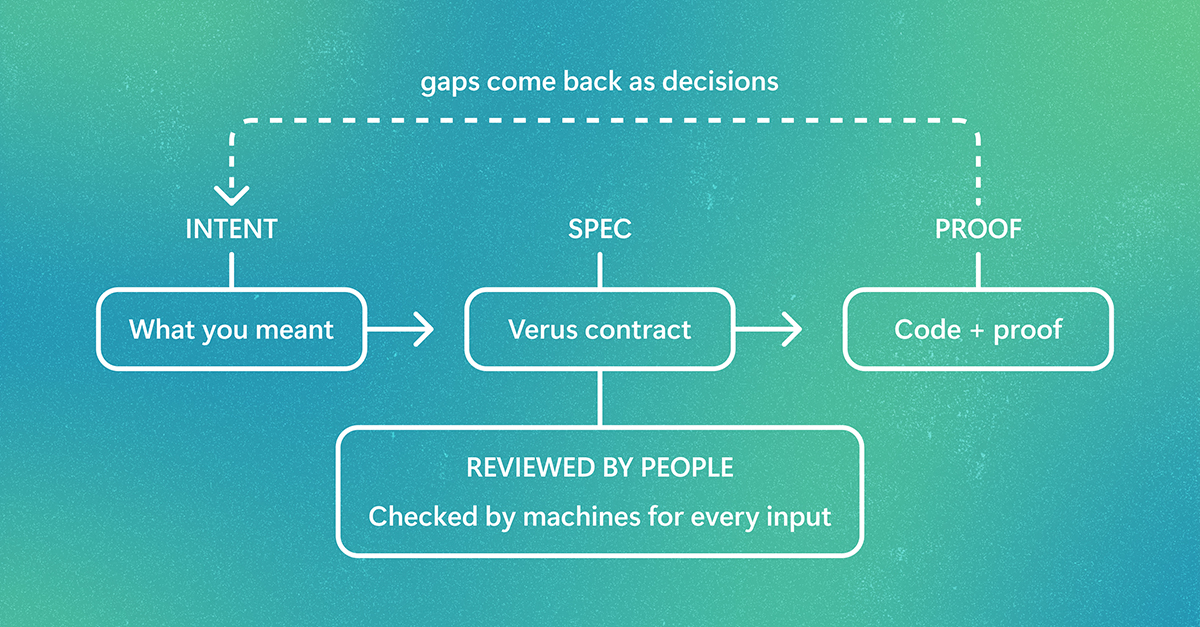
AI agents can generate code at a scale that’s hard for humans to review line-by-line. PDD Kit helps ensure the code is doing what the developer intended by creating formal specifications and testing against them. It converts developer intent into a Verus specification, proves AI-generated code meets it for every input, and uses tests where proofs aren't practical. Developers review intent, not every line. The post Formally verifying agent-written full-stack web apps with PDD Kit appeared first o…
Professor Paris Smaragdis develops computers with superhuman hearing for applications like speech recognition, music understanding, and environmental monitoring.
MIT News · Artificial Intelligence· news.mit.eduOct 23, 2026
During the School of Humanities, Arts, and Social Sciences’ 75th Anniversary Symposium, President Sally Kornbluth said “MIT has never needed your particular insight and guidance more than we do now.”
We use cookies to run the site and, with your consent, for analytics and to show ads.
See our Cookie Policy.