Skip to content
#human-computer interaction Preprint Open access

Love for Believable AI: Artificial Partiality and Relationship Persistence as an Engineerable Stance

Sebastian Cochinescu
Oct 2026
Human-computer Interaction

Abstract

We study a behavioral mechanism for artificial partiality in conversational agents. The paper reports no human-subjects data and makes no claim about attachment, trust, perceived mind, or machine interiority. Partiality has two components: caring, defined as allocation of a finite interaction surplus above a guaranteed per-user service floor, and particularity, defined as a per-user state estimate accumulated from relationship history on fixed inference machinery. We implement both as a persistence layer over one open-weight base model and evaluate them on constructed multi-session relationships with known hidden-state schedules. A four-channel divergence compares known-user and stranger conditions on identical probes with paired generation seeds; the stranger prompt is not length-matched, and one channel (initiative) is an allocator output rather than generated behavior. The full mechanism reproduces the ordinal shape, but not the magnitude, of an analytically specified curve and is the only arm satisfying the protocol-defined joint signature on the calibrated battery. The initial mechanism fails probe-quality equivalence because relationship content reduces topical relevance. A guarded revision satisfies equivalence on the calibrated battery but not on a second battery not used in calibration, where it scores higher than the unmodified baseline. On that second battery, the specificity margin is 0.0198, below the 0.02 protocol threshold. The paired mean right-user--wrong-user estimation-accuracy contrast is 0.375 but is not positive in every run. The mechanism is therefore a candidate for a later perception study, not evidence that users perceive love. The versioned protocol record is not independently time-stamped and is not described as a preregistration. Ethical constraints include a stranger-treatment floor, a bounded surplus, disclosure, and de-intensification.


View source

Similar papers

#computer vision Review Sep 2017

Agile Software Development Methods: Review and Analysis

This publication proposes a definition and a classification of agile software development approaches and analyses ten software development methods that can be characterized as being "agile" against the defined criterion.

P. Abrahamsson, O. Salo, Jussi Ronkainen et al. · 727 citations · ⚡54
#computer vision Jun 2008

The impact of agile practices on communication in software development

The study shows that agile practices improve both informal and formal communication, but indicates that, in larger development situations involving multiple external stakeholders, a mismatch of adequate communication mechanisms can sometimes even hinder the communication.

M. Pikkarainen, Jukka Haikara, O. Salo et al. · 401 citations · ⚡48
#machine learning Review Open access Oct 2014

Software development in startup companies: A systematic mapping study

The results indicate that software engineering work practices are chosen opportunistically, adapted and configured to provide value under the constrains imposed by the startup context.

Nicolò Paternoster, Carmine Giardino, M. Unterkalmsteiner et al. · 394 citations · ⚡54

Related blog posts

Microsoft Research Blog Nov 5, 2026

Formally verifying agent-written full-stack web apps with PDD Kit

AI agents can generate code at a scale that’s hard for humans to review line-by-line. PDD Kit helps ensure the code is doing what the developer intended by creating formal specifications and testing against them. It converts developer intent into a Verus specification, proves AI-generated code meets it for every input, and uses tests where proofs aren't practical. Developers review intent, not every line. The post Formally verifying agent-written full-stack web apps with PDD Kit appeared first o…

MIT News · Artificial Intelligence Oct 28, 2026

Making machines that can listen

Professor Paris Smaragdis develops computers with superhuman hearing for applications like speech recognition, music understanding, and environmental monitoring.

MIT News · Artificial Intelligence Oct 23, 2026

Reinforcing the value of human understanding at MIT

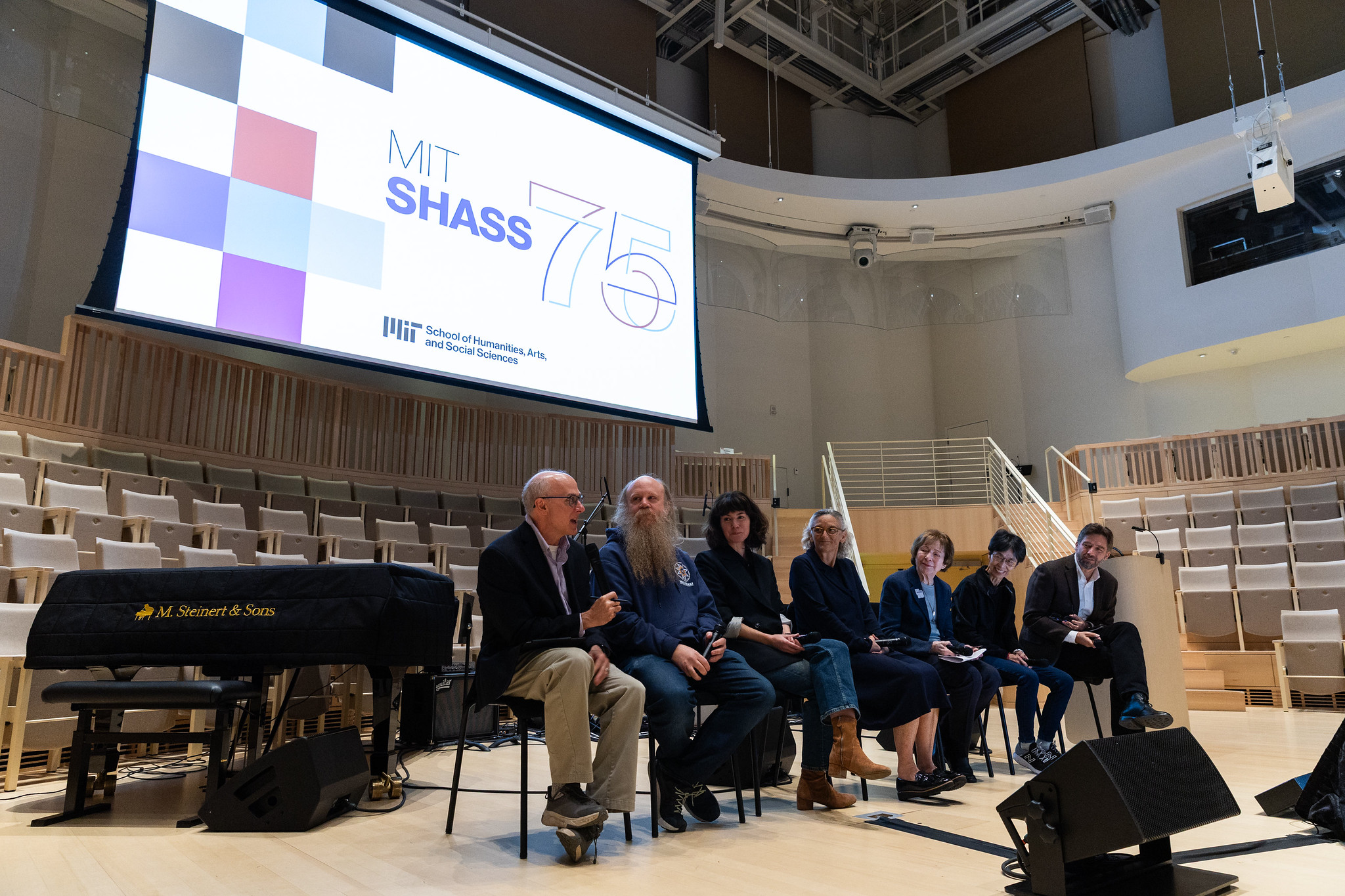
During the School of Humanities, Arts, and Social Sciences’ 75th Anniversary Symposium, President Sally Kornbluth said “MIT has never needed your particular insight and guidance more than we do now.”

We use cookies to run the site and, with your consent, for analytics and to show ads. See our Cookie Policy.