Skip to content

VBVR-Pro: A Scalable and Verifiable Suite for Native Visual Reasoning

Aug 2026 · 5 citations · 76 references
Computer Science

TL;DR

This work introduces VBVR-Pro, a closed-loop testbed that makes native visual reasoning through generation trainable, verifiable, optimizable, and experimentally controllable, and identifies recurring failure modes of the prevalent VLM-as-a-judge paradigm.

Abstract

Native visual reasoning treats visual generation as the medium of reasoning itself: visual states (i.e. images and videos) are not merely inputs to be understood or outputs to be rendered, but first-class substrates for problem solving beyond language. Yet progress remains bottlenecked by the lack of scalable training tasks, reliable feedback, and controlled comparisons across generative substrates. In this work, we introduce VBVR-Pro, a closed-loop testbed that makes native visual reasoning through generation trainable, verifiable, optimizable, and experimentally controllable. 1) Task scaling. VBVR-Pro turns visual reasoning into a controlled task space of 300 procedurally generated tasks. Models trained on VBVR-Pro show strong transfer beyond the proposed suite across seven external visual reasoning benchmarks such as RISE-Video, MME-CoF-Pro, and BabyVision. 2) Verifiable rewards. VBVR-Pro provides verifiable reward scorers for task-grounded evaluation. Through a systematic study of leading MLLMs as judges, we identify recurring failure modes of the prevalent VLM-as-a-judge paradigm. In contrast, the proposed scorers are grounded in deterministic, task-specific rules, achieve fine-grained alignment with human judgments. Importantly, they serve as reliable reward signals for large-scale multi-task reinforcement learning and demonstrate stronger post-RL performance across visual reasoning tasks. 3) Mechanism study. VBVR-Pro enables controlled modality studies across more than 30 image, video, and interleaved generators. Our analysis shows that video generation remains strongest for tasks requiring persistent spatiotemporal state tracking, while interleaved generation provides a compute-efficient alternative. Critically, ablations and probing suggest the presence of vision-native trajectories that are crucial to visual reasoning. We release all data, models, scorers, and code.

View source

Similar papers

#artificial intelligence Preprint Sep 2026

From Evaluation to Enhancement: Benchmarking and Improving Think-with-Video Reasoning for Video Generative Models

This work proposes Vid-PRE (Video Prompt Reasoner and Enhancer), a model-agnostic prompt rewriter that offloads the cognitive burden of reasoning to a dedicated VLM, and introduces VWG-Bench, a comprehensive benchmark spanning 9 reasoning dimensions and 38 fine-grained tasks.

Meng Luo, Yi-Chen Liu, Jia-Hao Wang et al. · 1 citation
Jul 2026

Trace: A Taxonomy-Guided Environment for Multidomain Visual Reasoning

Trace is introduced, a taxonomy-guided environment for multidomain visual reasoning that factorizes task construction into a scene grammar and an executable task program, separating visual realization from answer computation, providing evidence that broad procedural training can transfer beyond the generated task distr...

Md Tanvirul Alam · 0 citations
Preprint Aug 2026

ComplexityWorld: Benchmarking Vision-Language Models on Verifiable Visual Decision Making

Vision-language models (VLMs) have made rapid progress in visual perception and increasingly support real-world tasks that depend on images. Many such tasks, however, require more than rec- ognizing what an image contains: a model must use visual evidence to make a complete decision whose parts jointly satisfy global c...

Ning-Xin Pan, Han-Yu Li, Ye-Hui Tang · 0 citations
Preprint Sep 2026

GenPuzzle: Benchmarking Visual Reasoning in Image Generation Models

GenPuzzle provides a testbed for measuring progress from image rendering toward visual problem solving, and uses task-specific evaluation protocols that select the automatic judge by measuring agreement with human reference scores.

Chang-Peng Zhao, Yi-Ren Song, Jin-Peng Wang · 1 citation
Preprint Aug 2026

VGI-Bench: Probing Visual Intelligence in Video Generation Models

VGI-bench is introduced, containing 27 tasks and 810 instances, organized by a two-level taxonomy of task domains and skill tags for fine-grained evaluation of visual reasoning capabilities of video generation models, and it is hoped VGI-bench will help stimulate the development of next-generation video generation mode...

Xuan He, Cong Wei, Yuhao Cheng et al. · 3 citations
Jul 2026

See2Think: Do Multimodal Models Really Use Intermediate Visual States?

Evaluating representative proprietary and open-source multimodal models, it is found that visual reasoning is strongly model- and environment-dependent, with no single setting consistently dominating across tasks.

Siyu Yan, Zhuoran Yan, Haiying Xu et al. · 0 citations

Related blog posts

Microsoft Research Blog Aug 11, 2026

Introducing CARE-X: Towards Clinically Useful Radiology VLMs with Auxiliary Supervision, Reward-Aligned Learning, and Tool-Augmented Measurement

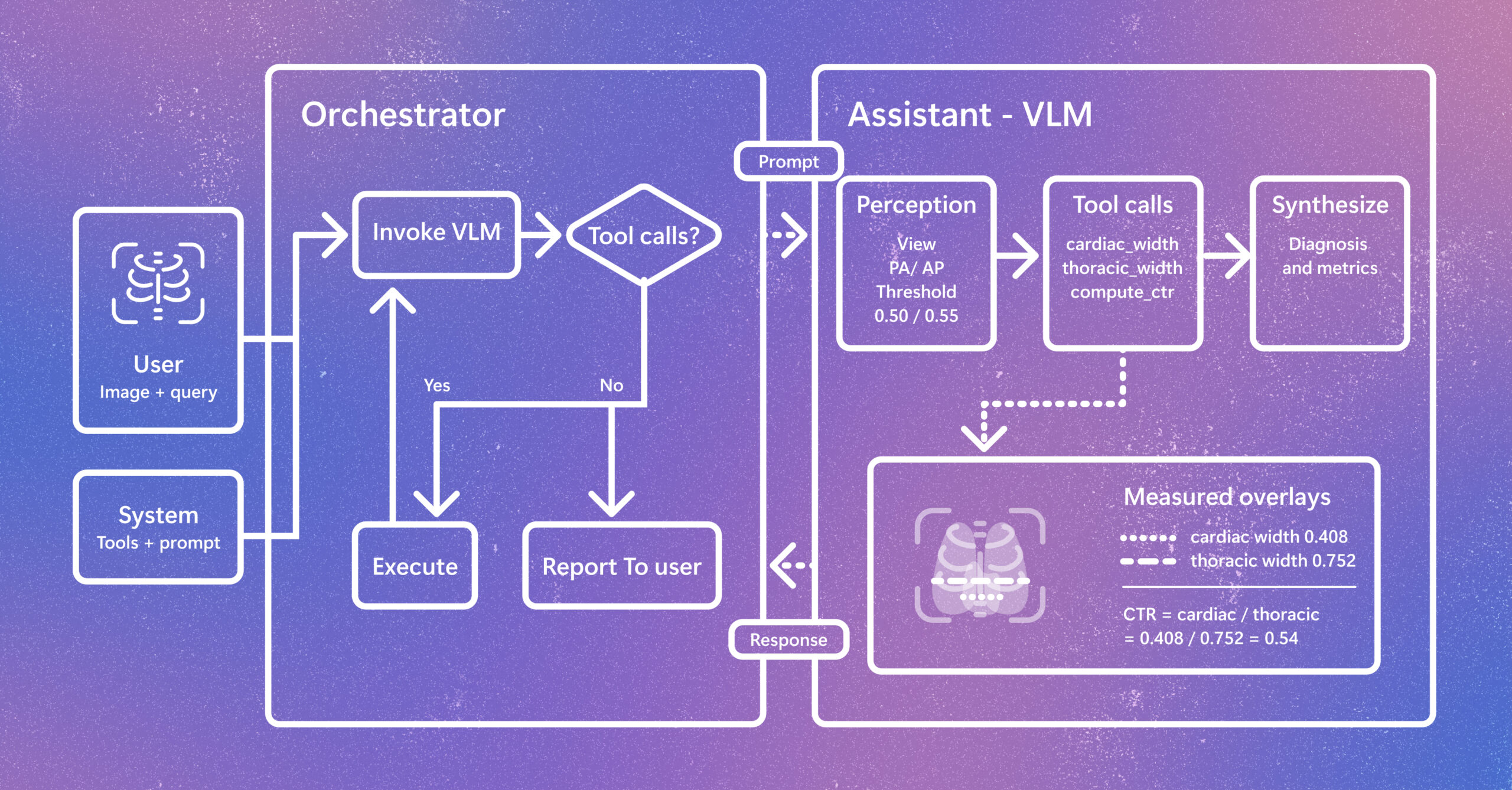
Radiology AI is evolving beyond report generation. CARE-X explores a unified approach that combines flexible reasoning, calibrated predictions, and measurement-based tools for chest X-ray interpretation. The post Introducing CARE-X: Towards Clinically Useful Radiology VLMs with Auxiliary Supervision, Reward-Aligned Learning, and Tool-Augmented Measurement appeared first on Microsoft Research.

We use cookies to run the site and, with your consent, for analytics and to show ads. See our Cookie Policy.
