Bernard CVaR-UCBVI is minimax-optimal over the full return-law class in the leading-order regime; the lower-order terms retain their $\tau^{-1}$ dependence.
Abstract
For finite-horizon tabular CVaR reinforcement learning, prior work proves a $\widetilde{O}(\tau^{-1}\sqrt{SAK})$ leading regret bound for arbitrary normalized return laws and the sharper $\widetilde{O}(\sqrt{SAK/\tau})$ rate under a density lower bound. We show that the same Bernstein CVaR-UCBVI algorithm attains the sharper rate without continuity assumptions. The key is a selected-budget self-bound: the conditional variance of the episode shortfall is at most $\tau$ plus the value-estimation width. Substitution into the original Bernstein decomposition yields, with high probability, $\widetilde{O}(\sqrt{SAK/\tau}+(SAHK^{1/4}+S^2AH)/\tau)$ regret for arbitrary normalized return laws, including atomic, mixed, and continuous laws. The $\tau^{-1/2}$ leading term matches the expected-regret minimax lower bound up to logarithmic factors. Thus Bernstein CVaR-UCBVI is minimax-optimal over the full return-law class in the leading-order regime; the lower-order terms retain their $\tau^{-1}$ dependence.
We study the time-uniform convergence of the raw iterate of standard stochastic gradient descent (SGD) for unconstrained smooth convex objectives. We prove that, under standard noise assumptions, the time-uniform convergence rate gets arbitrarily close to $\sqrt{\log n / n}$ but never reaches it. More specifically, we...
Let $\pi(\mathrm{d} x)\propto e^{-U(x)}\, \mathrm{d} x$ on $\mathbb{R}^d$, where $U$ is continuously differentiable and $m$-strongly convex with a globally $L$-Lipschitz gradient, $0<m\leq L<\infty$, and $\kappa=L/m$. Fixed-step Metropolis-adjusted Langevin algorithm (MALA) has known warm-start mixing-time upper bounds...
Can the classical Heavy-Ball method, with arbitrary horizon-dependent parameters chosen in advance, achieve Nesterov's $O(T^{-2})$ last-iterate rate on every smooth convex objective? We provide a negative answer. For every horizon $T\ge2$ and every predetermined schedule with nonnegative step sizes and momenta in $[0,1...
We establish near-linear accuracy bounds for the classical Moreau--Yosida unadjusted Langevin algorithm (MYULA). The target is $\pi\propto e^{-f-g}$, where $f\in C^2(\mathbb{R}^d)$ is $m$-strongly convex with Lipschitz gradient and $g$ is convex and globally Lipschitz. Under an explicit parameter-dependent step-size co...
We consider the problem of noisy gradient-free minimization of the k-th order partial derivative of a $\beta$-H{\"o}lder function supported on a d-dimensional cube. We show that T ^{($\beta$+d+k)/(2$\beta$+d)} log(T )^{(\beta-k)/(2\beta+d)} is a non-asymptotic minimax rate of the T step cumulative regret for all $\beta...
Théo Paquier, A. Tsybakov, F. Portier et al.· 0 citations
Bakhtiari, Lattimore and Szepesv\'ari (COLT 2025) proved that Thompson sampling (TS) has Bayesian regret $\tilde O(d^{5/2}\sqrt n)$ for bandit convex optimisation with convex \emph{monotone} ridge losses $f(x)=\ell(\ip{x}{\theta})$, and asked whether monotonicity of the link is necessary. We give a qualitative negative...
Research Manager Mike Walker reflects on a career spanning hacker culture, cybersecurity, and AI, sharing lessons about trust, teamwork, leadership, and why solving difficult problems requires curiosity, judgment, agility—and an understanding of the rules. The post Learn the rules: The hacker mindset appeared first on Microsoft Research.
Learn how Google Antigravity and our Cheminformatics Skills accelerate drug discovery workflows, search compounds, and propose novel rigidified macrocycles.
MIT News · Artificial Intelligence· news.mit.eduOct 28, 2026
Professor Paris Smaragdis develops computers with superhuman hearing for applications like speech recognition, music understanding, and environmental monitoring.
MIT News · Artificial Intelligence· news.mit.eduOct 27, 2026
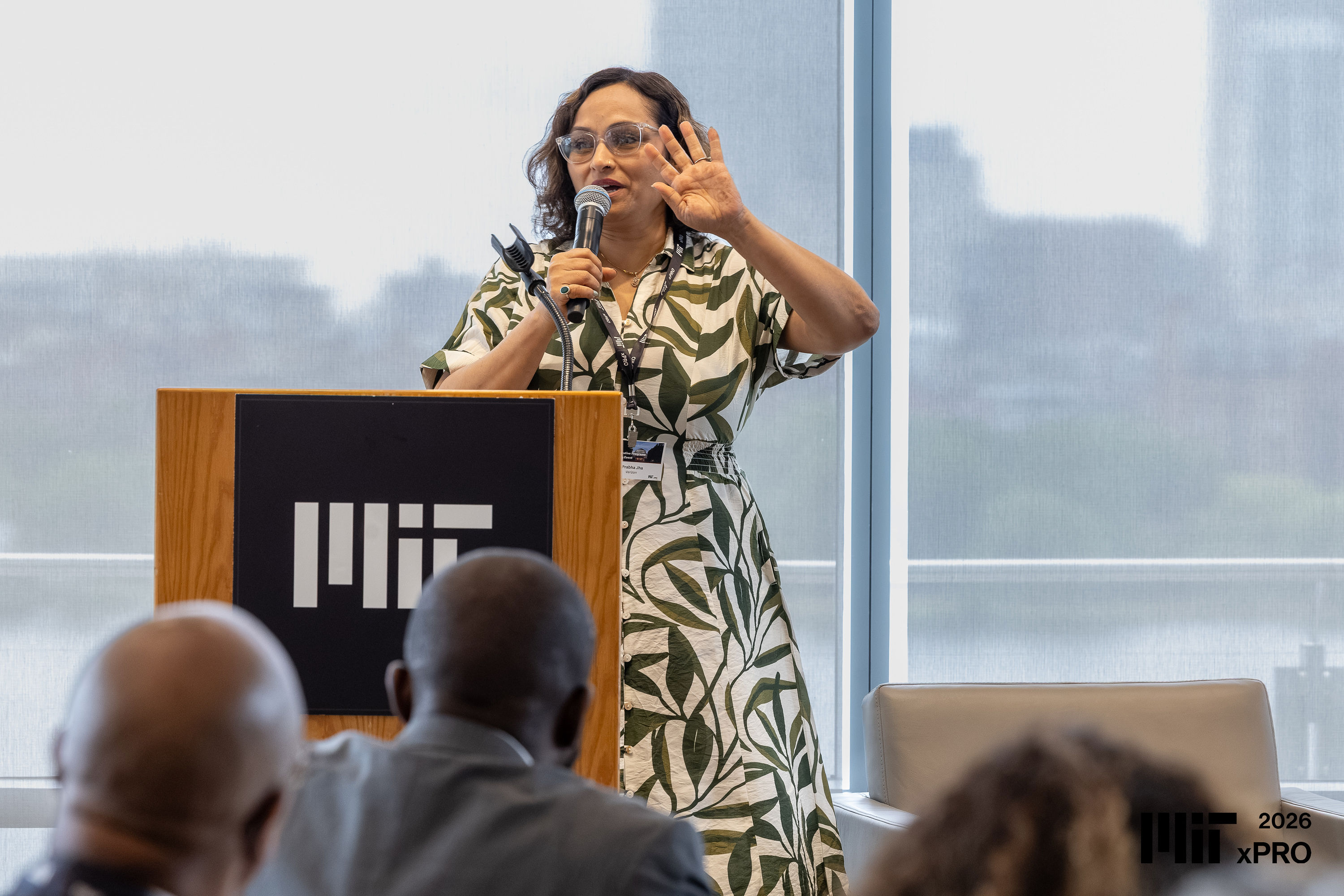
Prabha Jha used her experience with MIT Open Learning’s program for senior executives to develop AI solutions for her employer, Verizon, and to write a book.
We use cookies to run the site and, with your consent, for analytics and to show ads.
See our Cookie Policy.