A Spectral Identifiability Threshold for Dissipative Rate Recovery from Truncated Liouvillian Spectra
Yujun JiSomyajit Chakraborty
Sep 2026
Machine LearningQuantum Computing
Abstract
Open quantum systems lose energy and phase coherence through different dissipative processes, but these processes can produce overlapping dynamical signatures. The Liouvillian spectrum summarizes how such a system relaxes, yet it is not obvious how much of that spectrum is needed to distinguish the underlying dissipation rates. We study this question for amplitude damping and dephasing in a six-qubit Lindblad model whose spectrum can be derived analytically. We retain only the slowest non-steady spectral modes and ask how many are required before each dissipative rate becomes recoverable. We show that population modes contain no dephasing information, which creates a lower bound of D = 2^n retained modes for uniform dephasing identifiability in the relevant rate regime. The measured recovery threshold reaches this bound at n = 4,5,6, while n = 3 remains above it. At n = 6, least squares achieves a mean joint absolute error of order 10^-9, compared with 4.355 x 10^-4 for four tabular learning methods. Robustness tests show that this advantage weakens when the spectra are perturbed and when a transverse field breaks the commuting structure. These results show that the amount and structure of retained spectral information can determine whether dissipative parameters are recoverable, independently of the estimator used. The present conclusions apply to noise-free simulator spectra rather than measurement-derived spectra.
Agile - denoting "the quality of being agile, readiness for motion, nimbleness, activity, dexterity in motion" - software development methods are attempting to offer an answer to the eager business community asking for lighter weight along with faster and nimbler software development processes. This is especially the case with the rapidly growing and volatile Internet software industry as well as for the emerging mobile application environment. The new agile methods have evoked substantial amount of literature and debates. However, academic research on the subject is still scarce, as most of existing publications are written by practitioners or consultants. The aim of this publication is to begin filling this gap by systematically reviewing the existing literature on agile software development methodologies. This publication has three purposes. First, it proposes a definition and a classification of agile software development approaches. Second, it analyses ten software development methods that can be characterized as being "agile" against the defined criterion. Third, it compares these methods and highlights their similarities and differences. Based on this analysis, future research needs are identified and discussed.
P. Abrahamsson, O. Salo, Jussi Ronkainen et al.· arXiv.org· 728 citations· ⚡54
Context: Software startups are newly created companies with no operating history and fast in producing cutting-edge technologies. These companies develop software under highly uncertain conditions, tackling fast-growing markets under severe lack of resources. Therefore, software startups present a unique combination of characteristics which pose several challenges to software development activities. Objective: This study aims to structure and analyze the literature on software development in startup companies, determining thereby the potential for technology transfer and identifying software development work practices reported by practitioners and researchers. Method: We conducted a systematic mapping study, developing a classification schema, ranking the selected primary studies according their rigor and relevance, and analyzing reported software development work practices in startups. Results: A total of 43 primary studies were identified and mapped, synthesizing the available evidence on software development in startups. Only 16 studies are entirely dedicated to software development in startups, of which 10 result in a weak contribution (advice and implications (6); lesson learned (3); tool (1)). Nineteen studies focus on managerial and organizational factors. Moreover, only 9 studies exhibit high scientific rigor and relevance. From the reviewed primary studies, 213 software engineering work practices were extracted, categorized and analyzed. Conclusion: This mapping study provides the first systematic exploration of the state-of-art on software startup research. The existing body of knowledge is limited to a few high quality studies. Furthermore, the results indicate that software engineering work practices are chosen opportunistically, adapted and configured to provide value under the constrains imposed by the startup context.
Nicolò Paternoster, Carmine Giardino, M. Unterkalmsteiner et al.· Information and Software Tec...· 394 citations· ⚡54
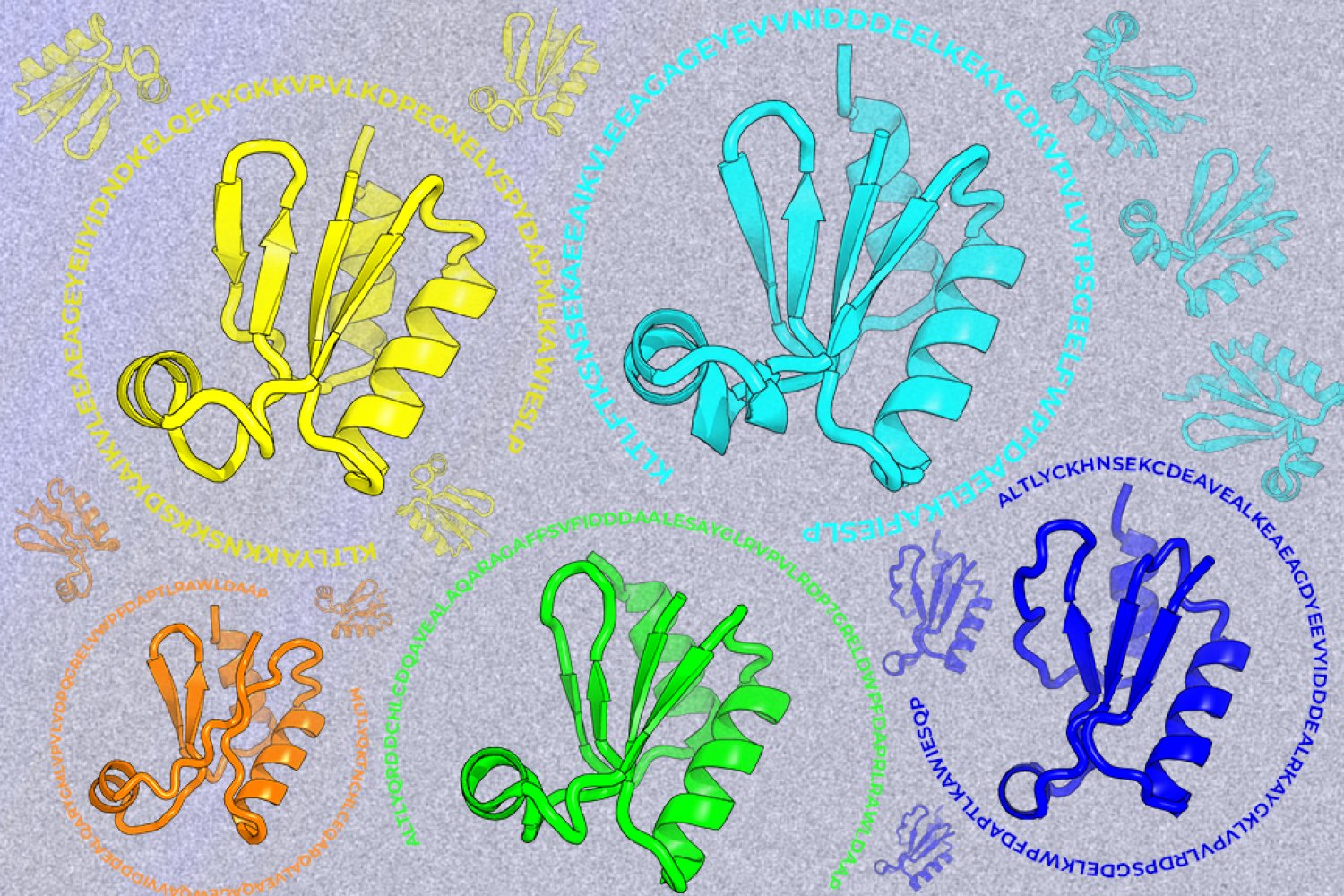
A new machine-learning framework aims to improve the success rate of computational protein design while moving away from results that reproduce sequences found in nature.
MIT News · Artificial Intelligence· news.mit.eduAug 3, 2026