FiLM-GPNet is proposed, a geometry-conditioned network for wrapped-phase restoration that explicitly adapts to acquisition differences using Feature-wise Linear Modulation (FiLM) and a 7D per-pair geometry descriptor, supporting geometry-conditioned restoration as an effective alternative to fixed classical filtering across heterogeneous stacks.

Abstract
The growing availability of dense commercial Synthetic Aperture Radar (SAR) time series enables temporal Interferometric SAR (InSAR) analysis, but fixed classical filters fail under heterogeneous acquisition geometries, degrading phase quality and temporal consistency. We propose FiLM-GPNet, a geometry-conditioned network for wrapped-phase restoration that explicitly adapts to acquisition differences using Feature-wise Linear Modulation (FiLM) and a 7D per-pair geometry descriptor. The model is trained with pseudo-supervision from Goldstein-filtered interferograms and regularized by interferometric physics via triplet-closure consistency, while also estimating per-pixel aleatoric uncertainty. Experiments on three Capella Spotlight stacks from the IEEE GRSS 2026 Data Fusion Contest show that FiLM-GPNet reduces temporal residual by 68% (Hawaii) and 66% (Western Australia) relative to the Goldstein baseline, alongside closure error reductions of 10% and 13%, respectively. In Western Australia, it further improves unwrapping success rate by 7.7 percentage points and Digital Elevation Model (DEM) Normalized Median Absolute Deviation (NMAD) by 31%. The model also shows strong zero-shot generalization to a geographically and geometrically distinct third stack (Los Angeles) without retraining, supporting geometry-conditioned restoration as an effective alternative to fixed classical filtering across heterogeneous stacks.

In ground-based interferometric synthetic aperture radar (GB-InSAR), the atmospheric phase (AP) can exhibit complex spatial variation due to rapid weather changes and steep topography. Conventional parametric-model-based compensation methods become inapplicable. Existing deep learning methods mostly rely on full superv...
Longyue Wang, Wei-Ming Tian, Yun-Kai Deng et al.· IEEE Transactions on Geoscie...· 0 citations
M-FSAD-KD is proposed, a full-link distillation framework whose neck-stage Fourier-gated alignment transfers low-frequency structural content while preserving target-edge high-frequency content; a joint spatial–channel attention mask, a shallow backbone adapter, and a response-level knowledge distillation (KD) term com...
Yu-Ming Tong, Kai-Na Xiong, Jun Liu et al.· Remote Sensing· 0 citations
Marine seismic imaging is affected by limited acquisition aperture, nonuniform illumination, and complex features such as seafloor structures and low-velocity gas clouds. These factors can produce blurred reflectors, amplitude imbalance, and migration artifacts in conventional reverse-time migration (RTM). Point-spread...
Zi-Dong Zhao, Hao-Ran Ren, Yu-Xiang Wu et al.· Journal of Marine Science an...· 0 citations
This method utilizes Structure-from-Motion to reconstruct a dense 3D seafloor mesh, acting as a geometric anchor between the visual and acoustic domains, and applies an inverse Lambertian model and a dual-Gaussian weighting function to isolate the intrinsic seabed reflectivity.
An Itoh-constrained hybrid graph (IC-HG) framework is proposed, which reformulates PU as an edgewise gradient regression problem using sparse observations and constructs a weighted hybrid graph that exhibits strong robustness and generalization capability, particularly when only sparse supervision is available, highlig...
Jia-Long Gong, Li-Fan Zhou, Han-Wen Yu et al.· IEEE Journal of Selected Top...· 0 citations
Experiments on the Nanjing and public SEN1-2 datasets demonstrate that DSAN outperforms state-of-the-art models—including Pix2PixHD, CycleGAN, MSTMNet, and ICMA—in perceptual distribution realism (FID) with the sharpest geometric boundaries.
Professor Paris Smaragdis develops computers with superhuman hearing for applications like speech recognition, music understanding, and environmental monitoring.
Exploring how generative AI could make machine vision more accessible to businesses. The post GenEye in a Box: Making Machine Vision Something You Can Just Ask For appeared first on GPT-Lab.
Microsoft Research Blog· microsoft.comAug 11, 2026
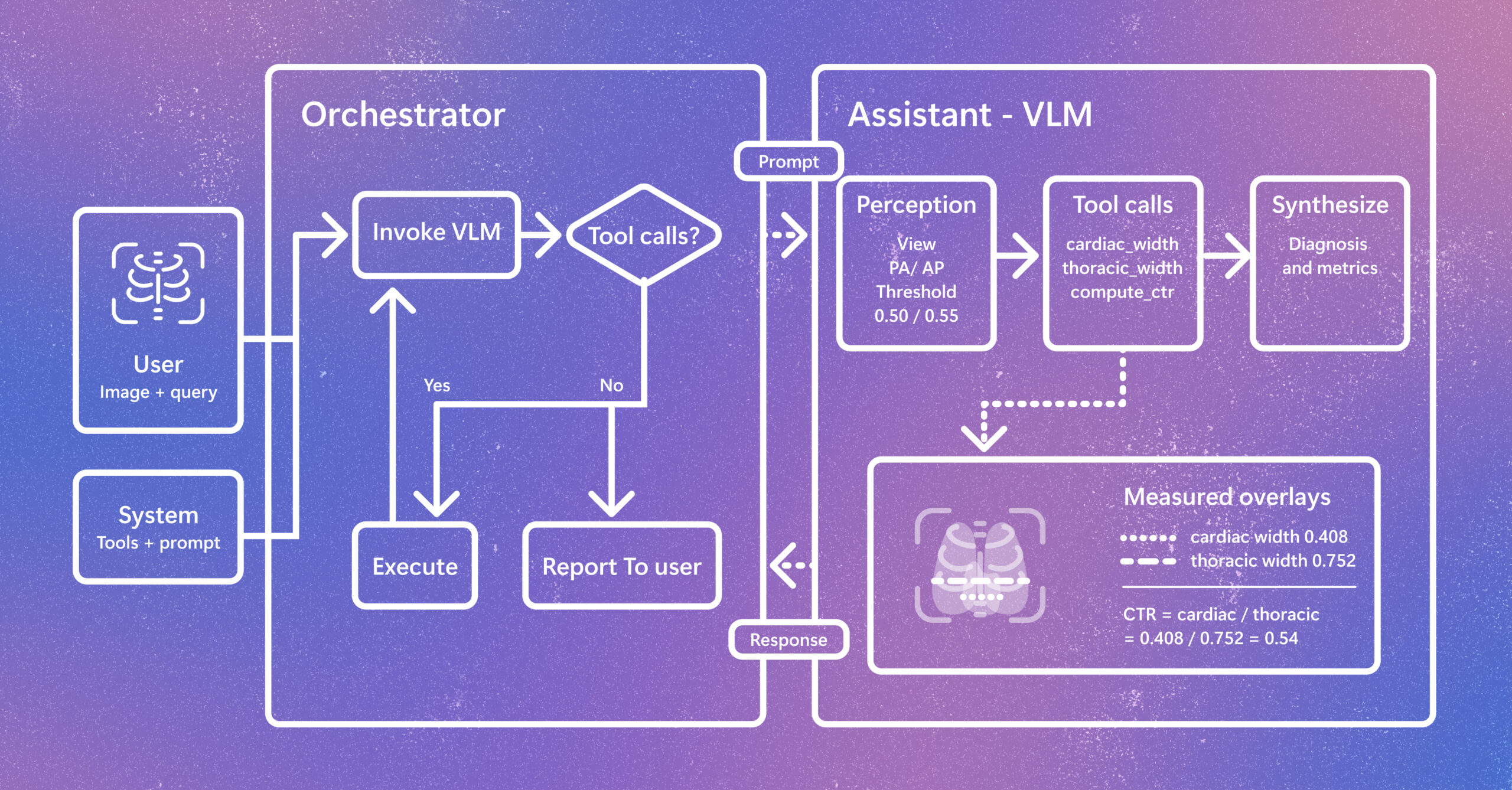
Radiology AI is evolving beyond report generation. CARE-X explores a unified approach that combines flexible reasoning, calibrated predictions, and measurement-based tools for chest X-ray interpretation. The post Introducing CARE-X: Towards Clinically Useful Radiology VLMs with Auxiliary Supervision, Reward-Aligned Learning, and Tool-Augmented Measurement appeared first on Microsoft Research.