VisER is proposed, a training-free two-sided metric for object-level hallucination detection that improves AUROC and AUPR over a range of baselines and measures whether object-context compatibility is backed by object-specific evidence from image tokens.
Abstract
Object hallucination remains a persistent reliability issue in large vision-language models, where generated object mentions may sound plausible but lack visual grounding. Recent training-free detectors use internal signals such as token likelihood, attention, visual confidence, or image-text similarity to identify hallucinated objects. These signals are useful, but they are often source-confounded. They measure how strongly an object is supported inside the model without distinguishing whether that support comes from object-specific visual evidence or the generated text prefix. In difficult cases, a hallucinated object can still receive high internal support because it fits the scene, is associated with nearby visual cues, or follows naturally from the generated text prefix. We propose VisER, a training-free two-sided metric for object-level hallucination detection. VisER evaluates each generated object mention from two complementary views. Visual Evidence measures whether object-context compatibility is backed by object-specific evidence from image tokens. Visual Reliance measures whether the object is supported more by the image than by the generated prefix. Combining these views gives a more source-aware grounding score, while avoiding additional object-level verification generations. Across multiple LVLMs and benchmarks, VisER improves AUROC and AUPR over a range of baselines.
ReWEIGH is a training-free decoding intervention that aggregates vocabulary ranks across visual positions and compares each candidate with a token-specific reference estimated from unlabeled images and applies a bounded penalty only to candidates that fall below their reference.
Multiple object hallucination, where large vision-language models (LVLMs) generate objects not supported by the visual input, is a persistent challenge caused by visual uncertainty during decoding. Existing methods reduce hallucinations using contrastive signals, but they rely on heuristics and lack principled control...
CADMP is proposed, a lightweight object hallucination detection framework that combines adjacent-layer cross-modal attention drift with prediction sensitivity to targeted visual masking, and achieves consistently competitive detection performance.
Attribute hallucination---where vision-language models (VLMs) correctly identify an object but mischaracterize its properties---is prevalent yet mechanistically poorly understood. The dominant explanation, language-prior dominance, has motivated prior-suppression methods, but this explanation has not been directly test...
A diagnosis-to-intervention pipeline for object hallucination is presented, and a controlled account of what acting on the diagnostic signal actually does is presented: it localizes intervention sites with real, non-random leverage, reported as a behavioral profile rather than a single score.
TruthLens is a self-evaluation framework that teaches the LM head to expose a per-object truthfulness signal without any auxiliary model or additional inference cost, and generalizes effectively to benchmarks with substantially larger label spaces.
Yan-Qi Wu, Run-He Lai, Xin-Hua Lu et al.· 0 citations
Exploring how generative AI could make machine vision more accessible to businesses. The post GenEye in a Box: Making Machine Vision Something You Can Just Ask For appeared first on GPT-Lab.
Microsoft Research Blog· microsoft.comAug 11, 2026
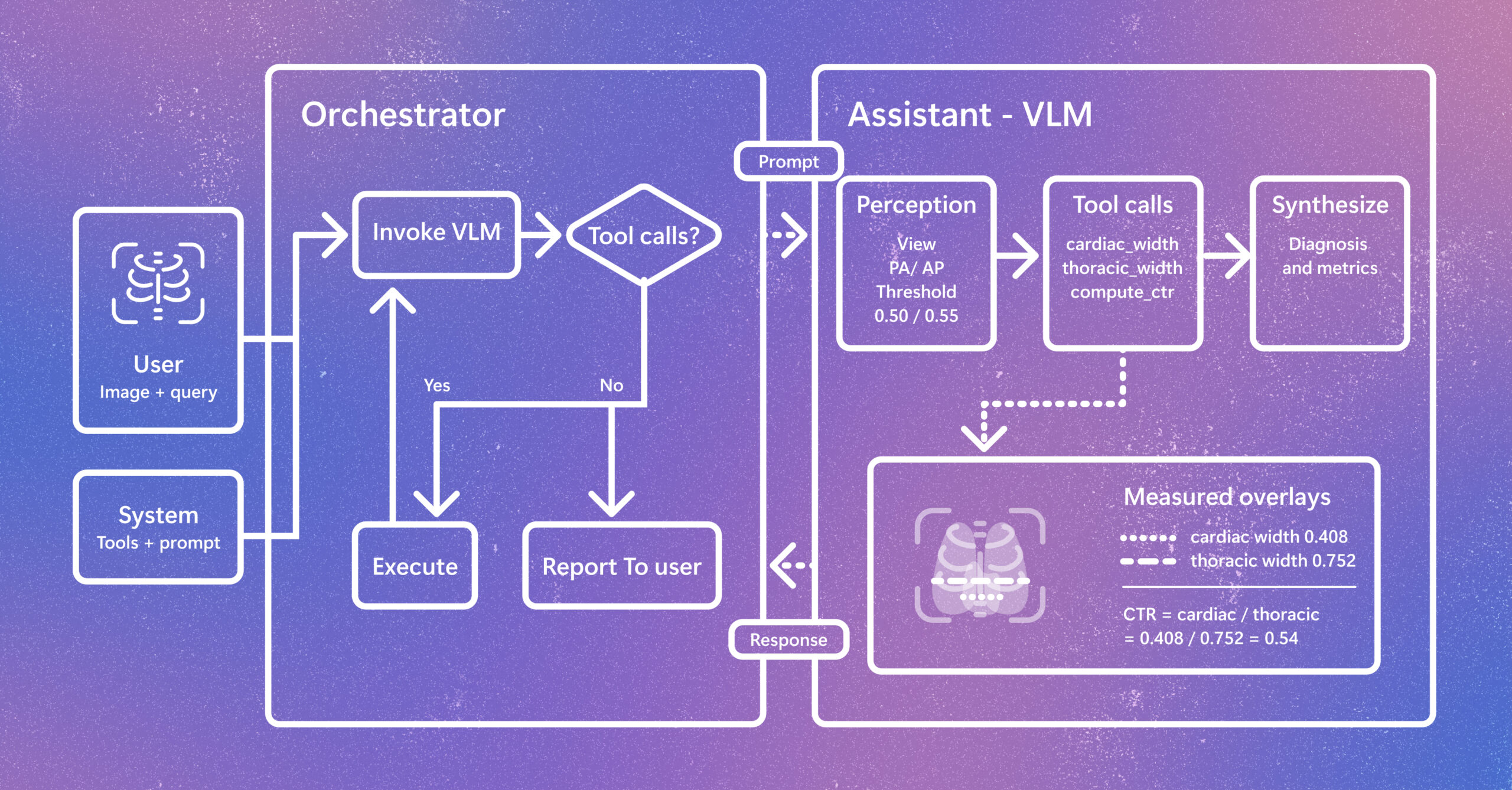
Radiology AI is evolving beyond report generation. CARE-X explores a unified approach that combines flexible reasoning, calibrated predictions, and measurement-based tools for chest X-ray interpretation. The post Introducing CARE-X: Towards Clinically Useful Radiology VLMs with Auxiliary Supervision, Reward-Aligned Learning, and Tool-Augmented Measurement appeared first on Microsoft Research.