This work proposes a VQA-based fine-tuning strategy that trains models to answer structured questions about visual content rather than relying solely on captions or simple instructions, which encourages deeper visual grounding and reasoning.
Abstract
Training multimodal large language models (MLLMs) for video understanding requires large-scale annotated data spanning diverse tasks such as object counting, question answering, and segmentation. However, collecting and annotating multimodal video data in real-world is costly, slow, and inherently limited in diversity and coverage. To address this challenge, we propose~\textbf{SynMulti} dataset, along with a unified synthetic data generation pipeline capable of automatically producing unlimited multimodal video data with rich and diverse supervision. Our framework supports multiple task formats within a single pipeline, enabling scalable and consistent data creation across tasks. To further enhance reasoning ability, we introduce a VQA-based fine-tuning strategy that trains models to answer structured questions about visual content rather than relying solely on captions or simple instructions. This formulation encourages deeper visual grounding and reasoning. We evaluate our approach in three challenging tasks: video object counting, video-based visual question answering, and video object segmentation. Experimental results demonstrate that models trained predominantly on synthetic data generalize effectively to real-world datasets, often outperforming traditionally trained counterparts. Our findings highlight the potential of unified synthetic data pipelines as a scalable alternative to expensive real-world annotation for multimodal video understanding.
Experimental results demonstrate that S2V can consistently improve LVU performance across multiple LVU benchmarks, outperforming both general MLLMs and reasoning-based methods not only in LVU accuracy but also in training and inference efficiency.
Beibei Zhang, Chao Xu, Jun Lan et al.· 0 citations
This work proposes a large-scale multimodal large language model-based supervision generation framework that improves supervision diversity, fidelity, and semantic coverage, and introduces a granularity-aware text representation with separate CLS tokens for summary and detailed views.
F. M. Thoker, Renaud Vandeghen, Karen Sanchez et al.· 0 citations
Multimodal Large Language Models (MLLMs) have demonstrated remarkable advances in remote sensing. However, existing remote sensing multimodal reasoning benchmarks exhibit two critical limitations: they rely on (i) template-driven questions, which causes repetitive questions; and (ii) static images that fail to capture...
Zhen Yao, Li-Kai Wang, Yu-Ming Yang et al.· 0 citations
Multimodal large language models (MLLMs) process multimodal inputs by converting text, images, and videos into token sequences that are subsequently processed by a backbone language model. While MLLMs have achieved excellent performance in understanding the content of individual images, video understanding remains sign...
This work conducts a large-scale evaluation of more than 20 recent MLLMs and shows that video instruction following remains challenging for current models, especially for instructions with many constraints, semantic constraints, or complex conditional structures that require selecting the correct branch or path based o...
Hongbo Liu, Peixian Chen, Siyuan Liu et al.· 0 citations
This work introduces ActionLMM, a memory-augmented vision-language model for long-video action summarization that aligns visual and motion modalities through joint representation learning and leverages a novel dual-memory mechanism to retain both local motion details and global temporal structure.
Rui-Rui Li, Dari Abdullah Alrwoaily, Turgut Sofuyev et al.· International Conference on...· 0 citations
Related blog posts
Microsoft Research Blog· microsoft.comAug 11, 2026
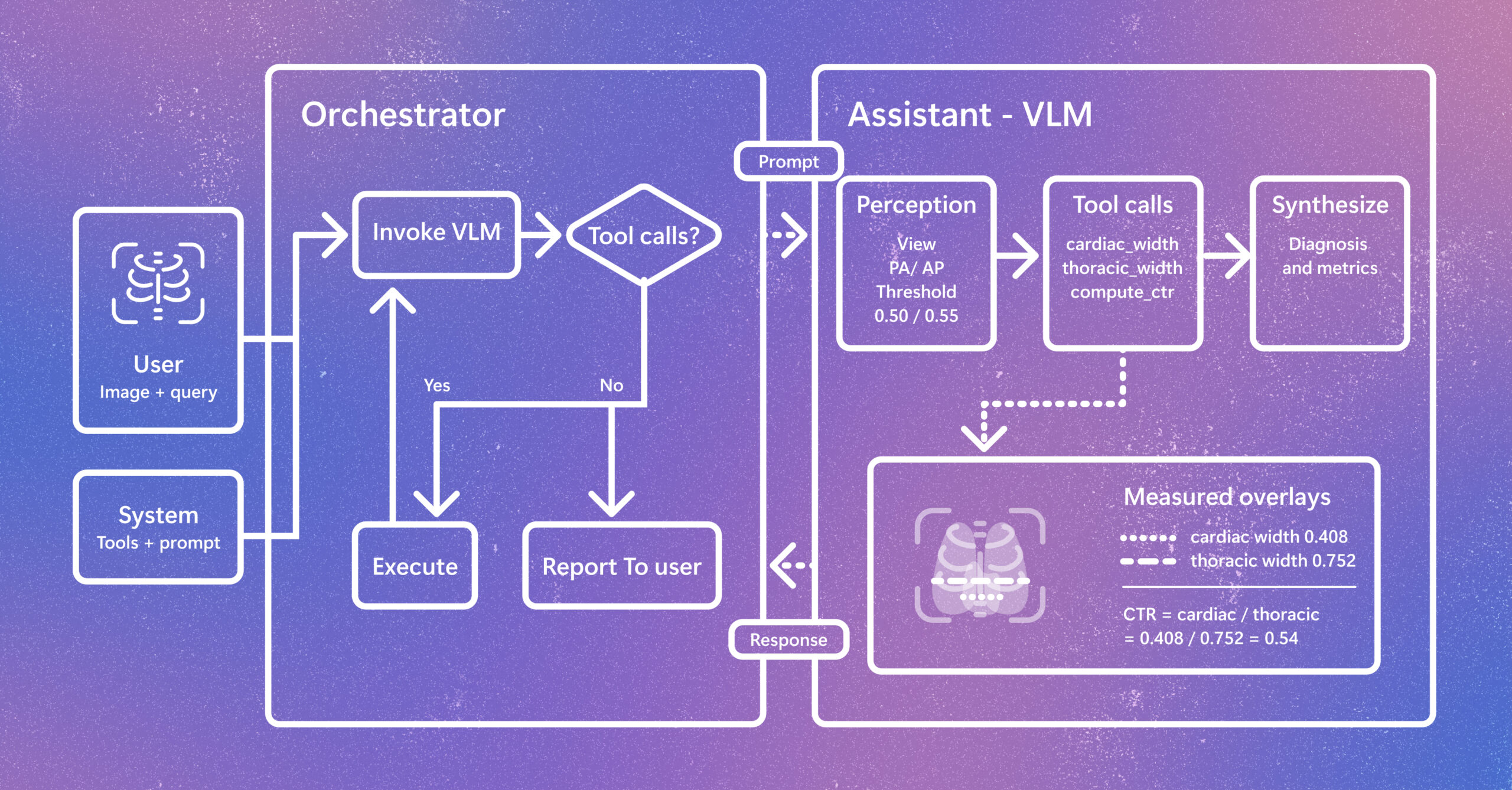
Radiology AI is evolving beyond report generation. CARE-X explores a unified approach that combines flexible reasoning, calibrated predictions, and measurement-based tools for chest X-ray interpretation. The post Introducing CARE-X: Towards Clinically Useful Radiology VLMs with Auxiliary Supervision, Reward-Aligned Learning, and Tool-Augmented Measurement appeared first on Microsoft Research.