Jun 2026· arXiv.org· Vol abs/2606.26636· 1 citation· 47 references
Computer ScienceEngineering
TL;DR
FracEvent, an event simulator that models this pixel-level lifecycle with fractional-relaxation voltage dynamics, improves the temporal structure of generated events and achieves stronger downstream-transfer results than competing simulator baselines, showing its practical value for event-camera simulation.
Abstract
Event cameras asynchronously report brightness changes with microsecond-level temporal resolution, but real event data remain difficult to collect at scale because specialized sensors, careful synchronization, and task-specific annotations are required. Event-camera simulation is therefore important to event-based vision tasks. Most practical simulators build on contrast-threshold event generation, some with additional filtering, stochastic noise, or hand-tuned sensor parameters. While effective, such formulations often simplify the temporal structure produced by the lifecycle of each pixel, which can distort event timing and weaken downstream transfer. We introduce FracEvent, an event simulator that models this pixel-level lifecycle with fractional-relaxation voltage dynamics. Given a log-intensity trajectory, FracEvent drives a compact stack of relaxation modes, combines their responses into a voltage state, emits ON/OFF events by localizing threshold crossings on the continuous voltage trajectory, and updates the reference while retaining the underlying memory modes. This retained state links residual voltage response to later event timing. We evaluate FracEvent through event-stream comparison and downstream transfer on image reconstruction and optical flow estimation. Across multiple datasets, FracEvent improves the temporal structure of generated events and achieves stronger downstream-transfer results than competing simulator baselines, showing its practical value for event-camera simulation.

Event cameras asynchronously detect brightness changes as events rather than capturing full image frames, making them attractive for a wide range of applications. This has created a growing demand for simulation methods that generate realistic event streams directly from 3D scenes. However, accurate simulation remains...
Yuichiro Manabe, Tatsuya Yatagawa, Shigeo Morishima et al.· IEEE Transactions on Visuali...· 0 citations
Event cameras detect per-pixel brightness changes asynchronously on microsecond timescales, with high dynamic range and low power draw. These are desirable properties for robots that move fast or work in difficult lighting conditions. However, integrating an event camera into a real-world robotic pipeline still require...
Adam D. Hines, Michael Milford, Tobias Fischer· 0 citations
Temporally dense optical flow is essential for dynamic perception in immersive VR/AR systems, where rapid head, hand, and object motion must be continuously captured and tracked. Existing frame-based optical flow estimation methods are constrained by the tradeoff between temporal resolution and computational cost; whil...
Jia-Le Wu, Xiao-Yang Bai, Hao-Ming Yu et al.· 0 citations
This paper analyzes two features used in event-based corner detection---the eigenvalues of the structure tensor and the spatiotemporal density values---and shows that they are motion cues, and hypothesize that these features, combined with local geometric information, can enhance motion estimation tasks.
Hesam Araghi, J. V. van Gemert, Nergis Tomen· 0 citations
We present EventSVGF, an event camera rendering framework based on spatiotemporal variance‐guided filtering (SVGF) [SKW*17], designed to achieve high temporal accuracy especially in high‐frequency regions, which is critical for faithful event simulation. Unlike conventional rendering, event cameras measure temporal c...
Juhyeon Kim, Wojciech Jarosz, A. Pediredla· Computer graphics forum (Pri...· 1 citation
Event-guided video super-resolution (VSR) leverages high-temporal-resolution event streams to address motion blur, rapid dynamics, and poor illumination that challenge frame-only VSR methods. However, most existing approaches emphasize reconstruction quality while overlooking real-time performance and computational eff...
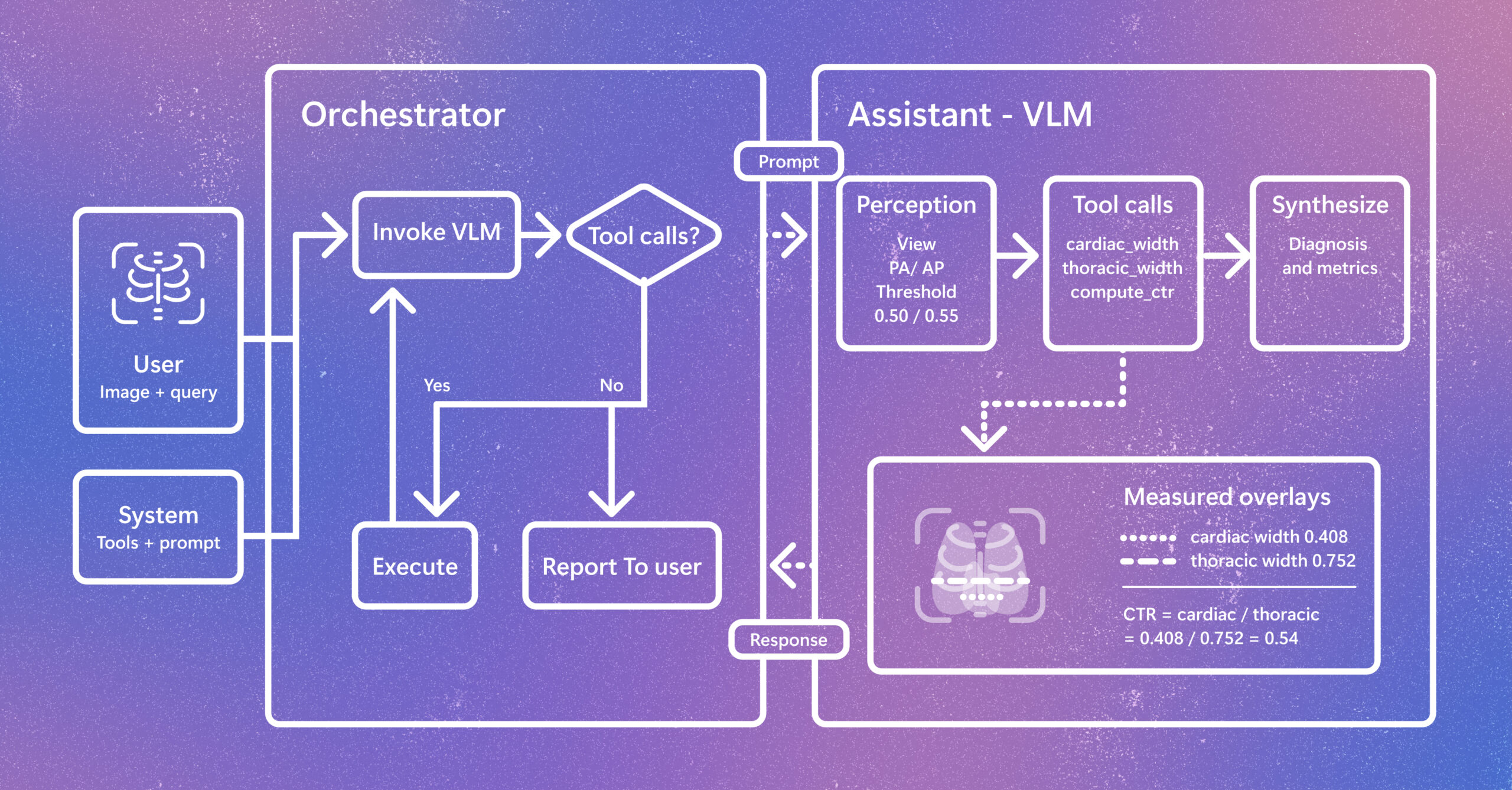
Radiology AI is evolving beyond report generation. CARE-X explores a unified approach that combines flexible reasoning, calibrated predictions, and measurement-based tools for chest X-ray interpretation. The post Introducing CARE-X: Towards Clinically Useful Radiology VLMs with Auxiliary Supervision, Reward-Aligned Learning, and Tool-Augmented Measurement appeared first on Microsoft Research.