It is suggested that local preference recognition requires community-specific training signal, not just better prompting, and this work supports future research on community-aware reward modeling, feed curation, and positive moderation.

Abstract
Online communities develop distinct norms for content they collectively value, yet it remains unclear whether current language models can recognize locally valued contributions in context. We formalize this as \textbf{community-conditioned preference prediction} and introduce \textsc{Vastu} (\underline{V}alue-\underline{A}ware \underline{S}ocial \underline{Tu}ning), a benchmark of 75,000 Reddit comments from 15 communities spanning Gaming, Science, Q\&A, Advice, and Politics. We evaluate four model families---prompted LLMs, LoRA-adapted SLMs, supervised encoders, and feature-based classifiers---across global, local, and context-conditioned settings. Our central finding is that parametric adaptation consistently outperforms prompting: supervised encoders reach 0.74 AUROC and fine-tuned SLMs 0.64--0.71, while the best prompted result is only 0.62. This gap is not merely quantitative---vanilla prompting yields over 80\% false-negative rates, systematically discarding content communities actually value. Conversational context narrows but does not close this divide. Together, these results suggest that local preference recognition requires community-specific training signal, not just better prompting. Our work supports future research on community-aware reward modeling, feed curation, and positive moderation.

TRIAGE can be applied alongside existing unlearning benchmarks to complement behavioral evaluation with a model-internal view of how unlearning reshapes the model's parameter space and affects retained knowledge.
This work investigates whether large language models (LLMs) can automatically adapt template-based bias datasets to specific domains using zero-shot prompting and shows that domain-adapted templates capture real-world bias patterns more faithfully than standard templates.
Tamara Quiroga, Felipe Bravo-Marquez, Valentin Barrière· ACM Transactions on Intellig...· 0 citations
This work introduces DocHop, a benchmark for integrated chart--context reasoning in document-style images and constructs DocHop via a stochastic logic-first generation pipeline with controllable reasoning depth and visual density, to enable systematic evaluation.
Zhuo-Ran Yu, Le Thien Phuc Nguyen, Jaden Park et al.· 1 citation
This work introduces Giga-Embeddings, a family of text embedding models designed to combine strong retrieval quality with efficient serving, and trains the compact model using a dimension-agnostic objective that aligns teacher and student similarity distributions.
Egor Kolodin, Egor Krasnoperov, Evgeniy Kosarev et al.· 0 citations
The results suggest that frozen embedding-based recommendation could be a viable option, particularly when considering the cost/performance ratio, however, model and method selection should be evaluated against domain-specific tasks and protocols, rather than being based on general intuitions about scaling, general-pur...
Patrik Müller, B. Walek, R. Farana· Computers· 0 citations
PALRec is proposed, a parameter-preserving augmentation framework that equips an LLM with recommendation capabilities while keeping its original parameters fixed and consistently outperforms fully fine-tuned counterparts in recommendation accuracy while preserving the LLM’s pre-trained knowledge.
Hyunsoo Na, Minseok Gang, Sang-goo Lee et al.· ACM Transactions on Informat...· 0 citations
AI agents can generate code at a scale that’s hard for humans to review line-by-line. PDD Kit helps ensure the code is doing what the developer intended by creating formal specifications and testing against them. It converts developer intent into a Verus specification, proves AI-generated code meets it for every input, and uses tests where proofs aren't practical. Developers review intent, not every line. The post Formally verifying agent-written full-stack web apps with PDD Kit appeared first o…
Professor Paris Smaragdis develops computers with superhuman hearing for applications like speech recognition, music understanding, and environmental monitoring.
MIT News · Artificial Intelligence· news.mit.eduOct 23, 2026
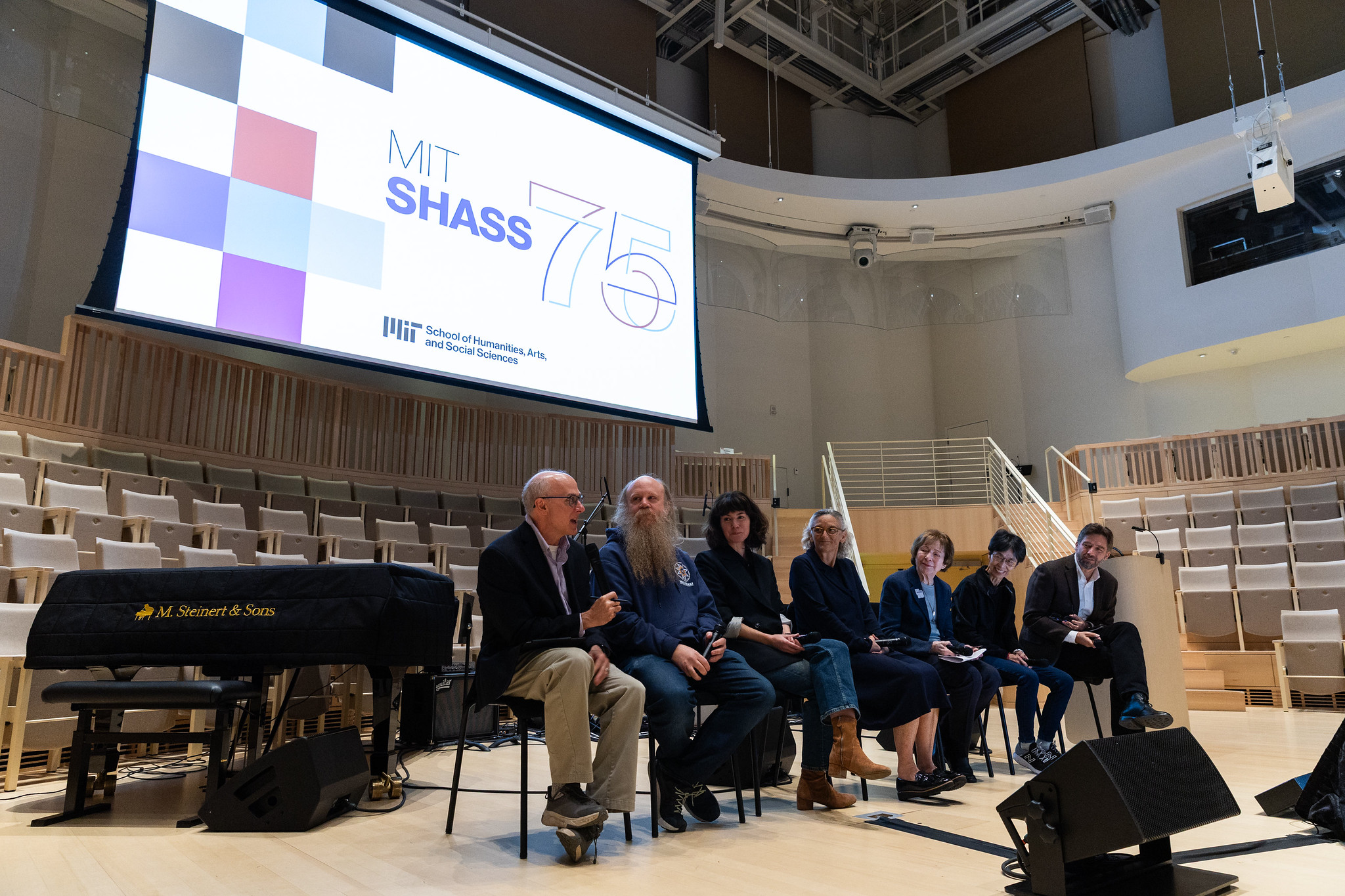
During the School of Humanities, Arts, and Social Sciences’ 75th Anniversary Symposium, President Sally Kornbluth said “MIT has never needed your particular insight and guidance more than we do now.”
We use cookies to run the site and, with your consent, for analytics and to show ads.
See our Cookie Policy.