Aug 2026· Frontiers in Computing and Intelligent Systems· 0 citations· 15 references
TL;DR
A formalized privacy-aware scheduling perspective is proposed that incorporates latency, energy consumption, cost, node trustworthiness, data sensitivity, privacy leakage risk, reliability and auditability into a unified decision model.
Abstract
With the rapid development of edge computing, cloud computing, big data, artificial intelligence and the Internet of Things, traditional centralized cloud computing faces increasing challenges in latency, bandwidth pressure, resource utilization and data privacy protection. Edge-cloud collaboration provides a new computing paradigm by extending computing, storage and network resources from centralized cloud data centers to edge nodes closer to users and data sources. This architecture can improve service response efficiency and reduce data transmission pressure, but it also introduces heterogeneous resources, dynamic task requests, unclear security boundaries and privacy leakage risks. This paper reviews existing studies on edge-cloud collaboration, resource scheduling, intelligent optimization and privacy protection, and then conducts an analytical discussion of the research gaps rather than an experimental evaluation. The review shows that existing studies have achieved valuable progress in task offloading, resource allocation, deep reinforcement learning, access control, encryption and federated learning. However, research on integrated frameworks that combine intelligent resource scheduling with privacy-aware security management remains limited. To address this limitation, this paper proposes a formalized privacy-aware scheduling perspective that incorporates latency, energy consumption, cost, node trustworthiness, data sensitivity, privacy leakage risk, reliability and auditability into a unified decision model. The analysis indicates that future edge-cloud systems should evolve from efficiency-centric scheduling toward secure, trustworthy and sustainable collaborative governance.

According to the review, combining AI-powered optimisation with sophisticated security frameworks has the potential to enhance the performance, resilience and reliability of multi-cloud environments.
A. Jain· Journal of Global Research i...· 0 citations
This paper introduced an Intelligent Portable Edge – Cloud Computing Architecture (IPECA) that combines the portable computing hardware, AI-based workload prediction, adaptive resource optimization, container-based virtualization and secure edge-cloud collaboration into a single computing architecture.
Pradeep Kachakayala, Akshith Kachakayala· International Journal for Re...· 0 citations
Cloud computing has become a part of modern technology. It is used in intelligence, online education, banking,
healthcare, entertainment, business applications and many other areas. The growth of intelligence is increasing the demand for
computing power, storage, networking and data-centre resources. Because of this gr...
Fayiza Rinaz K. M, Ayesha Thahleela K. K, Aaslim Sanofar A et al.· International Journal for Re...· 0 citations
Abstract
Artificial Intelligence (AI) and Cloud Computing are two transformative technologies that reshape the digital landscape of modern organizations. Cloud computing provides scalable computing resources, storage capabilities, and on-demand services, while AI offers intelligent decision-making, automation, predicti...
Kurban Kurban, A. Farooqi· International Scientific Jou...· 0 citations
A framework is proposed for collaborative decision-making learning to select secure, load-balanced routing paths, leveraging multiple-level distributed computation to achieve trustworthy communication.
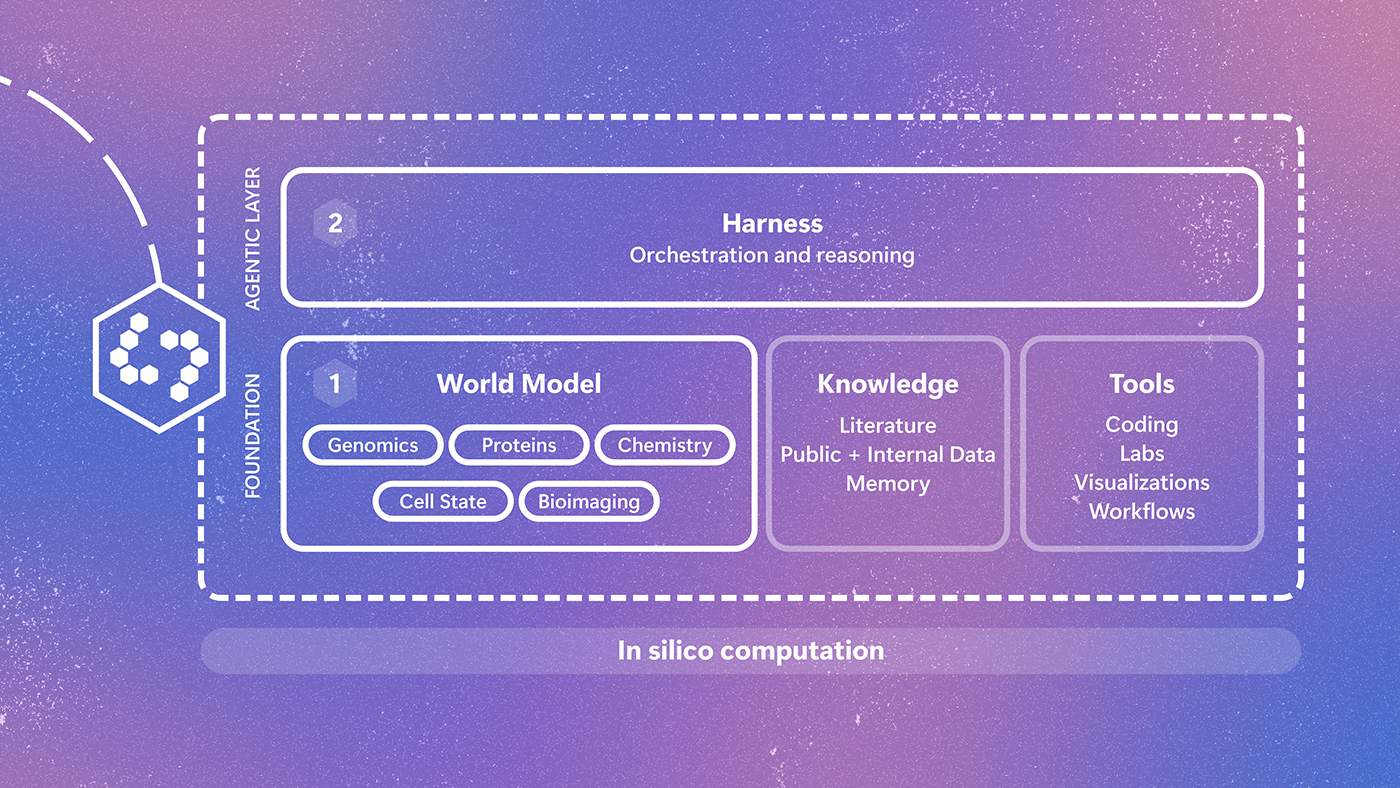
Biology doesn't operate in silos, and neither should the AI representation of it. Quine is an early-stage research effort to create a multimodal world model of biology. By connecting insights across biological scales and modalities, Quine helps scientists computationally search a space far larger than intuition allows and prioritize hypotheses before they reach the lab. Experimental results provide important feedback, helping researchers sharpen future research directions. The post Introducing Q…