A thin-slab interaction model and an interaction-driven quantum kernel constructed from entangled Pauli-string feature maps that achieves the highest mean accuracy and F1 on Credit Card Fraud Detection and ranks second on IEEE-CIS Fraud Detection.
Abstract
Similarity in many decision systems is governed not by distance alone but by interactions among variables. In fraud and anomaly detection, small local perturbations can cross interaction-sensitive decision boundaries while leaving ambient distance almost unchanged. Motivated by this setting, we introduce a thin-slab interaction model and an interaction-driven quantum kernel constructed from entangled Pauli-string feature maps. The feature map explicitly encodes sparse high-order block interactions. We show that the resulting fidelity kernel is positive semidefinite, admits an exact block-factorized formulation, and induces a geometry sensitive to changes in interaction regime. Across balanced and imbalanced synthetic experiments spanning third-, fourth-, sixth-, and eighth-order interactions, the proposed kernel consistently outperforms linear, radial basis function, Laplacian, and polynomial kernels, as well as an engineered-interaction linear baseline supplied with the planted block products. On real fraud-detection benchmarks, it achieves the highest mean accuracy and F1 on Credit Card Fraud Detection and ranks second on IEEE-CIS Fraud Detection. These findings show that quantum-kernel performance depends on alignment between feature-map geometry and the underlying predictive structure, rather than on Hilbert-space dimension alone. Because the prescribed block-factorized kernel can also be evaluated exactly on a classical computer, the results establish predictive and representational value rather than computational quantum speedup.

We introduce Quantum-KIP, a method that compresses a training set into a small set of kernel inducing points with soft labels. It uses a quantum feature map to compute state-fidelity overlaps and relies only on forward evaluations, avoiding backpropagation through quantum circuits. We provide a compression-induced stab...
Baobao Song, Shiva Raj Pokhrel, Athanasios V. Vasilakos et al.· IEEE Transactions on Informa...· 0 citations
It is proved that in the small-bandwidth regime the induced kernel is, to leading order, an anisotropic Gaussian kernel with metric M = I + pi^2 Q, where Q is the signless Laplacian of the entanglement graph, and that the quadratic structure persists at every circuit depth as a pullback of the Fubini-Study metric.
A quantum kernel fusing amplitude encoding of l2-normalized delay windows with a grouped single-qubit rotation layer that assigns contiguous temporal blocks to each qubit, making the circuit delay-window-aware and the first mechanistic localisation of quantum-kernel advantage to a specific dynamical regime of a classic...
Zhi-Hui Wang, Sujit Roy, Ata Akbari et al.· 0 citations
KWA is proposed, a hyperparameter-free aggregation strategy that recovers FedAvg under IID conditions, adapts to client drift, and requires no manually tuned hyperparameters.
This work adds the missing non-linearity to UCI Default of Credit Card Clients data with a quantum-inspired feature map, specific to linear models: Random Forest, SVM, XGBoost, and k-NN, already non-linear, do not benefit.
Menachem Finkelstein, Diana Levy, Sarel Cohen et al.· Proceedings of the 19th ACM...· 0 citations
It is shown that ordinary hyperparameter choices move performance by considerably more than the quantum kernel does, that additional qubits degrade rather than improve performance through kernel concentration, and that the clustering framing itself fails at realistic class imbalance though kernel-based anomaly scoring...
M. Faryad· 0 citations
Related blog posts
MIT News · Artificial Intelligence· news.mit.eduOct 2, 2026
A weeklong summer workshop brought higher education faculty to campus to explore how AI and machine learning materials can be adapted for their classrooms.
MIT News · Artificial Intelligence· news.mit.eduAug 27, 2026
A new machine-learning framework aims to improve the success rate of computational protein design while moving away from results that reproduce sequences found in nature.
Microsoft Research Blog· microsoft.comAug 20, 2026
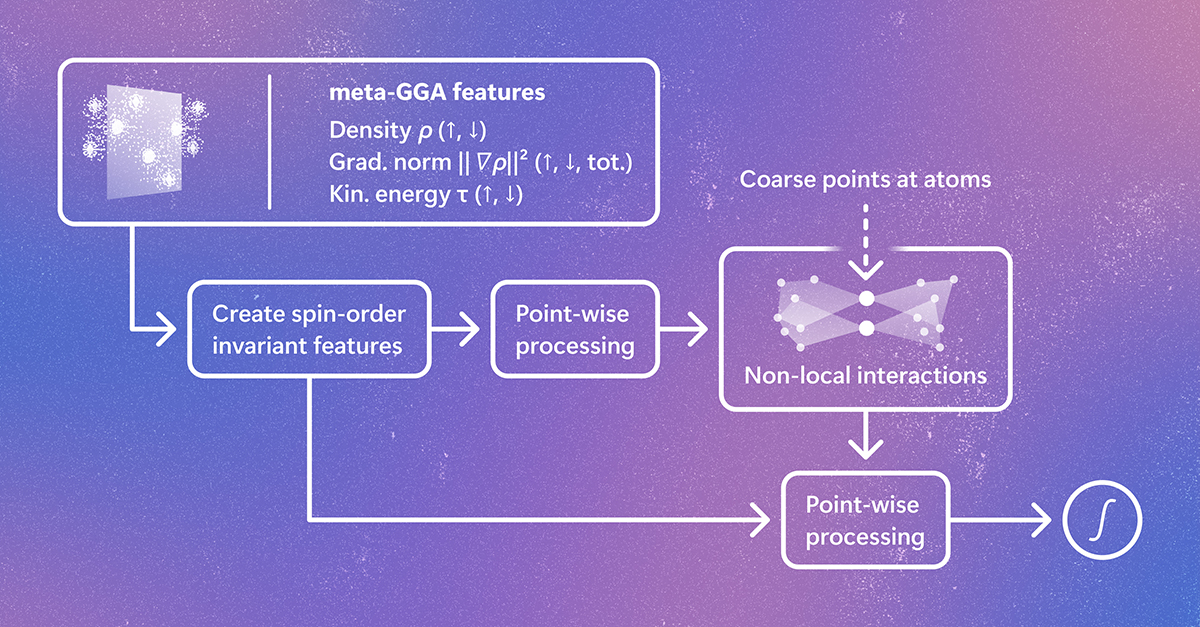
Skala 1.1, the updated deep-learning exchange-correlation functional from Microsoft Research, provides greater accuracy, expanded accessibility across the computational chemistry ecosystem, and a living benchmark to track computational performance. The post Broadening access to Skala creates a faster path to predictive DFT appeared first on Microsoft Research.
We use cookies to run the site and, with your consent, for analytics and to show ads.
See our Cookie Policy.