The scalability of variational quantum algorithms is limited by barren plateaus, where gradients vanish exponentially in system size. This worst-case result raises fundamental questions about the trainability of quantum AI models. We present a major advance towards resolving this trainability question by answering whether a given quantum circuit has a barren plateau. We do this using an analytical framework that bounds the gradient variance for arbitrary input states $\rho$ and observables $\mathcal{M}$ by decomposing the unitary representation of the associated compact Lie group. When the circuit segments on both sides of a gate form $2$-designs, we obtain the variance exactly and prove a sufficient condition for trainability: if $\rho^{\otimes 2}$ and $\mathcal{M}^{\otimes 2}$ are sufficiently concentrated on the same irreducible invariant subspace of polynomial dimension, and the differentiated gate moves this subspace by an inverse-polynomial amount, then the gradient variance is at least inverse-polynomial. We further present a sampling algorithm that estimates the gradient variance from runs of the ansatz, without constructing the representation-theoretic projectors. Our algorithm decides whether the variance exceeds a tolerance $\tau$ with the number of runs polynomial in $1/\tau$, including cases in which the bounds are inconclusive. This resolves the question of the trainability of the circuit before expensive training procedures.

It is found that Llama 3 delivers comparable quality to leading language models such as GPT-4 on a plethora of tasks, and performs competitively with the state-of-the-art on image, video, and speech recognition tasks.
This paper investigates developing real-world perception for active agents, proposes Gibson Environment for this purpose, and showcases a set of perceptual tasks learned therein.
F. Xia, Amir Zamir, Zhi-Yang He et al.· 2018 IEEE/CVF Conference on...· 1,069 citations· ⚡112
This publication proposes a definition and a classification of agile software development approaches and analyses ten software development methods that can be characterized as being "agile" against the defined criterion.
P. Abrahamsson, O. Salo, Jussi Ronkainen et al.· arXiv.org· 727 citations· ⚡54
The study shows that agile practices improve both informal and formal communication, but indicates that, in larger development situations involving multiple external stakeholders, a mismatch of adequate communication mechanisms can sometimes even hinder the communication.
M. Pikkarainen, Jukka Haikara, O. Salo et al.· Empirical Software Engineeri...· 401 citations· ⚡48
The results indicate that software engineering work practices are chosen opportunistically, adapted and configured to provide value under the constrains imposed by the startup context.
Nicolò Paternoster, Carmine Giardino, M. Unterkalmsteiner et al.· Information and Software Tec...· 394 citations· ⚡54
Related blog posts
MIT News · Artificial Intelligence· news.mit.eduNov 17, 2026
By studying the computational foundations of language learning, Associate Professor Jacob Andreas builds intelligent systems that can communicate effectively with humans.
MIT News · Artificial Intelligence· news.mit.eduOct 28, 2026
Professor Paris Smaragdis develops computers with superhuman hearing for applications like speech recognition, music understanding, and environmental monitoring.
MIT News · Artificial Intelligence· news.mit.eduOct 2, 2026
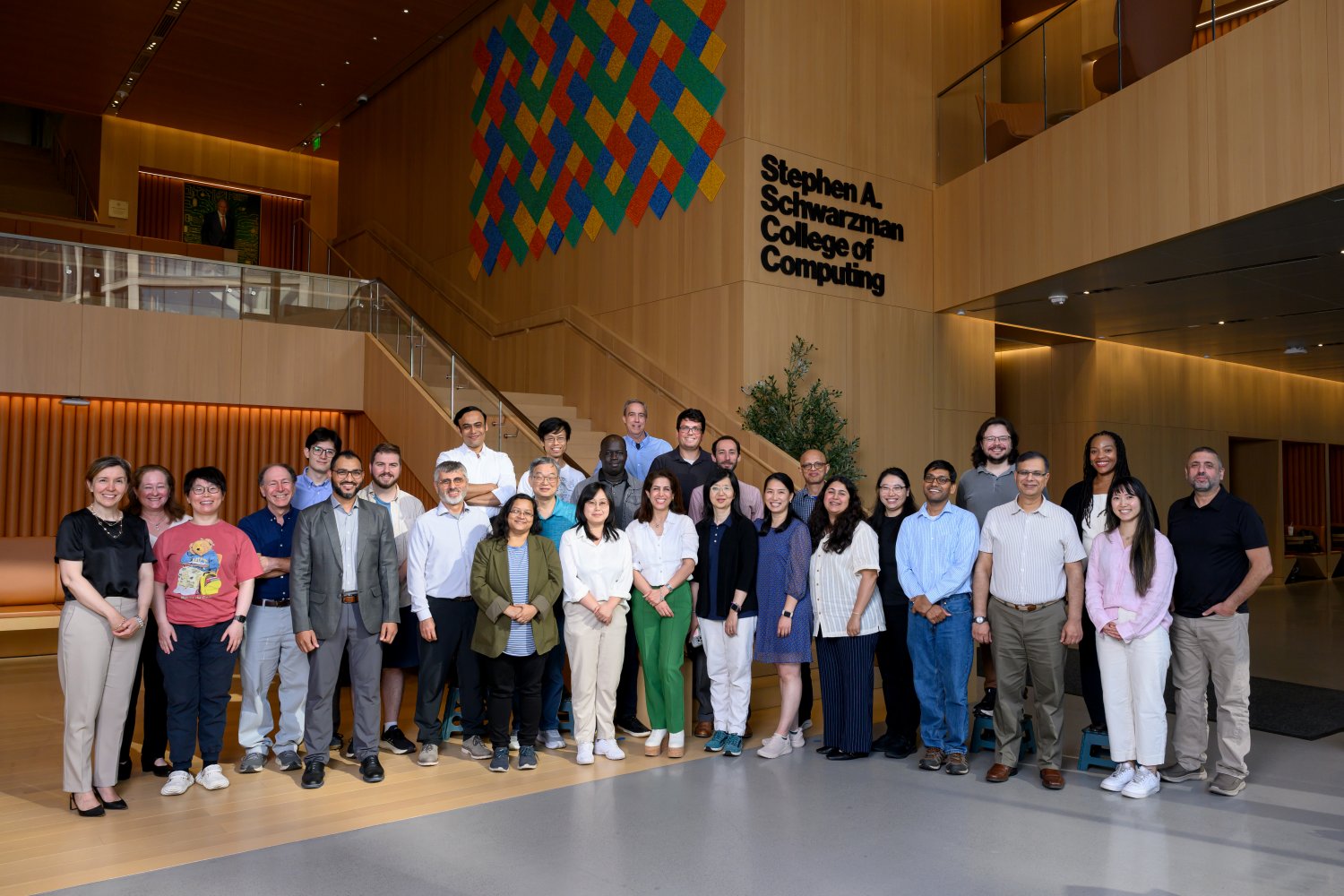
A weeklong summer workshop brought higher education faculty to campus to explore how AI and machine learning materials can be adapted for their classrooms.
We use cookies to run the site and, with your consent, for analytics and to show ads.
See our Cookie Policy.