Command-line coding agents (e.g., Claude Code, Gemini CLI) can already read and write files and sustain long sessions, yet end-to-end research still fragments across chat tools, IDEs, terminals, and writing environments, and the decisions that make it auditable are rarely preserved. We present Dr. Claw, an open-source workspace that wraps existing coding-agent executors in a controllable and auditable human-in-the-loop workflow rather than introducing another autonomous agent. Persistent state objects, a reusable skill library, and multi-executor coordination link human decisions to AI execution, turning planning, execution, and writing into one traceable, recoverable loop. We demonstrate Dr. Claw through an interactive three-view scenario and a failure-recovery walkthrough, and evaluate it against a bare command-line agent sharing the same backend executor, so the comparison contrasts the whole orchestration layer (task graph, state objects, and skill library) with the agent it wraps. Holding the executor fixed, Dr. Claw scores higher on research completeness while persisting an auditable, recoverable process trail. Demo access: repository https://github.com/OpenLAIR/dr-claw, released under AGPL-3.0 with GPL-3.0 upstream components.

This publication proposes a definition and a classification of agile software development approaches and analyses ten software development methods that can be characterized as being "agile" against the defined criterion.
P. Abrahamsson, O. Salo, Jussi Ronkainen et al.· arXiv.org· 727 citations· ⚡54
The study shows that agile practices improve both informal and formal communication, but indicates that, in larger development situations involving multiple external stakeholders, a mismatch of adequate communication mechanisms can sometimes even hinder the communication.
M. Pikkarainen, Jukka Haikara, O. Salo et al.· Empirical Software Engineeri...· 401 citations· ⚡48
The results indicate that software engineering work practices are chosen opportunistically, adapted and configured to provide value under the constrains imposed by the startup context.
Nicolò Paternoster, Carmine Giardino, M. Unterkalmsteiner et al.· Information and Software Tec...· 394 citations· ⚡54
The possibility of inferring high-dimensional data inference in a model that consists of a prior and an auxiliary differentiable constraint given some additional information is considered, thereby allowing a range of potential applications in adapting models to new domains and tasks.
Alexandros Graikos, Esmeralda S. Whitammer, N. Jojic et al.· Neural Information Processin...· 316 citations· ⚡15
It is proved that any global minimizer of the trajectory balance objective can define a policy that samples exactly from the target distribution, and empirically demonstrate the benefits of the trajectories balance objective for GFlowNet convergence, diversity of generated samples, and robustness to long action sequences and large action spaces.
Esmeralda S. Whitammer, Moksh Jain, Emmanuel Bengio et al.· Neural Information Processin...· 302 citations· ⚡60
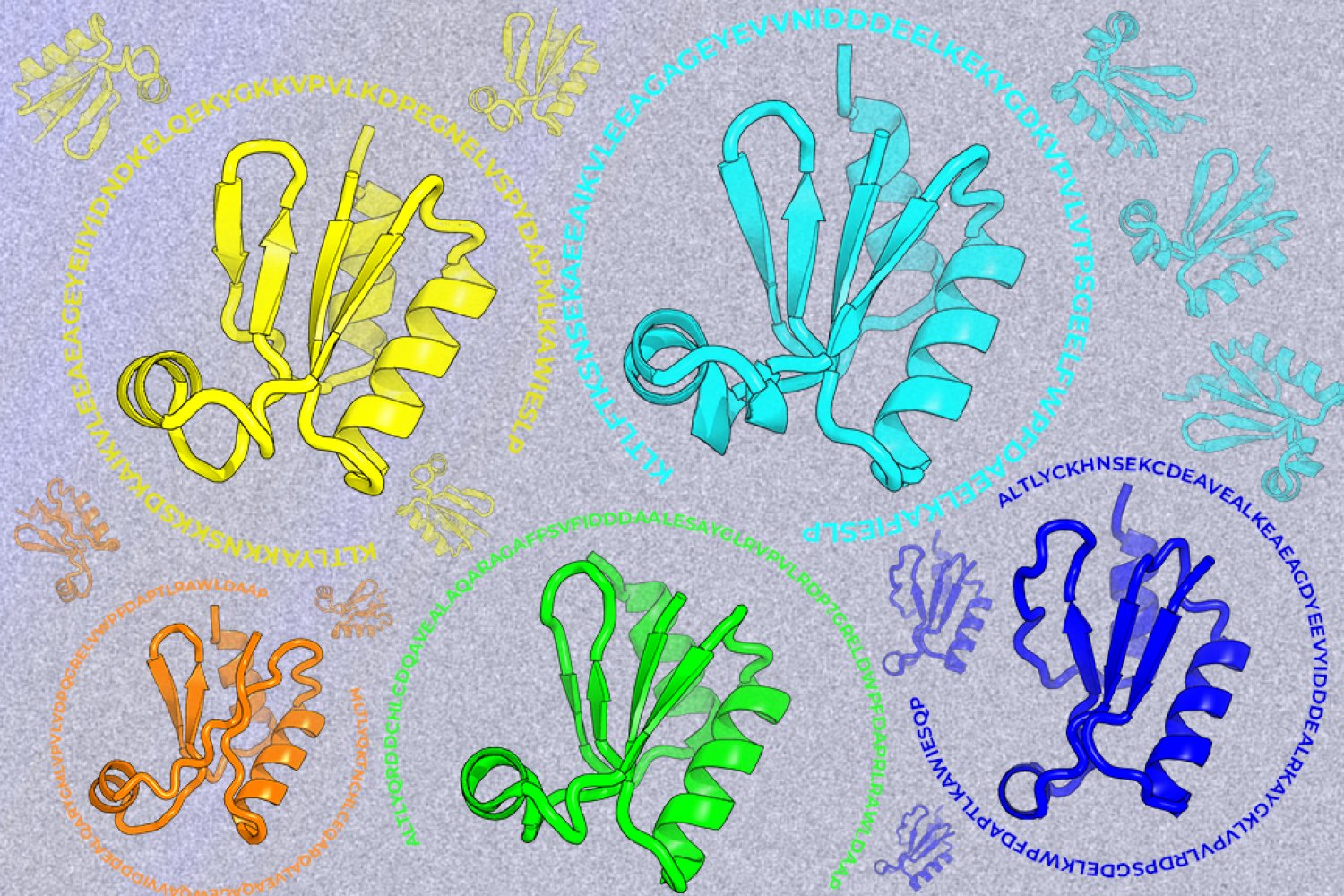
A new machine-learning framework aims to improve the success rate of computational protein design while moving away from results that reproduce sequences found in nature.
We use cookies to run the site and, with your consent, for analytics and to show ads.
See our Cookie Policy.