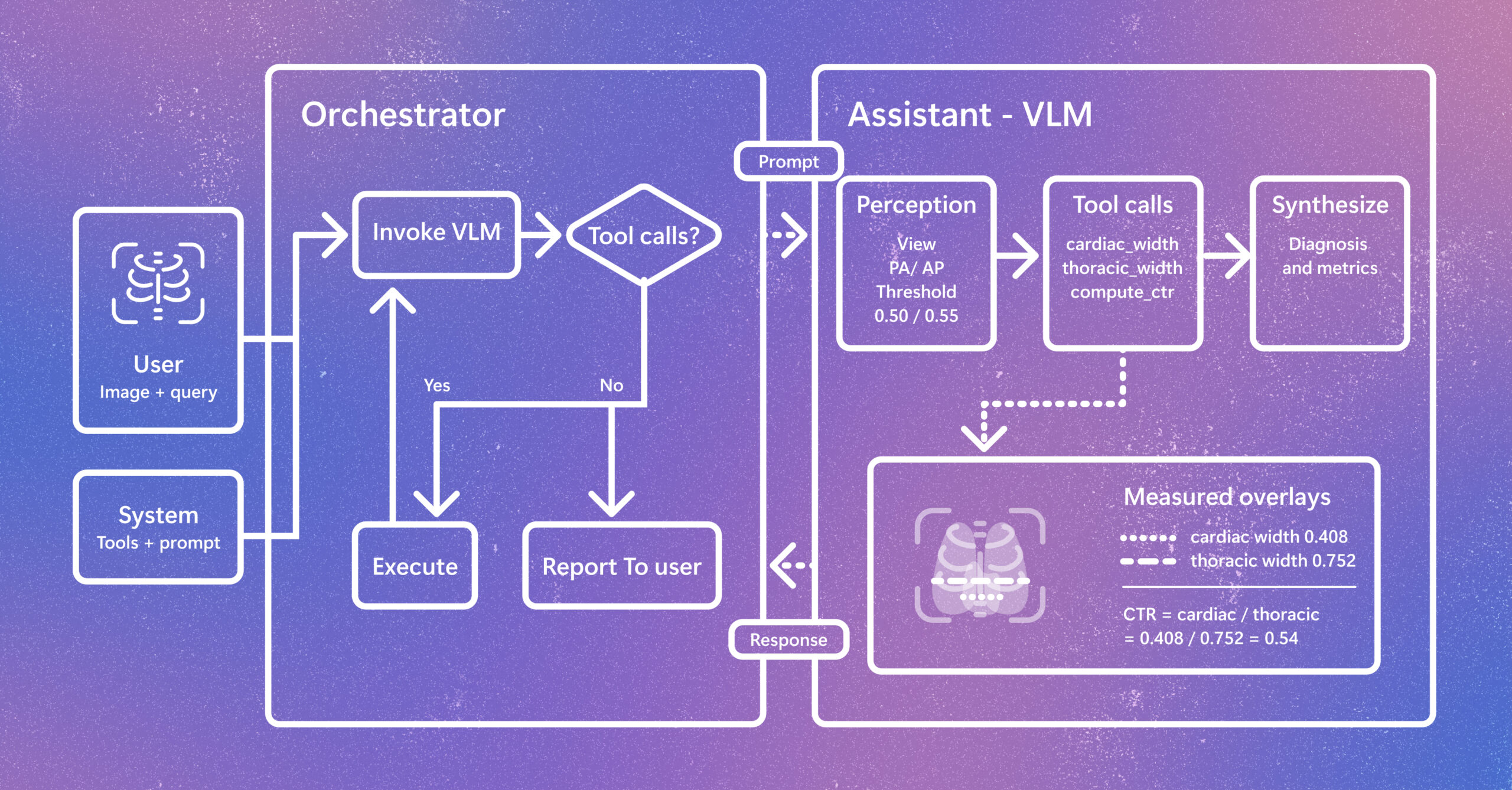
Two distinct effects are reported: paired-example FedAvg partially recovers the missing-ECG gap, while validation-selected completion is a task-specific classifier-logit correction rather than literal ECG recovery.
Abstract
Federated multimodal models often assume every site has every modality, although hospitals differ in access to EHRs, chest radiographs, and ECGs. We study this setting on a MIMIC-derived respiratory deterioration task with simulated FL clients and introduce FedCoRe (Federated Cross-Modal Representation Completion). FedCoRe learns representation- or logit-space corrections rather than generating synthetic ECGs or CXR images. When a client observes a modality that may be missing at deployment, it evaluates the same example with and without that modality to obtain paired supervision. Only clients with such pairs update the completion module, and validation may retain the unchanged prediction. We freeze the trained multimodal predictor during evaluation so that measured differences come only from completion. Hiding ECG reduced AUROC by about 0.085; paired-example FedAvg restored 0.0415 AUROC, or 49.0% of the lost performance. We therefore report two distinct effects: paired-example FedAvg partially recovers the missing-ECG gap, while validation-selected completion is a task-specific classifier-logit correction rather than literal ECG recovery. For CXR, effect-aware completion recovers 52.8% of the loss in a controlled test where CXR is hidden. Paired-example FedAvg transfers part of this effect, but validation keeps the no-completion baseline for deployment cases whose inputs lack CXR. Thus, FedCoRe should be read as a validation-gated completion/correction framework: it can recover missing-modality signal in supported settings, but it should be deployed only when paired examples and validation evidence support that modality.

This article investigates several physics-informed and hybrid machine learning strategies that incorporate physics knowledge in experimental data-driven deep-learning models for predicting the bond quality and porosity of fused filament fabrication (FFF) parts. Three types of strategies are explored to incorporate physics constraints and multi-physics FFF simulation results into a deep neural network (DNN), thus ensuring consistency with physical laws: (1) incorporate physics constraints within the loss function of the DNN, (2) use physics model outputs as additional inputs to the DNN model, and (3) pre-train a DNN model with physics model input-output and then update it with experimental data. These strategies help to enforce a physically consistent relationship between bond quality and tensile strength, thus making porosity predictions physically meaningful. Eight different combinations of the above strategies are investigated. The results show how the combination of multiple strategies produces accurate machine learning models even with limited experimental data.
B. Kapusuzoglu, S. Mahadevan· JOM· 79 citations· ⚡2
This work introduces a pioneering exploration of Self-Supervised Learning (SSL) within the SNN, and proposes a novel Spiking Self-Attention (SSA) and Spiking Transformer (Spikformer) that achieves 80+% accuracy on ImageNet.
Zhaokun Zhou, Kaiwei Che, Wei Fang et al.· arXiv.org· 69 citations· ⚡10
This paper considers global sensitivity analysis (GSA) for situations where both a physics-based model and experimental observations are available, and investigates physics-informed machine learning strategies to effectively combine the two sources of information in order to maximize the accuracy of the sensitivity estimate.
B. Kapusuzoglu, S. Mahadevan· Reliability Engineering & Sy...· 45 citations
EquiPocket is proposed, an E(3)-equivariant Graph Neural Network for binding site prediction, which comprises three modules: the first one to extract local geometric information for each surface atom, the second one to model both the chemical and spatial structure of protein and the last one to capture the geometry of the surface via equivariant message passing over the surface atoms.
Yang Zhang, Wenbing Huang, Zhewei Wei et al.· International Conference on...· 43 citations· ⚡4
Investigating how experienced developers use agents in building software, including their motivations, strategies, task suitability, and sentiments finds that while experienced developers value agents as a productivity boost, they retain their agency in software design and implementation out of insistence on fundamental software quality attributes.
An adaptive surrogate modeling method for problems with very high-dimensional spatio-temporal outputs is developed that combines exploration and exploitation to improve the surrogate model accuracy with the fewest possible runs of the expensive physics-based model.
B. Kapusuzoglu, S. Mahadevan, Shunsaku Matsumoto et al.· Structural And Multidiscipli...· 17 citations
Known for his clear and elegant writing style, Bertsekas shaped fields from control and optimization to large-scale computation and artificial intelligence.