We present the orienteering problem with uncertain time-varying rewards (OP-UTVR), a novel variant of the orienteering problem (OP). While most existing OP formulations assume rewards to be known in advance, practical applications involve uncertain and time-varying rewards, as with shifting customer demand for delivery agents. OP-UTVR relaxes this assumption by allowing agents to estimate reward dynamics from observations and forecast future rewards. This enables informed routing decisions despite stochastic reward changes and inevitable prediction errors. We address this problem using three planners that differ in planning horizon and online adaptivity, and derive theoretical bounds on their performance under reward stochasticity. We further introduce a mobile service robot benchmark for OP-UTVR, where a robot navigates among pedestrians in indoor environments. Experiments reveal trade-offs between planning horizon and adaptivity, and demonstrate the effectiveness of long-horizon planning with online adaptation.
This work presents NeuralParker, a reinforcement learning-based hybrid planner for arbitrary-pose parking that encodes full-environment obstacle and boundary geometry in a target-relative vertex representation, allowing the policy to retain route-defining context throughout the approach.
Zihan Wang, Baixiang Huang, Yang Guan et al.· 1 citation
Executable environments enable LLM agents to learn from the consequences of their actions. For embodied agents, those consequences extend beyond whether the current task succeeds: completing a delivery can consume the time, energy, or money needed for later work. Learning to plan therefore requires environments that pr...
Haoqiang Kang, Yi-Ming Zhang, Yi-Yang Guo et al.· 2 citations
The orienteering problem (OP) and its many variants are standard models for route planning when rewards are uncertain. Almost all of these models share one assumption: the reward at a location is either fixed or changes on its own, independently of what the traveller does. This paper studies a different setting. Visiti...
Advaith Jyothi Arun· Princeton Journal of Pre-Col...· 0 citations
Decision making under uncertainty requires balancing the value of additional information against the cost of delaying the decision until that information becomes available. This challenge is especially prevalent for embodied decisions such as those faced by animals moving between food sources and robots selecting navig...
Chu-Wei Wang, A. Vladimirsky, Anastasia S. Bizyaeva· 0 citations
Planning Diffusion Policy Optimization is proposed, an offline-to-online reinforcement-learning framework that uses a diffusion policy to generate short-horizon action chunks for crowd navigation and obtains an improved success rate over strong baselines and ablations demonstrate that action chunks are especially impor...
We address the Person Goal Navigation (PersonNav) problem, enabling robots to search for people under realistic constraints on information accessibility and language uncertainty. This tackles the current solutions revolving around rigid person finding systems requiring exact knowledge of the individual for item-deliver...
Tyler Chung, Nahl Farhan, Hao Zhang et al.· 0 citations
Related blog posts
MIT News · Artificial Intelligence· news.mit.eduJul 30, 2026
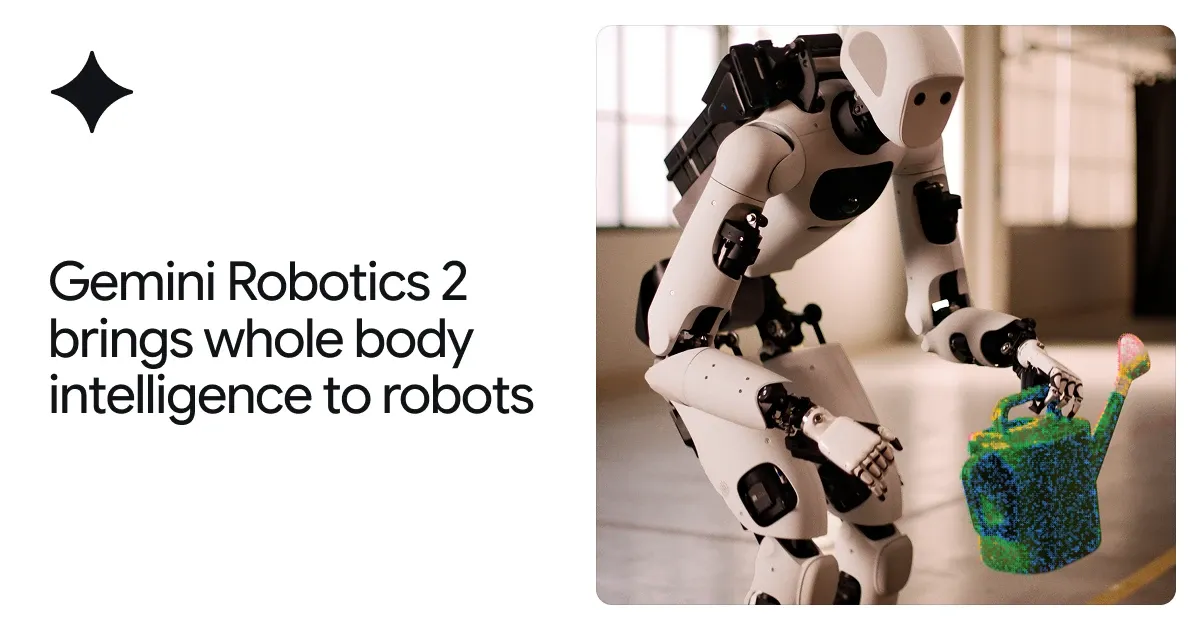
From feet to fingertips — we are teaching robots intelligent whole-body control, fine dexterity, and teamwork to complete a broad range of complex tasks.
MIT News · Artificial Intelligence· news.mit.eduOct 13, 2026
Machine-learning networks can learn without detailed instructions from a designer. Those that do may offer insight into how the brain reorganizes itself during learning.