Skip to content

Hidden Axis of Uncertainty: Latent-Posterior Alignment in Graph Neural Networks with Bayesian Output Layers

Aug 2026 · 0 citations
Computer Science

TL;DR

This work observes that predictive uncertainty decreases as latent representations shift toward lower-variance posterior directions, even though the posterior variance does not contract, and proposes Alignment-Guided Learning (AGL), which explicitly promotes this alignment during training.

Abstract

Bayesian Neural Networks (BNNs) with Bayesian output layers provide a principled and tractable framework for quantifying predictive uncertainty, yet the mechanisms shaping that uncertainty remain unclear. While conventional theory attributes uncertainty reduction to posterior contraction, the corresponding assumptions need not hold for deep models. In the Graph Neural Networks (GNNs) with Bayesian output layers studied here, we observe that predictive uncertainty decreases as latent representations shift toward lower-variance posterior directions, even though the posterior variance does not contract. We term this behavior Latent-Posterior Alignment (LPA) and conduct interventional experiments that support its functional role in shaping predictive uncertainty. Building on this insight, we propose Alignment-Guided Learning (AGL), which explicitly promotes this alignment during training. AGL effectively reduces predictive uncertainty while preserving accuracy and improves structural calibration, ensuring that the model confidence faithfully mirrors underlying data density. These findings provide a new perspective on uncertainty dynamics in GNNs with mean-field Bayesian output layers, shifting the focus from the magnitude of the posterior to the geometric interplay between latent and parameter spaces.

View source

Similar papers

#machine learning Preprint Sep 2026

Optimal Transport Dropout for Structured Predictive Uncertainty

Optimal Transport Dropout (OTD) is introduced, which offers a way to learn structured predictive uncertainty without explicit posterior inference or ensembles of independently trained predictors.

Giacomo Lorenzon, Francesco Regazzoni · 0 citations
#artificial intelligence Preprint Oct 2026

Scalable AI Uncertainty Quantification via Generalized Laplace Active Subspaces

Reliable uncertainty quantification (UQ) is essential for deploying neural networks in scientific and high-stakes applications, but full Bayesian inference over the network parameters is computationally infeasible. We propose a low-rank generalized Laplace approximation for neural-network UQ based on a small number of...

W. Edeling, P. V. Coveney · 0 citations
Preprint Sep 2026

From Good Starts to Optimal Inference: Generalized Latent Factor Models with Missingness and Implicit Regularization

A theory is developed that connects a computationally tractable nonconvex procedure directly to statistical inference for nonlinear latent factor models with exponential-family links and partially observed entries with severe missingness, weak low-rank signals, and diminishing local curvature.

Cheng-Zhu Huang, Yu-Qi Gu · 0 citations
#artificial intelligence Preprint Sep 2026

A Unified Uncertainty Representation for Graph Neural Networks via Doubly-Spectral Stochastic Expansion

A capacity theorem shows that, under a full-rank feature assumption, a restricted subfamily matches the chaos coefficients of any Gaussian-latent random graph signal, with exponentially decaying truncation error under a growth condition; the task-level claims are established empirically.

Fred Xu, Thomas Markovich, Florence Regol et al. · 0 citations
Preprint Oct 2026

When Is a Graph a Covariance? Bayesian Residual Propagation under Covariance Uncertainty

Observing a prediction error at one node can help correct predictions elsewhere, but the benefit depends on the residual dependence between nodes. A graph suggests where that dependence might occur, yet does not establish its sign or strength. We develop a Bayesian model of residual covariance to determine how revealed...

Robert Richardson · 0 citations
Preprint Sep 2026

B-GRASP: A Bayesian Framework for Inferring Graph Weights from SPDE-Inspired Dynamics

We present B-GRASP (Bayesian GRAph inference with SPDE priors), a Bayesian framework for inferring uncertain edge weights in stochastic dynamical systems on graphs from noisy observations of nodal states. The unknown edge weights parameterize the graph differential operator and therefore directly govern the evolution o...

Christina Schenk, B. Afkham · 0 citations

Related blog posts

Microsoft Research Blog Jul 13, 2026

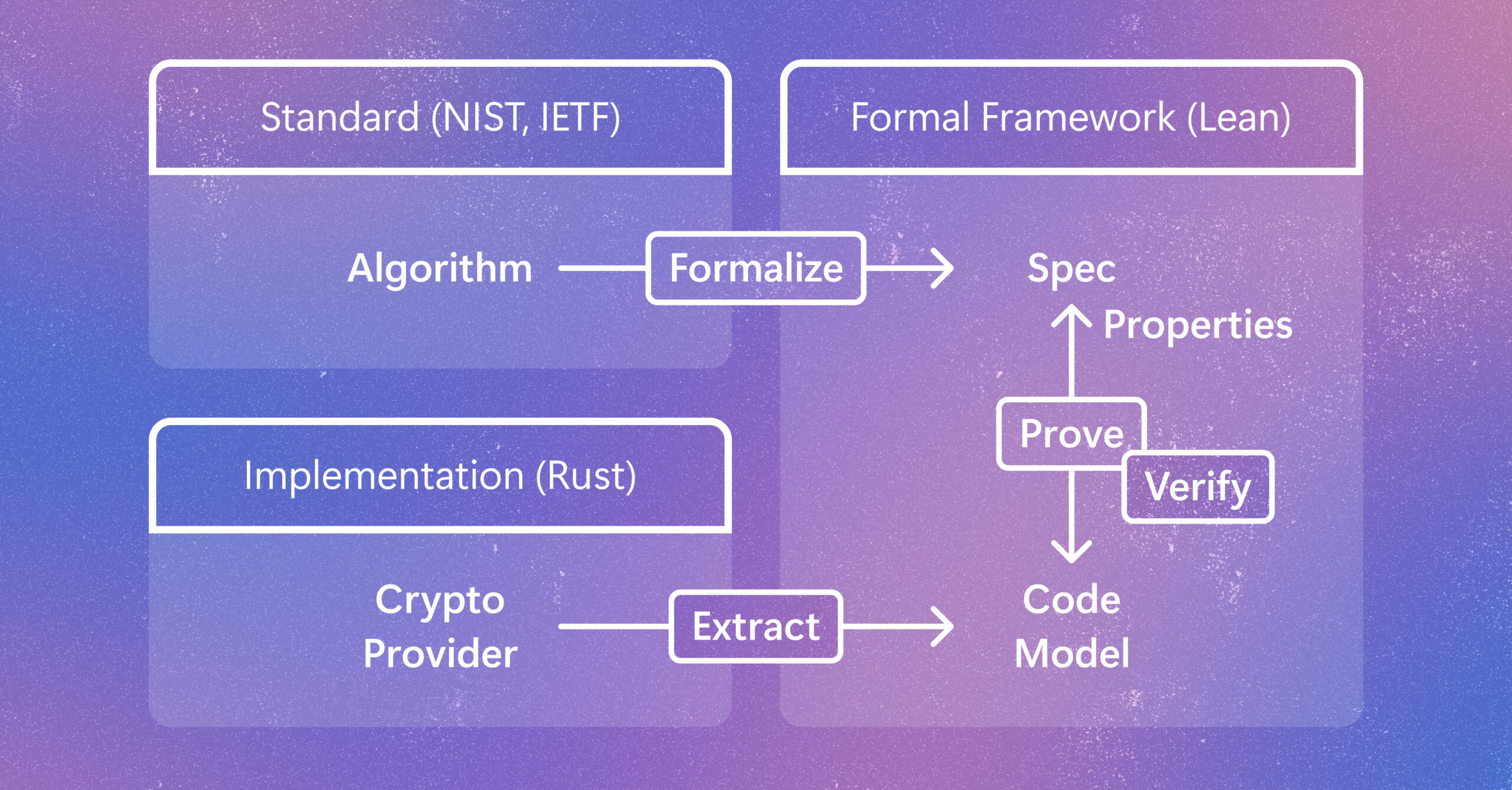
Verifying Rust cryptography in SymCrypt, from standards to code

Cryptographic code supports vital protections in modern computing systems. Learn how a new method helps verify code as developers write it while preserving speed and adaptability as it gets implemented and evolves. The post Verifying Rust cryptography in SymCrypt, from standards to code appeared first on Microsoft Research.

We use cookies to run the site and, with your consent, for analytics and to show ads. See our Cookie Policy.