Sep 2026· Proceedings of the 17th ACM Workshop on Wireless of the Students, by the Students, for the Students· pp. 8-11· 0 citations
Computer ScienceEngineering
TL;DR
The results show that learned ISAC schedulers should be evaluated using constraint-aware feasibility metrics in addition to conventional accuracy measures, and show that feasibility alone does not guarantee robustness to false data injection attacks.
Abstract
Learning-based schedulers have been proposed to provide real-time user, target, and access point (AP) association in distributed cell-free integrated sensing and communication systems. In a typical approach, a graph neural network (GNN), trained on labels from a mixed-integer linear program, maps lightweight per-AP statistics to decisions on AP clustering, user and target scheduling, and mode selection in one forward pass. Such solutions assume that hard constraints, enforced only as soft training penalties, hold at inference, and that the self-reported statistics are truthful. Using our ASSENT algorithm as an example, we find that despite high F1 scores, many solutions violate at least one hard constraint, demonstrating that high prediction accuracy does not ensure joint feasibility. Projecting the GNN output onto a feasible solution restores constraint satisfaction with low utility loss, even with a simple greedy repair procedure. We further show that feasibility alone does not guarantee robustness to false data injection attacks. A single malicious AP that reports false information cannot substantially increase its user associations, but can greatly increase the rate of infeasible solutions. The effect of such attacks depends on the type of information being falsified. Misreporting information that affects the objective can largely be mitigated through feasibility projection, whereas falsifying information that affects the constraints cannot. The latter can, however, be detected using a low-complexity cross-AP consistency check. These results show that learned ISAC schedulers should be evaluated using constraint-aware feasibility metrics in addition to conventional accuracy measures.

This paper establishes a model-based upper bound for CCMDPs with fixed bounded successor support and access to a certified planning oracle, and gives a model-free variance-reduced policy-gradient algorithm with a finite-sample expected KKT-residual guarantee and independent validation of every accepted policy.
This work designs a learning-centric algorithmic framework which employs bandit learning to address the intractability and manage draft length selection in the first subproblem and applies online learning to address the online uncertainty and manage battery states and grid-energy use in the second subproblem, both with...
Heng-Di Wang, Lei Jiao, Kong-Lin Zhu et al.· Proceedings of the Internati...· 0 citations
DU-SCA is proposed, a fixed-depth unfolding of nested proximal Successive Convex Approximation that replaces online Armijo searches and static schedules with learned layer-wise updates while preserving the optimization structure and is placed as a practical structured solution for feasible low-latency ISAC precoding.
Rafael Marasca Martins, B. F. Costa, L. Mathias et al.· IEEE Transactions on Wireles...· 1 citation
A training-free Rank-Based Softmax Ensemble that fuses pre-trained Deep Q-Network and Proximal Policy Optimization agents at inference time for adaptive anti-jamming transmission and provides a rigorous comparative study of all three methods.
T. Mengistu, Avilia Kusumaputeri Nugroho, Taewoon Kim· International Conference on...· 0 citations
MAADBench is presented, the first refreshable MAS AD benchmark designed for diverse, evolving LLM backbones underlying the agents, and automated provision of cost-free, deterministic step-level labels for fine-grained AD evaluation.
Lei Ma, Dennis M. Hofmann, Hao-Wen Xu et al.· 0 citations
Results show that MLP-TPC validates the deployability of the ONNX inference pipeline inside the O-DU scheduler, while CQL-TPC improves power-headroom efficiency by 1.6-3.8 dB without significant throughput or BLER loss.
Hsin-Ya Chen, Jui-Tang Wang· International Conference on...· 0 citations
Related blog posts
MIT News · Artificial Intelligence· news.mit.eduOct 13, 2026
Machine-learning networks can learn without detailed instructions from a designer. Those that do may offer insight into how the brain reorganizes itself during learning.
Microsoft Research Blog· microsoft.comJul 13, 2026
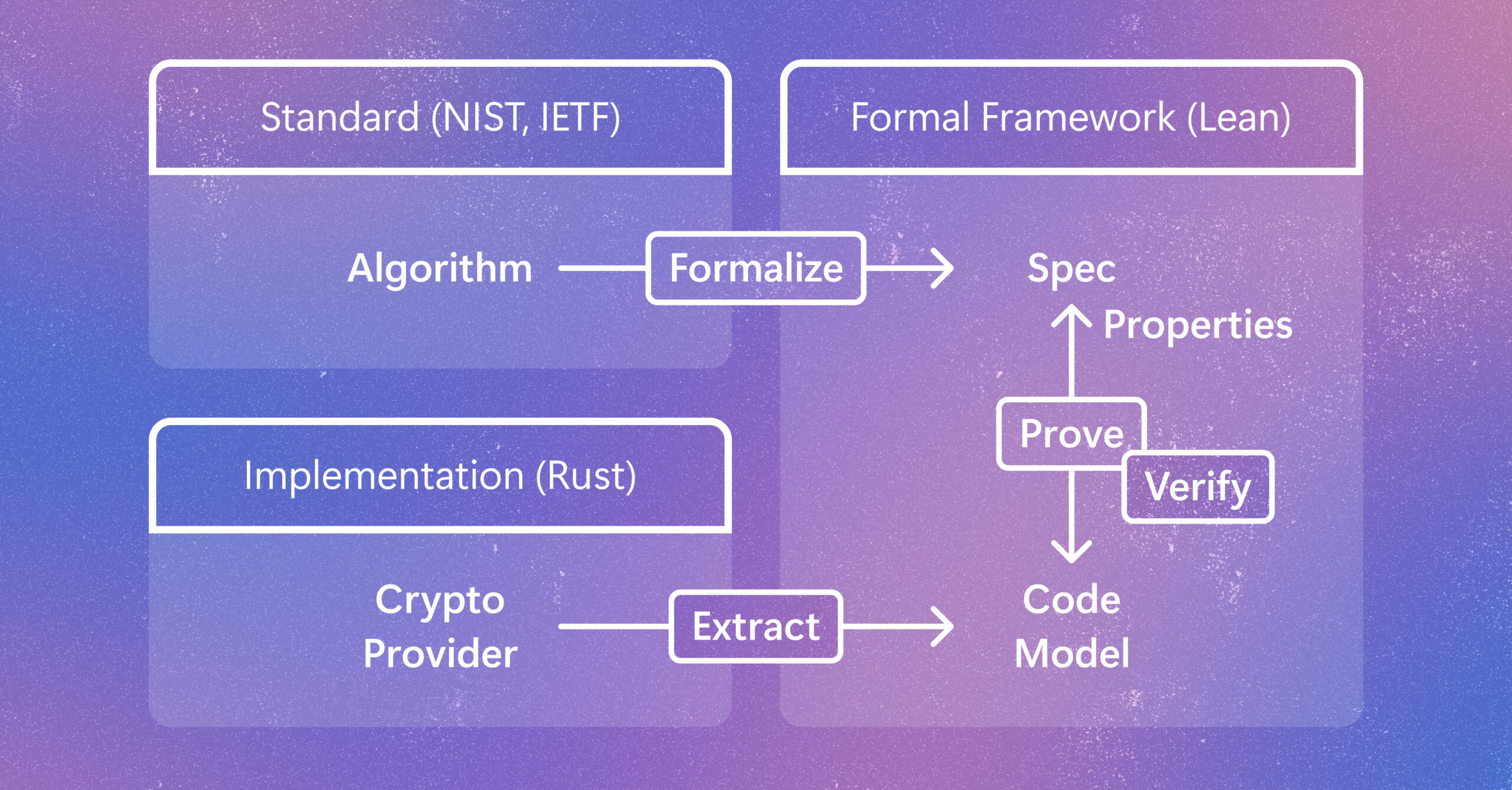
Cryptographic code supports vital protections in modern computing systems. Learn how a new method helps verify code as developers write it while preserving speed and adaptability as it gets implemented and evolves. The post Verifying Rust cryptography in SymCrypt, from standards to code appeared first on Microsoft Research.