LARK (Latent-Aligned Reasoning frameworK), a two-stage latent reasoning framework with complementary alignment mechanisms within a single VLM, achieves state-of-the-art performance across multiple recommendation architectures, with controlled ablations confirming the distinct contribution of each component.
Abstract
Multimodal Vision-Language Models (VLMs) have demonstrated remarkable capabilities in cross-modal understanding, yet a fundamental challenge persists when applying them to recommendation: as representations propagate through multi-step reasoning, both visual and textual signals progressively attenuate - a phenomenon we term cross-modal dilution. To address this, we propose LARK (Latent-Aligned Reasoning frameworK), a two-stage latent reasoning framework with complementary alignment mechanisms within a single VLM. In the first stage, learnable latent tokens are interleaved with multi-step chain-of-thought (CoT) reasoning and explicitly aligned with a frozen vision encoder, serving as visual checkpoints that preserve perceptual details throughout the reasoning chain. In the second stage, the latent representations are projected via a bridge MLP and trained with item-to-item contrastive learning; to prevent the reasoning semantics from fading, intermediate features are aligned with the CoT hidden states from the first stage, anchoring the final embeddings to the model's own reasoning output. Experiments on three public benchmarks and one industrial dataset show that LARK achieves state-of-the-art performance across multiple recommendation architectures, with controlled ablations confirming the distinct contribution of each component.

Unified Latent Diffusion Reasoner improves multimodal reasoning by weaving it into a single thread, where the model predicts successive thoughts in a common representation space.
Latent-OPD is proposed, which augments OPD with trajectory-level latent distillation and introduces a progressive teacher-lookahead strategy, which aligns middle-to-late student layers with increasingly deeper teacher layers, establishing Latent-OPD as a highly effective approach to frame-efficient video reasoning.
Aoni Shen, Yongheng Zhang, Ying-Hui Li et al.· 1 citation
GLaQ, a grounded latent-query framework that replaces sequential latent rollout with a fixed set of context-conditioned queries grounded in the original visual tokens, is introduced, suggesting that direct query-to-image grounding can recover localized evidence from the full image without external visual operations or...
Ze-Sheng Yang, Lingling Zhang, Xinyu Zhang et al.· 1 citation
Latent reasoning has advanced multimodal reasoning through a two-stage training paradigm: (1) a helper image is encoded into latent tokens to teach visual chain-of-thought during a supervised fine-tuning (SFT) stage, and (2) these latent tokens are further refined with reward feedback during a reinforcement learning (R...
Haoqiang Kang, Yin-Ping Chen, Lu-Yang Liu et al.· 2 citations
Explicit textual Chain-of-Thought (CoT) has improved the reasoning ability of large audio language models (LALMs). However, textual CoTs are often constructed from text captions of audio and provide limited access to the acoustic evidence, which can introduce problems like hallucination. To address this modality-gap is...
Dong-Hang Wu, Hao-Yang Zhang, Yizhou Peng et al.· 0 citations
Large Vision-Language Models (LVLMs) have shown strong promise for multimodal reasoning, yet often struggle with tasks requiring concepts beyond what is directly observable in the input image. Existing methods generate intermediate images or latent visual tokens to guide reasoning, but these representations can introdu...
Wen-Han Yang, Nilay Naharas, Ali Payani et al.· 0 citations
A new machine-learning framework aims to improve the success rate of computational protein design while moving away from results that reproduce sequences found in nature.
Microsoft Research Blog· microsoft.comAug 11, 2026
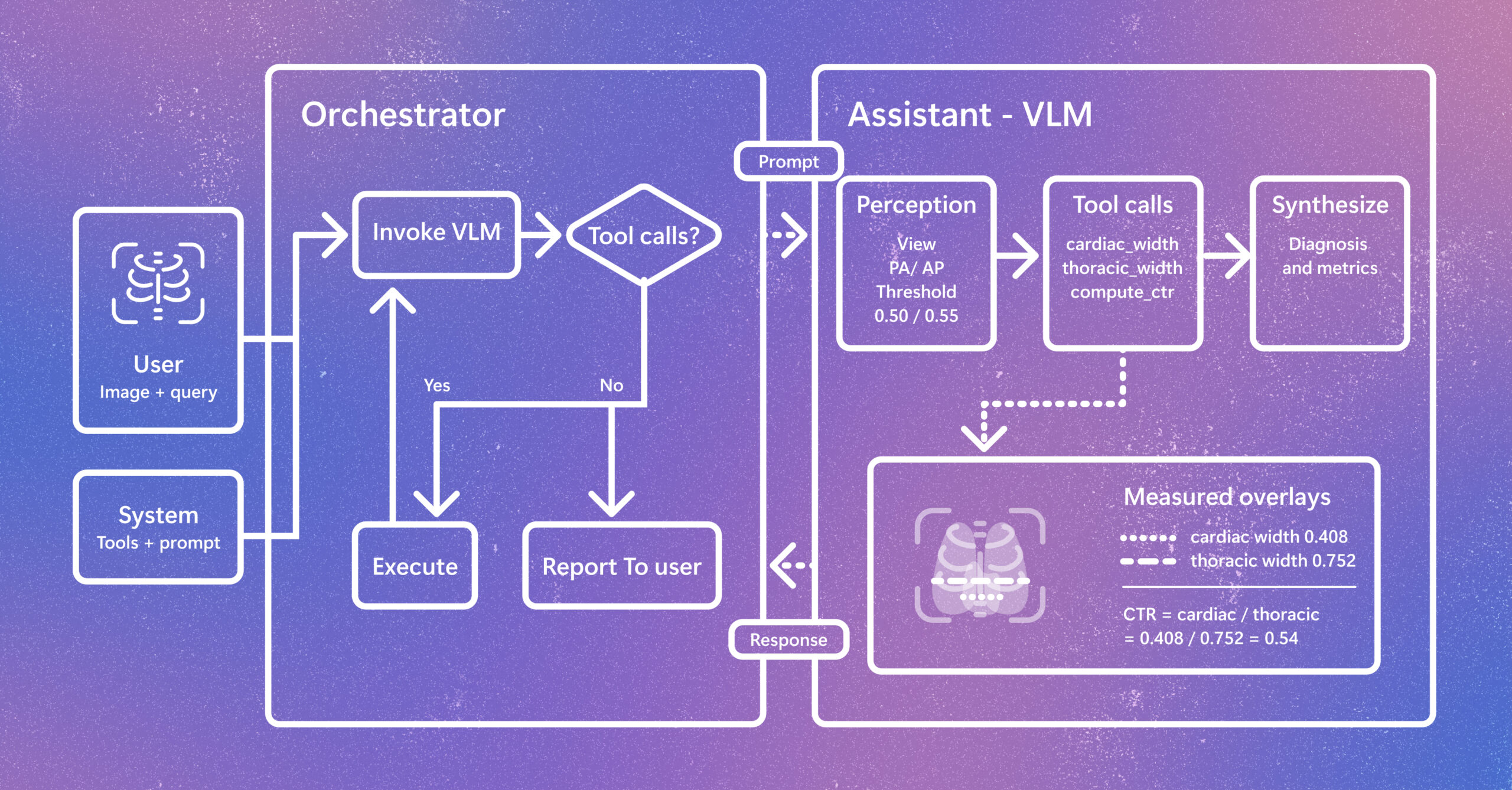
Radiology AI is evolving beyond report generation. CARE-X explores a unified approach that combines flexible reasoning, calibrated predictions, and measurement-based tools for chest X-ray interpretation. The post Introducing CARE-X: Towards Clinically Useful Radiology VLMs with Auxiliary Supervision, Reward-Aligned Learning, and Tool-Augmented Measurement appeared first on Microsoft Research.