The future of smart stadiums lies in highly connected, intricate systems that must respond instantly and maintain smooth operations. When it comes to handling the operational complexity of such dynamic infrastructures, traditional maintenance strategies — whether time-based or reactive — are rapidly falling short. A game-changing method for predictive maintenance is now available through the combination of Digital Twin (DT) technology, artificial intelligence (AI), and 6G connectivity. This research presents the Standardized Predictive AI-Driven Digital Twin Architecture for 6G Smart Stadiums (SPADTA-6G), introducing a new framework. Our goal is to provide a solution that can scale, operate in real-time, and communicate with other systems by leveraging 6G capabilities and standardized AI models for intelligent failure prediction and maintenance scheduling. SPADTA-6G integrates a federated AI learning model, semantic middleware for standardised integration, and a 6G-enabled telemetry layer for ultra-low-latency communication into a multi-layered DT ecosystem. By using attention mechanisms and transformer-based RUL estimation techniques, it enables real-time data interchange and prediction execution. To ensure data governance and interoperability, the framework adheres to developing standards, including the IEEE P7000 series, ISO/IEC TR 24030, and OPC UA. In a virtual stadium setting, the findings indicate that there is less unscheduled equipment downtime, improved prediction accuracy with a low mean RUL error, enhanced latency with reaction times of sub-10 ms using 6G URLLC and mobile edge computing (MEC), and increased scheduling efficiency in maintenance operations. SPADTA-6G provides a foundation for predictive maintenance in 6G-enabled smart venues, ensuring performance, robustness, and compliance with standards. It paves the way for the universal adoption of auto-maintenance systems for smart city infrastructures based on digital twins. This paper presents SPADTA-6G, a standardized predictive AI-driven digital twin architecture for 6G smart stadiums, which achieves up to a 32% reduction in edge energy consumption, a 27%improvement in predictive maintenance accuracy, and a 40% lower false positive rate compared to baseline models. Empirical measurements across heterogeneous stadium assets indicate that median inference latency remains at 7-9 ms, with a 95th-percentile latency of under 10 ms, even under peak operational loads.

Vehicle maintenance is transitioning from time-based and reactive repair toward continuous, evidence-based fleet health management. This transition is enabled by the convergence of onboard diagnostics, Internet of Things (IoT) telemetry, artificial intelligence (AI), and digital twins. This paper presents a practical r...
Ekerete Usak· International journal of res...· 0 citations
In Industrial Internet of Things systems, learning-enabled Digital Twins (DTs) support remote monitoring by using data reported by distributed devices to maintain digital representations of physical processes. When uplink resources are limited, a base station cannot collect new observations from every device at every c...
An Artificial Intelligence (AI) centric network management framework that combines 5G radio access and core capabilities, Software-Defined Networking (SDN) for centralized and programmable control and Multi-access Edge Computing (MEC) for localized and low latency processing is introduced.
Praveen Kumar, S. Hashmi, Preeti Singhwal et al.· International journal of com...· 0 citations
Future 6G networks are expected to operate as intelligent and autonomous ecosystems where monitoring, prediction, and control are integrated into continuous self-optimization loops. However, many digital-twin-based network management approaches still act mainly as synchronized replicas of the network. They observe the...
J. Sengendo, Andreas Kassler, Fabrizio Granelli· 0 citations
Digital twin (DT) technology combined with artificial intelligence (AI) is becoming a key enabler for resilient and self-optimising electrical power networks that are increasingly digitalised. A digital twin is a continuously updated virtual representation of a physical grid asset or network that uses real-time sensor,...
Jennifer Ikeoluwa Ade-moomiyo, M. Oladosu, M. Abah et al.· International Journal of Inn...· 0 citations
HAMA demonstrates that tiered deployment, real online adaptation, multi-node aggregation, and locally hosted explainability can be integrated into one measured, reproducible system without sacrificing detection quality - an architectural contribution whose statistics and resource footprints are all regenerated from rel...
Rebin Saleh, K. Dinh, Balázs Villányi et al.· IEEE Access· 0 citations
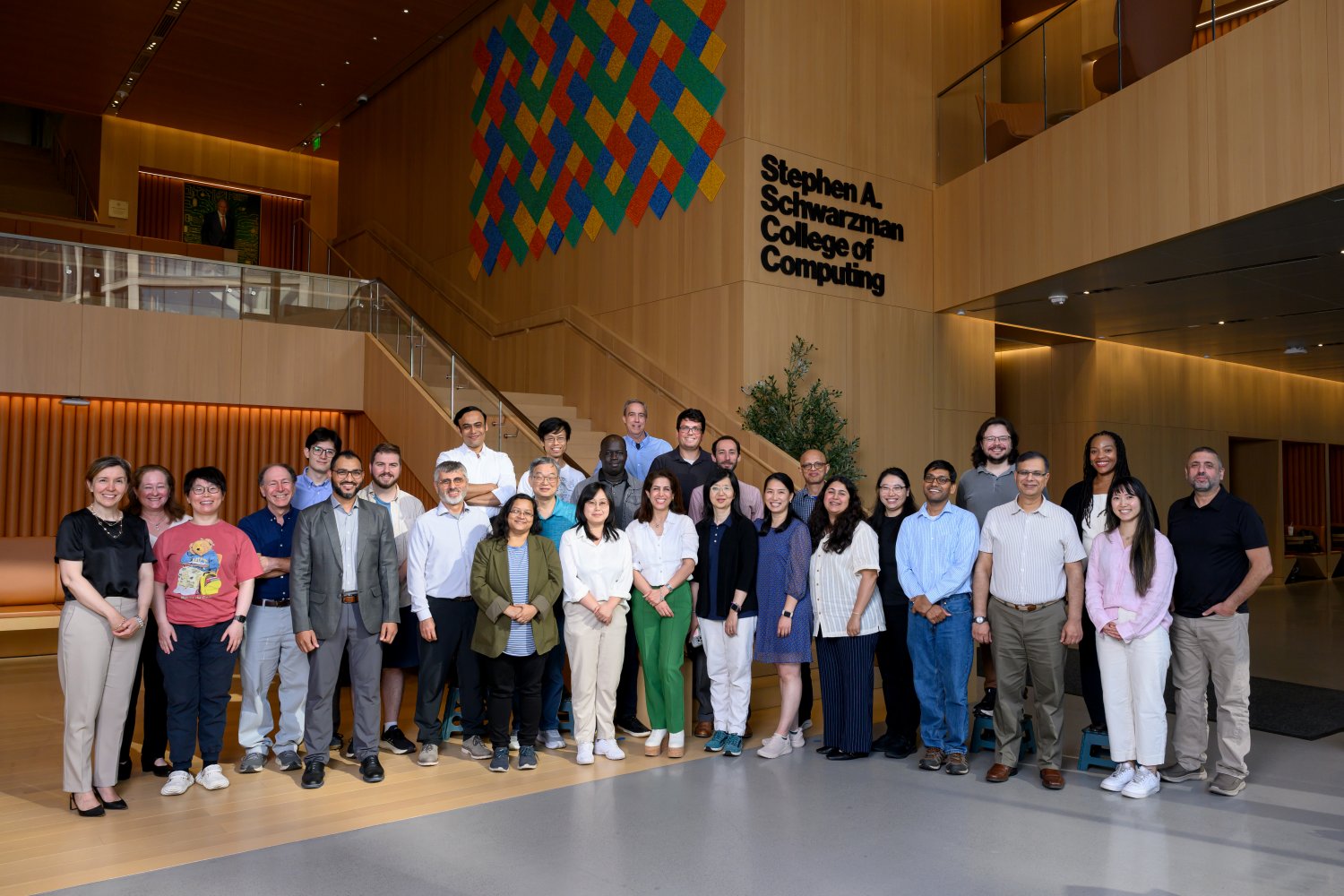
A weeklong summer workshop brought higher education faculty to campus to explore how AI and machine learning materials can be adapted for their classrooms.
MIT News · Artificial Intelligence· news.mit.eduAug 27, 2026
A new machine-learning framework aims to improve the success rate of computational protein design while moving away from results that reproduce sequences found in nature.
We use cookies to run the site and, with your consent, for analytics and to show ads.
See our Cookie Policy.