This paper proposes conditioned initialization, a principled scheme that initializes attention weights to improve the spectral properties of the attention layer and shows that conditioned initialization can potentially reduce the condition number of the attention Jacobian, leading to more stable optimization.
Abstract
Transformers are a dominant architecture in modern machine learning, powering applications across vision, language, and beyond. At the core of their success lies the attention layer, where the query, key, and value matrices determine how token dependencies are captured. While considerable work has focused on scaling and optimizing Transformers, comparatively little attention has been paid to how the weights of the queries, keys and values are initialized. Common practice relies on random initialization or alternatives such as mimetic initialization, which imitates weight patterns from converged models, and weight selection, which transfers weights from a teacher model. In this paper, we argue that initialization can introduce an optimization bias that fundamentally shapes training dynamics. We propose conditioned initialization, a principled scheme that initializes attention weights to improve the spectral properties of the attention layer. Theoretically, we show that conditioned initialization can potentially reduce the condition number of the attention Jacobian, leading to more stable optimization. Empirically, it accelerates convergence and improves generalization across diverse applications, highlighting conditioning as a critical yet underexplored area for advancing Transformer performance. Importantly, conditioned initialization is simple to apply and integrates seamlessly into a wide range of Transformer architectures.
Most post-training quantization pipelines fit each weight matrix to its pretrained counterpart, one matrix at a time. Whether that proxy tracks what an attention block actually computes, or how errors in the Q, K and V projections compound inside the softmax, is rarely checked. We write the objective on the attention o...
Nafiseh HosseinpourFardi, Negar Alihadi, Mahmoudreza Babaei et al.· 0 citations
Designing expressive sequence layers with efficient inference remains a central challenge in modern machine learning. Standard softmax attention achieves excellent sequence modeling performance through rich nonlinear token interactions, but it requires a key-value cache that grows linearly with sequence length, limitin...
Hyun Dong Lee, X. Gonzalez, Nicolas Zucchet et al.· 0 citations
How expressive is prompting a transformer? Answering this question is important for separating the roles of prompting, architecture, and pretraining in transformer models, and for determining whether task-specific behavior must be stored in model weights or can instead be induced at inference time through the prompt. W...
Universal approximation is a necessary qualitative property of learning architectures to benefit from scaling laws. While it is generically verified on a variety of neural architectures and random feature models, it typically involves infinite width limits. In this work, we focus on deep self-attention models and consi...
Steering large language models typically relies on linear, context-independent interventions in activation space, an assumption that recent work has challenged and that can induce an information bottleneck when a fixed representation must encode many behavioral distinctions. We introduce MetaSteer, a method that learns...
The projection of queries and keys are central to the attention mechanism in Transformer architectures. While they are mathematically symmetric, they play different roles in attention mechanisms. The question of whether there is an effect from their functional distinction on their geometric development in training rema...
Vidit Gupta, Siddhesh Nadkarni, Mihik Chaudhari et al.· 0 citations
Exploring how generative AI could make machine vision more accessible to businesses. The post GenEye in a Box: Making Machine Vision Something You Can Just Ask For appeared first on GPT-Lab.
Microsoft Research Blog· microsoft.comAug 11, 2026
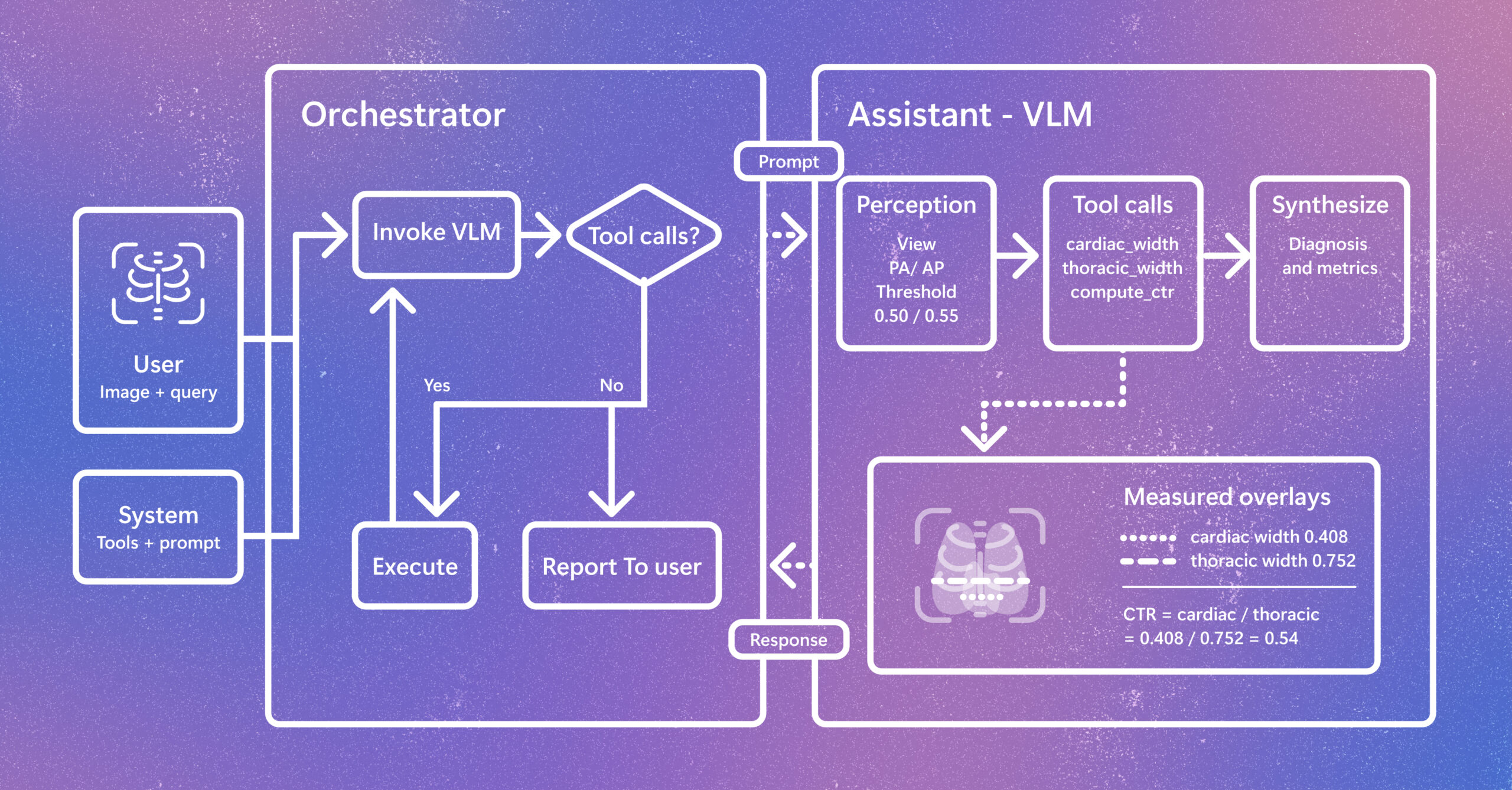
Radiology AI is evolving beyond report generation. CARE-X explores a unified approach that combines flexible reasoning, calibrated predictions, and measurement-based tools for chest X-ray interpretation. The post Introducing CARE-X: Towards Clinically Useful Radiology VLMs with Auxiliary Supervision, Reward-Aligned Learning, and Tool-Augmented Measurement appeared first on Microsoft Research.
Students in MIT’s Concourse program delve deeply into the human condition, debate challenging questions, and learn to develop judgment about issues that can’t be quantified.
We use cookies to run the site and, with your consent, for analytics and to show ads.
See our Cookie Policy.