We study state tomography when each measurement acts on at most $k$ fresh copies and no quantum memory is retained between blocks. We prove a lower bound matching the upper bound in [arXiv:2510.07788]. Thus the copy complexity of estimating an arbitrary $d$-dimensional state to trace distance $\epsilon$ is, up to absolute constant factors, $\max\{d^3/(\sqrt{k}\epsilon^2),d^2/\epsilon^2\}$ for every $k$ and all sufficiently small $\epsilon$. This removes the earlier restriction that $k$ be small as a function of the accuracy. The lower bound applies to arbitrary measurements within each block and adaptive choices between blocks. The lower bound already applies in a small neighborhood of any state whose smallest eigenvalue is of order $1/d$, even when the center is known. The main ingredient is a uniform Fisher information bound for one measurement block that depends only on the smallest eigenvalue of the state. The proof avoids the perturbative expansion responsible for the restriction in [arXiv:2402.16353]. Fano's inequality for metric balls and a log-Sobolev comparison between mutual and Fisher information then reduce the adaptive protocol to this block bound [arXiv:1607.00550, arXiv:1902.08582].
We prove that learning an unknown mixed fermionic Gaussian state on $m$ modes to trace distance $\epsilon$ requires $\Omega(m^3/\epsilon^2)$ copies when measurements act on one copy at a time, even with arbitrary POVMs, fresh ancillas and classical adaptivity, but without quantum memory between copies. The bound holds...
We determine the optimal sample complexity of low-rank quantum state tomography when each measurement may act jointly on at most $t$ samples. For sufficiently small $\varepsilon$, estimating an unknown state on $\mathbb{C}^d$ of rank at most $r$ to trace norm error $\varepsilon$ with constant success probability requir...
This work gives the first near optimal algorithm for learning $n$-qubit $k$-sparse pure quantum states, obtaining fidelity at least $1-\varepsilon$ with high probability using $\tilde{O}(k/\varepsilon)$ copies of the state and $\tilde{O}(kn/\varepsilon)$ time.
How many past requests are needed to decide which qubits should share entanglement? We show that the answer depends on the allocation choices created by the queries: a larger memory can require no more data. The memory stores a classical bit and answers requests through a fixed detector that preserves coherence within...
Shadow Tomography is a fundamental problem in quantum information theory. Given multiple copies of an unknown $d$-dimensional quantum state $\rho$ and a known collection of observables $E_1,\ldots,E_M$, the goal is to estimate all expectation values $\{\text{Tr}(\rho E_i)\}_{i=1}^M$ to additive accuracy $\varepsilon$ w...
F. G. Jeronimo, Qi-Zhao Huang, Le Liu· 2 citations
We study tomography for quantum channels with input dimension $d_1$, output dimension $d_2$, and Kraus rank at most $r$, to within diamond norm error $\varepsilon$, using adaptive experiments that retain no quantum memory between channel queries. - For quantum channels whose non-zero Choi eigenvalues are bounded below...
Ke-An Chen, Aadil Oufkir· 0 citations
Related blog posts
MIT News · Artificial Intelligence· news.mit.eduOct 2, 2026
A weeklong summer workshop brought higher education faculty to campus to explore how AI and machine learning materials can be adapted for their classrooms.
MIT News · Artificial Intelligence· news.mit.eduAug 27, 2026
A new machine-learning framework aims to improve the success rate of computational protein design while moving away from results that reproduce sequences found in nature.
Microsoft Research Blog· microsoft.comAug 20, 2026
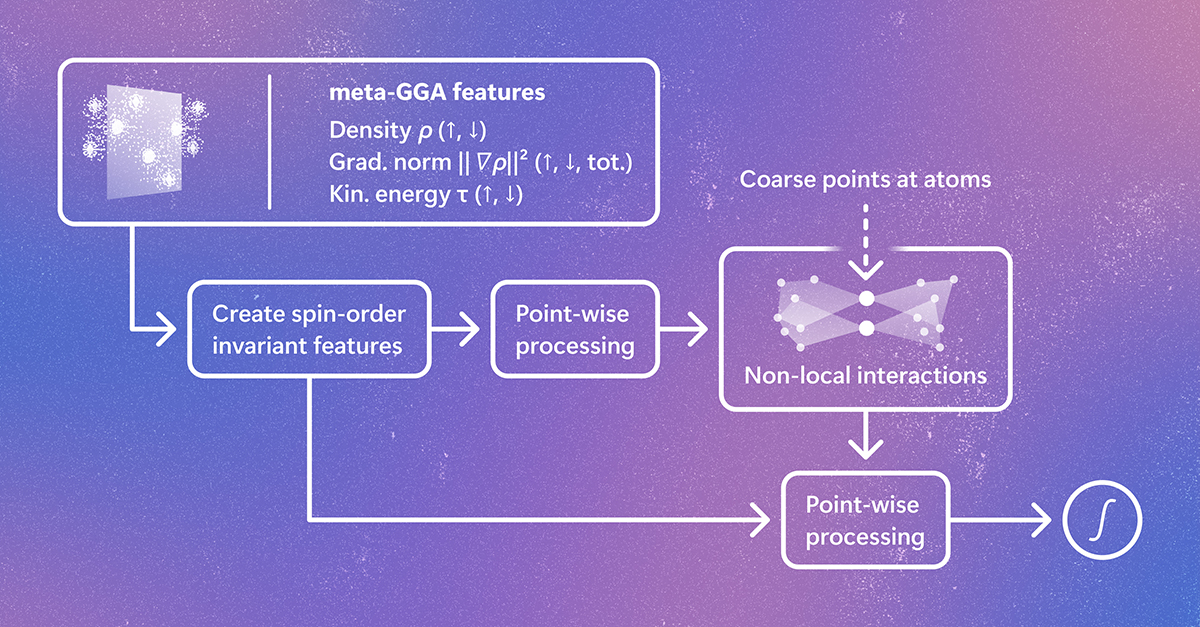
Skala 1.1, the updated deep-learning exchange-correlation functional from Microsoft Research, provides greater accuracy, expanded accessibility across the computational chemistry ecosystem, and a living benchmark to track computational performance. The post Broadening access to Skala creates a faster path to predictive DFT appeared first on Microsoft Research.
We use cookies to run the site and, with your consent, for analytics and to show ads.
See our Cookie Policy.