Skip to content

Discriminative Span as a Predictor of Synthetic Data Utility via Classifier Reconstruction

May 2026 · arXiv.org · Vol abs/2605.09697 · 0 citations · 18 references
Computer Science

TL;DR

This work proposes a geometry-driven metric that predicts the utility of synthetic data without requiring model training and shows that this metric exhibits strong correlation with downstream classification performance of CNNs trained on mixtures of real negative and synthetic positive data.

Abstract

In many real-world computer vision applications, including medical imaging and industrial inspection, binary classification tasks are characterized by a severe scarcity of positive samples. A widely adopted solution is to generate synthetic positive data using image-to-image transformations applied to negative samples. However, a fundamental challenge remains: how can we reliably assess whether such synthetic data will improve downstream model performance? In this work, we propose a geometry-driven metric that predicts the utility of synthetic data without requiring model training. Our approach operates in the embedding space of a pre-trained foundation model and represents the dataset through difference vectors between samples. We evaluate whether the weight vector of a linear classifier can be expressed within the subspace spanned by these variations by measuring the relative projection error. Intuitively, if the variations induced by synthetic data capture task-relevant directions, their span can approximate the classifier, resulting in low projection error. Conversely, poor synthetic data fails to span these directions, leading to higher error. Across multiple datasets and architectures, we show that this metric exhibits strong correlation with downstream classification performance of CNNs trained on mixtures of real negative and synthetic positive data. These findings suggest that the proposed metric serves as a practical and informative tool for evaluating synthetic data quality in data-scarce settings.


View source

Similar papers

Conference Sep 2026

Impact of Advanced Data Augmentation and Synthetic Samples on Model Generalization in Small- Scale Computer Vision Tasks

In many specialized computer vision applications, such as smart wearable sensor monitoring and industrial quality control, acquiring large-scale labeled datasets is often prohibitive due to privacy concerns, operational costs, and the rarity of target events. Consequently, convolutional neural networks (CNNs) trained o...

B. Potapov, P. D. Cherniaeva, I. Panfilov · 0 citations
Preprint Sep 2026

Learning Continuous Source Responses For Generalizable AI-Generated Image Detection

Advances in image generation have made synthetic images increasingly difficult to distinguish from real photographs, raising concerns about the trustworthiness of visual media. Existing AI-generated image detectors often perform well on in-domain data, but their robustness and cross-generator generalization remain limi...

Man-Ni Cui, Rui-Qi Liu, Zi-Jian Yu et al. · 0 citations
Preprint Sep 2026

Representation Risk in Pretrained Image Encoders

This paper compares ten modern and legacy frozen encoders across applications involving house prices, racehorse performance, breast-cancer histology, chest radiographs, continuous facial age, and rice disease, and implements a simple workflow to benchmark plausible representations, select on locked validation data, com...

Ardyn Nordstrom, Morgan Nordstrom, Vamuyan Sesay et al. · 0 citations
Conference Sep 2026

Influence of Image Quantization on the Sim-to-Real Gap of Synthetically Trained Deep Learning Models

For domains where data is scarce, costly, or privacy-sensitive, synthetic data generation offers a reasonable alternative as a basis for the training of deep learning models. Yet, a persistent challenge arises from the sim-to-real gap, which can deteriorate a synthetically trained model's performance when applied to re...

Alexander Moriz, M. Huber, Robert H. Schmitt · 0 citations
#artificial intelligence Preprint Sep 2026

REALIS: A Curated Dataset for Studying the Challenges of AI Image Detection

REALIS provides a unified framework for measuring and improving the reliability of AI-image detectors under conditions that better reflect real-world use, and proposes a robustness protocol covering 35 transformations at five severity levels to analyze detector behavior under image processing.

A. Gushchin, Khaled Abud, G. Bychkov et al. · 0 citations
Preprint Oct 2026

Beyond Training from Scratch: Foundation Models for Data-Efficient and Generalizable Cardiac MRI Reconstruction

Cardiac magnetic resonance imaging reconstruction aims to recover high-quality images from undersampled acquisitions, enabling faster scans while preserving diagnostic fidelity. Recent reconstruction methods are typically trained from scratch and often require large amounts of task-specific data, limiting their robustn...

Anam Hashmi, Mayug Maniparambil, Julia Dietlmeier et al. · 0 citations

Related blog posts

MIT News · Artificial Intelligence Oct 28, 2026

Making machines that can listen

Professor Paris Smaragdis develops computers with superhuman hearing for applications like speech recognition, music understanding, and environmental monitoring.

Microsoft Research Blog Aug 11, 2026

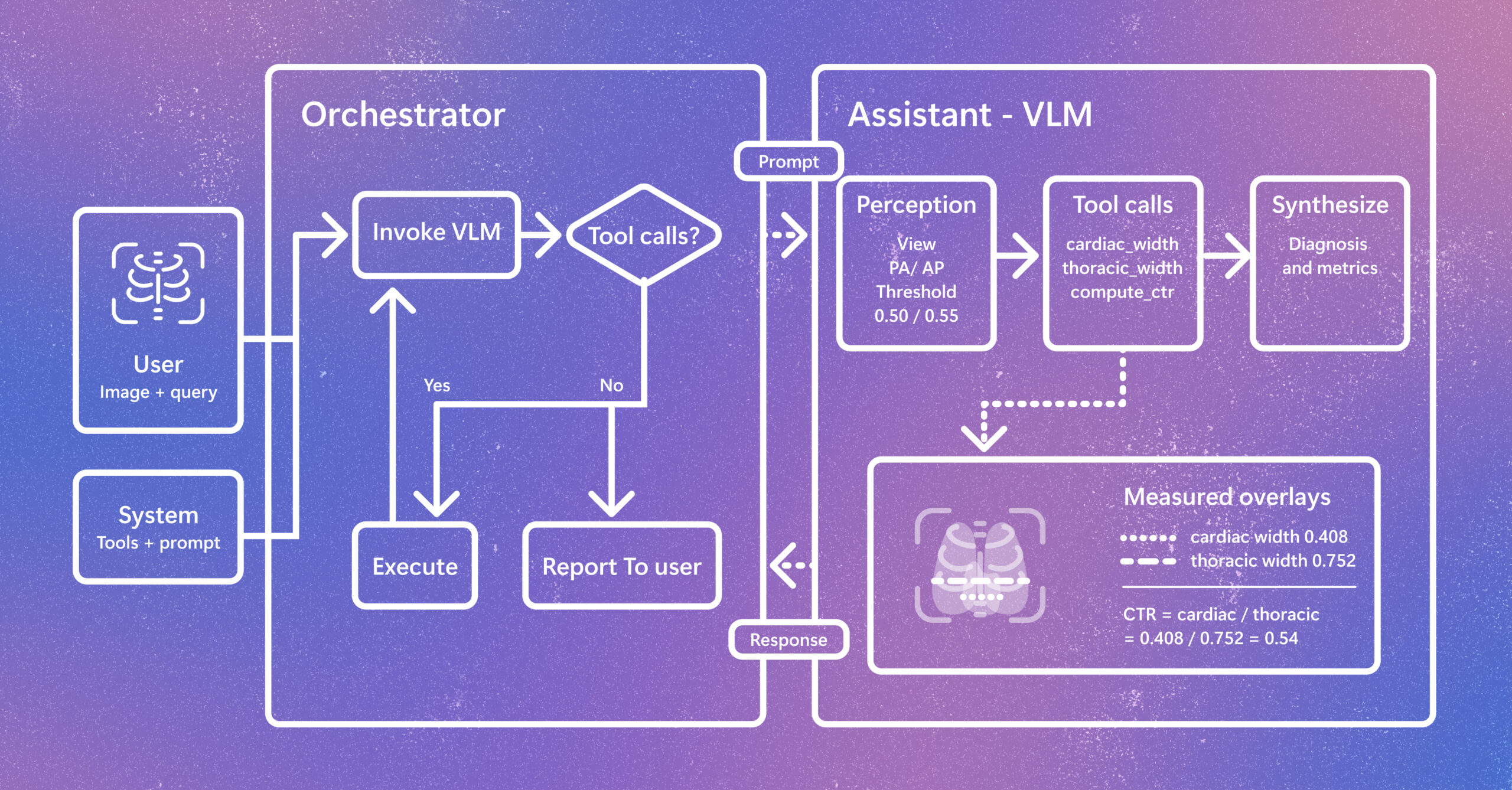
Introducing CARE-X: Towards Clinically Useful Radiology VLMs with Auxiliary Supervision, Reward-Aligned Learning, and Tool-Augmented Measurement

Radiology AI is evolving beyond report generation. CARE-X explores a unified approach that combines flexible reasoning, calibrated predictions, and measurement-based tools for chest X-ray interpretation. The post Introducing CARE-X: Towards Clinically Useful Radiology VLMs with Auxiliary Supervision, Reward-Aligned Learning, and Tool-Augmented Measurement appeared first on Microsoft Research.

We use cookies to run the site and, with your consent, for analytics and to show ads. See our Cookie Policy.