Skip to content

A Controlled Comparison of Manual and Teleoperated Intraocular Instrument Motion for an Input Device

Sep 2026 · 0 citations · 43 references
Computer Science

TL;DR

Manual and teleoperated intraocular instrument motion was compared with the trocar constraint, the instrument, the eye model and the tracking source common to both conditions, so that the control interface was the only factor varied.

Abstract

Input devices for robotic microsurgery are frequently described as preserving the surgeon's trained technique, but the claim is rarely measured. We compared manual and teleoperated intraocular instrument motion with the trocar constraint, the instrument, the eye model and the tracking source common to both conditions, so that the control interface was the only factor varied. Prior comparisons cannot hold the instrument fixed, because a robotic instrument is not the tool used manually. Sixteen participants performed a navigation task on a commercial ophthalmic simulator by hand and through a three-degree-of-freedom input device commanding a five-joint robot. Task outcome was equal but at ceiling: every participant acquired all five targets under both interfaces with no retinal or lens injury. Execution differed on every measure. Teleoperated trials took three times as long at a quarter of the median speed, covered less than half the angular working range, and were broken into 3.5 times as many separate movements. Completion time and movement fragmentation improved substantially across four trials of practice and had not plateaued; the measures set by the configured rate ceiling and joint limit changed the least. Finger activity doubled and pinch variability tripled, so reducing instrument degrees of freedom redistributed manual effort rather than reducing it. The interface preserves the outcome and reshapes the execution.

View source

Similar papers

#artificial intelligence Conference Open access Jun 2018

Gibson Env: Real-World Perception for Embodied Agents

This paper investigates developing real-world perception for active agents, proposes Gibson Environment for this purpose, and showcases a set of perceptual tasks learned therein.

F. Xia, Amir Zamir, Zhi-Yang He et al. · 1,069 citations · ⚡112
#computer vision Review Sep 2017

Agile Software Development Methods: Review and Analysis

This publication proposes a definition and a classification of agile software development approaches and analyses ten software development methods that can be characterized as being "agile" against the defined criterion.

P. Abrahamsson, O. Salo, Jussi Ronkainen et al. · 727 citations · ⚡54
#computer vision Jun 2008

The impact of agile practices on communication in software development

The study shows that agile practices improve both informal and formal communication, but indicates that, in larger development situations involving multiple external stakeholders, a mismatch of adequate communication mechanisms can sometimes even hinder the communication.

M. Pikkarainen, Jukka Haikara, O. Salo et al. · 401 citations · ⚡48
#machine learning Review Open access Oct 2014

Software development in startup companies: A systematic mapping study

The results indicate that software engineering work practices are chosen opportunistically, adapted and configured to provide value under the constrains imposed by the startup context.

Nicolò Paternoster, Carmine Giardino, M. Unterkalmsteiner et al. · 394 citations · ⚡54

Related blog posts

Microsoft Research Blog Nov 5, 2026

Formally verifying agent-written full-stack web apps with PDD Kit

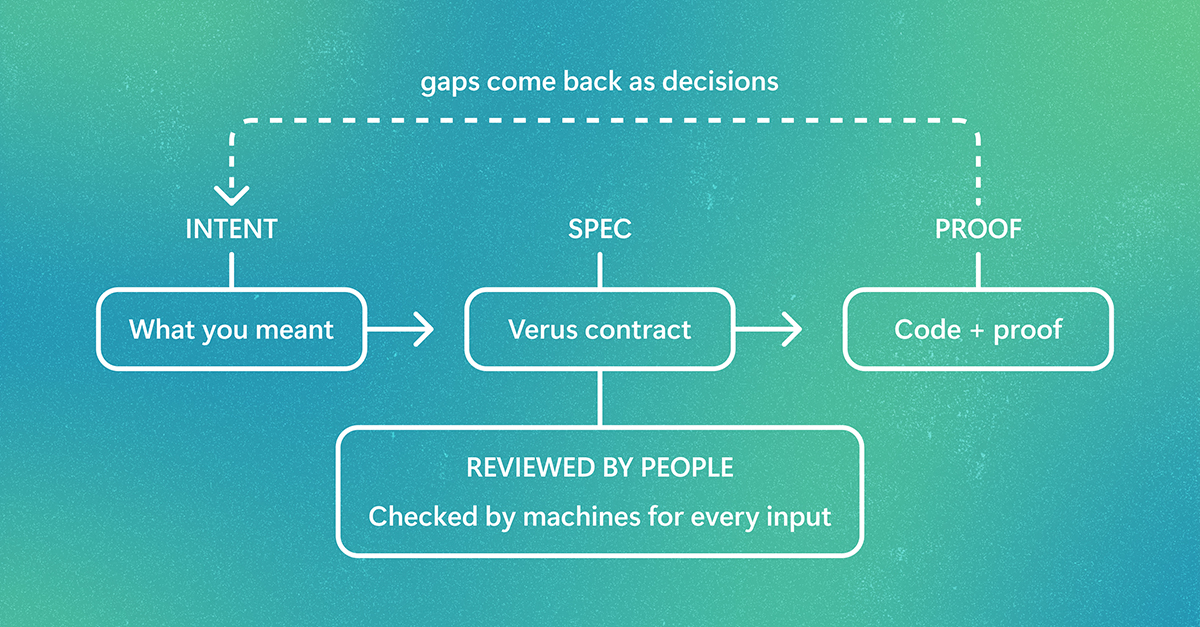
AI agents can generate code at a scale that’s hard for humans to review line-by-line. PDD Kit helps ensure the code is doing what the developer intended by creating formal specifications and testing against them. It converts developer intent into a Verus specification, proves AI-generated code meets it for every input, and uses tests where proofs aren't practical. Developers review intent, not every line. The post Formally verifying agent-written full-stack web apps with PDD Kit appeared first o…

MIT News · Artificial Intelligence Nov 5, 2026

Clearing up a robot’s fuzzy memory

A new system identifies and corrects unreliable object descriptions stored in a robot’s memory, improving the robot’s ability to interact with its environment.

We use cookies to run the site and, with your consent, for analytics and to show ads. See our Cookie Policy.