This work studies a variety of retrieval-based in-context learning (RetICL) strategies for detecting defamatory offences under {\S}{\S} 185-187 StGB (the subject of GermEval 2026 Subtask 4).
Abstract
With hate speech being ubiquitous online, automatic detection is crucial, in particular when it comes to criminally relevant social media posts. We study a variety of retrieval-based in-context learning (RetICL) strategies for detecting defamatory offences under {\S}{\S} 185-187 StGB (the subject of GermEval 2026 Subtask 4). Few-shot prompting beats zero-shot, but retrieval-based approaches offer only marginal gains over random demonstrations, and even fall behind an optimised static set of demonstrations. Providing concrete legal knowledge helps, yet model choice outweighs every other system choice. Models over-predict criminal relevance while still missing 26-57% of criminally relevant posts, suiting them for triage rather than autonomous moderation.
The GermEval 2026 shared task scores its detection in four subtasks in a per-subtask nine-voter ensemble spanning three orthogonal axes: LLM, training method and class scope, placing first on all four subtasks.
P. Steigerwald, Eric Rudolph, J. Albrecht· 1 citation
This work examines the effectiveness of stacking traditional machine learning techniques like Logistic Regression, k-Nearest Neighbors, Random Forest, Multi-Layer Perceptron, Support Vector Classifier and simple word counting and compares them to BERT, a powerful pre-trained language model.
Björn Kießwetter, Christoph Lukas, Tim Sieber· 0 citations
Aligned language models fail under two independent pressures: the structural jailbreak class recently formalized as Involuntary In-Context Learning (IICL), which reframes a harmful request as the final missing cell of a data-labeling task completed by pattern rather than judged as content; and the erosion of safety ali...
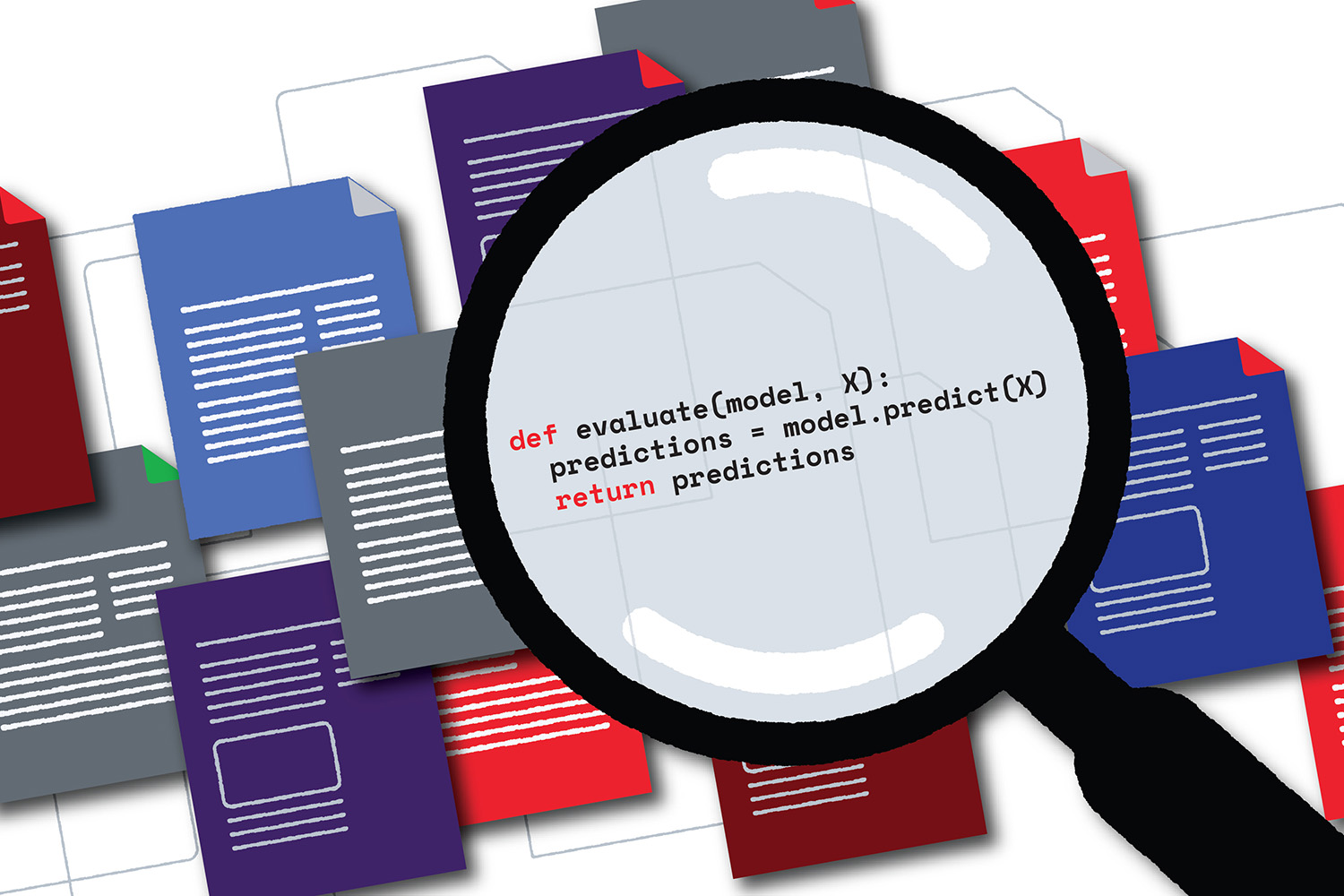
An MIT and Dana-Farber Institute-led team used large language models to examine nearly 4,000 studies and hundreds of code repositories, revealing gaps in the information needed to scrutinize and reuse published research.
By studying the computational foundations of language learning, Associate Professor Jacob Andreas builds intelligent systems that can communicate effectively with humans.