A confidence-aware multimodal fusion framework (CAMF) is proposed to realize reliable human intention prediction for industrial human-robot collaboration and outperforms existing multimodal fusion approaches in overall performance and stability.
Abstract
A confidence-aware multimodal fusion framework (CAMF) is proposed to realize reliable human intention prediction for industrial human-robot collaboration. This framework fuses four heterogeneous modalities including object 6D pose, gaze, skeletal motion and IMU-based hand motion. It embeds a confidence-trend-driven dynamic fusion mechanism into BiLSTM to adaptively balance bidirectional temporal features according to real-time modality reliability. A confidence-guided balanced learning strategy combined with a confidence freezing mechanism is further adopted to adjust network gradients dynamically, suppress noise from low-quality modalities and mitigate cross-modal learning bias. A physical platform based on the UR3 collaborative robot is built for experimental validation. Comparative results show that the proposed method reaches an intention recognition accuracy of 91.86% and outperforms existing multimodal fusion approaches in overall performance and stability. It also maintains satisfactory accuracy under low light and partial occlusion interference. In practical assembly tasks, the framework enables proactive and stable human-robot cooperation with strong environmental adaptability.

Industrial humanoid robots are increasingly expected to execute high-precision manipulation tasks, such as assembly, welding, and material handling, under dynamic and contact-rich working conditions. In such scenarios, operational safety and task reliability depend not only on accurate motion execution but also on time...
Hui-Qing Nong, Sheng-Zhu Wang, Wei Liu et al.· International Journal of Hum...· 0 citations
A multi-modal, data-driven machine learning model for classifying behavioral patterns associated with distinct trust states under controlled trust-inducing conditions is introduced and demonstrates the effectiveness of multi-modal behavior analysis and sensor data fusion for accurate trust classification in human–robot...
Human activity state recognition is a basic perception capability for assistive robots that interact with older adults, rehabilitation users, and workers in shared environments. However, many embodied-intelligence studies depend on vision-heavy perception pipelines that are difficult to deploy in low-cost, privacy-sens...
Jing-Run Pan, Ze-Yi Ding, Shun-Hui Mo et al.· 2026 International Conferenc...· 0 citations
Humanoid robots increasingly rely on multimodal perception and closed-loop interaction to perform contact-rich industrial assembly. However, existing vision-language-action methods often lack fine-grained contact-semantic understanding, explicit structural consistency modeling, and reliable recovery from disturbances....
Hai-Feng Ma, Hui Pan, Lin Li et al.· International Journal of Hum...· 0 citations
Human–robot collaboration (HRC) in industrial environments requires safety mechanisms that protect workers without sacrificing productivity. Conventional industrial robots typically lack built-in collaborative safety functions and contextual awareness, limiting the speed and separation monitoring (SSM) effectivenes...
Chong Keat How, Tsung Heng Chiew, Y. Goh et al.· Industrial robot· 0 citations
This research presents an adaptive multimodal fusion framework for human intent recognition in intelligent information-control systems under asynchronous, noisy, and conflicting behavioral inputs. The proposed approach combines Dynamic Time Warping, Variational Autoencoders, Graph Attention Networks, Jensen-Shannon Div...
V. Rudoi· Collection of scientific pap...· 0 citations
Related blog posts
MIT News · Artificial Intelligence· news.mit.eduOct 28, 2026
Professor Paris Smaragdis develops computers with superhuman hearing for applications like speech recognition, music understanding, and environmental monitoring.
MIT News · Artificial Intelligence· news.mit.eduOct 23, 2026
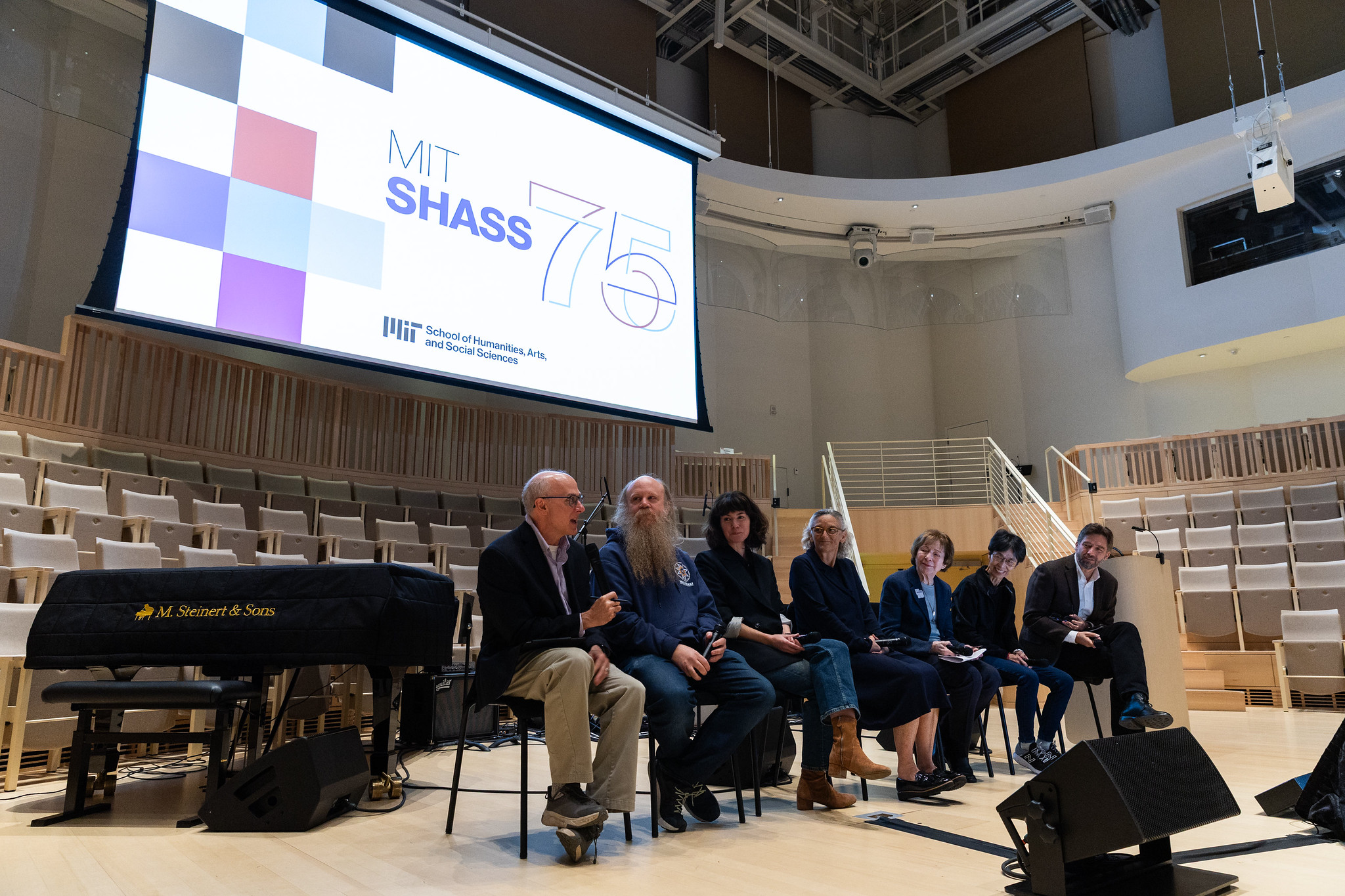
During the School of Humanities, Arts, and Social Sciences’ 75th Anniversary Symposium, President Sally Kornbluth said “MIT has never needed your particular insight and guidance more than we do now.”
MIT News · Artificial Intelligence· news.mit.eduOct 23, 2026
Assistant Professor Benjamin Lindquist studies how engineers deliberately injected randomness into early AI, giving rise to deep-learning models that sometimes hallucinate.
MIT News · Artificial Intelligence· news.mit.eduOct 22, 2026
“X-Hinges” helps design and 3D print items like lamps and gloves with an interactive twist: automatically embedded sensors that perceive and adaptively respond to human contact.
We use cookies to run the site and, with your consent, for analytics and to show ads.
See our Cookie Policy.