Skip to content

Deep operator learning for efficient sampling from invariant measures of stochastic differential equations

Sep 2026 · 0 citations · 38 references
Mathematics Computer Science

TL;DR

An amortized neural sampler that combines operator learning with flow methods for sampling, enabling efficient sampling across families of stochastic differential equations, and theoretically establishes the expressivity and resolution invariance of the framework.

Abstract

We introduce an amortized neural sampler that combines operator learning with flow methods for sampling. It maps SDE coefficient functions to pushforwards from a reference measure to the invariant measures, enabling efficient sampling across families of stochastic differential equations. Our framework shifts traditional sampling cost to an initial training phase, after which new SDE instances require only one encoder pass and a few ODE solver steps, independent of mixing time. To handle problems in high dimensions, we use Lagrangian trajectory sensors for the coefficient functions and cross attention in the architecture. We also theoretically establish the expressivity and resolution invariance of our framework. Experiments on 1D and 2D SDE families show competitive accuracy with substantial speedups over MCMC in regimes with slow mixing, transfer across sensor counts, and demonstration results on a 64D interacting particle SDE where traditional grid approaches are infeasible.
View source

Similar papers

#machine learning Preprint Sep 2026

Structured Neural SDEs for Functional Calibration

Neural Stochastic Differential Equations (Neural SDEs) provide flexible continuous-time generative models, but generic neural drift and diffusion networks are costly to simulate on long horizons and can give unstable gradients when the training signal is a path functional rather than a pointwise observation. We introdu...

Francesco Piatti, Andrea Iannucci, Thomas Cass · 0 citations
#machine learning Preprint Sep 2026

SINO: Scale-Invariant Neural Operator

In scientific machine learning, physical fields governed by partial differential equations exhibit low-rank structure and scale invariance. When solving equations on coarse grids, missing information leads to the closure problem: modeling unresolved physics to recover lost dynamics. Although closure terms depend on gri...

Kai-Chen Ouyang, Cheng-Lei Yu, Chuan-Rui Wang et al. · 0 citations
#machine learning Preprint Sep 2026

Equation Recast for Canonical Operator Learning Across Parametric PDEs

Learning solution operators across broad parameter ranges can require substantial coverage of both input functions and physical parameters, particularly for purely data-driven parametric models. In addition, the resulting models may fail silently outside the training distribution. We introduce equation recast, which re...

Qi-Yun Cheng, Valentin Duruisseaux, C. Clauser et al. · 0 citations
Preprint Aug 2026

Kernel Methods for Learning Operators with Multiple Inputs and Outputs

This work introduces a general kernel-based encoder-decoder framework for operator learning that separates observation, representation, learning, and reconstruction, and develops this framework for multi-input, multi-output operator learning, where operators map between products of potentially distinct function spaces.

Adrien Weihs, Chun-Yang Liao, Jingmin Sun et al. · 0 citations
#machine learning Preprint Sep 2026

Local gradient neural operator

Field temporal prediction and source identification constitute canonical problems in dynamical systems. Conventional approaches to these problems depend on a thorough understanding of the governing partial differential equations (PDEs). Recently, deep learning, as represented by neural operators, has provided a data-dr...

Bai-Ming Zhang, Jin-Song Tang, Ying Xu et al. · 0 citations
#machine learning Preprint Sep 2026

Learning to Bias: Machine Learning-Enhanced Particle Filters

Sequential inference estimates latent states from noisy and incomplete observations. Particle Filters (PFs), a class of Monte Carlo methods based on importance sampling, provide a flexible framework for this task, but often suffer from poor sample efficiency and unfavorable scaling with dimension, partly due to subopti...

Apoorv Srivastava, Eric F. Darve · 0 citations

Related blog posts

Microsoft Research Blog Sep 30, 2026

Forecasting space weather risks on power grids

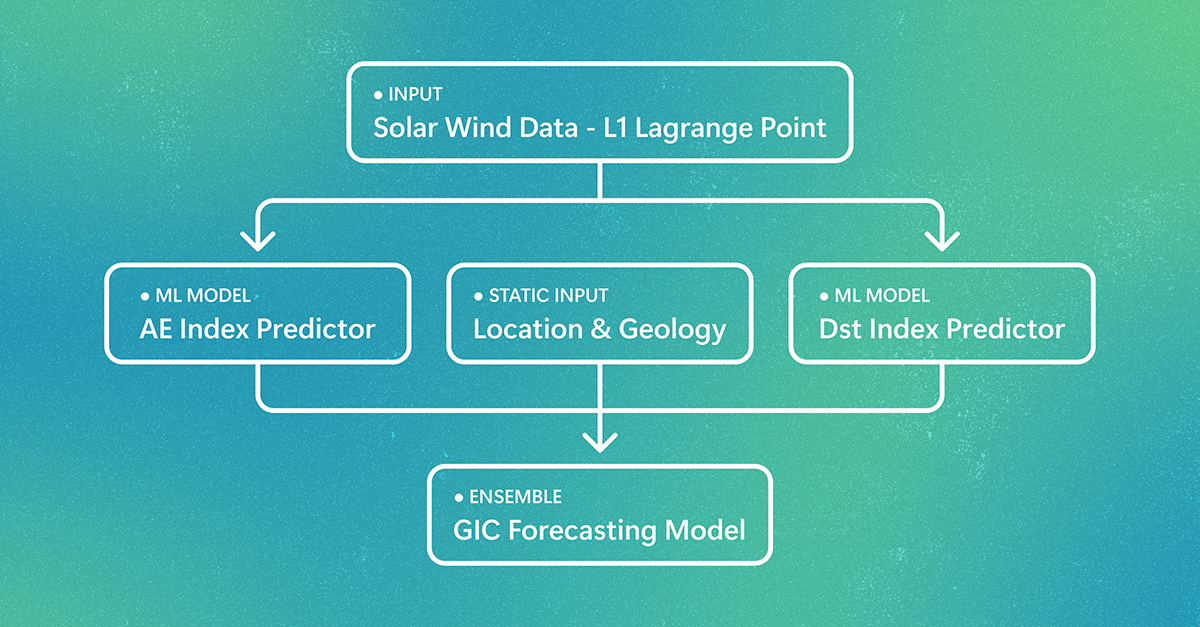
Extreme space-weather events can damage power systems on Earth and degrade GPS accuracy and satellite operations. A new machine learning system can predict where damage is likely to occur 30-60 minutes before a storm arrives. The post Forecasting space weather risks on power grids appeared first on Microsoft Research.

We use cookies to run the site and, with your consent, for analytics and to show ads. See our Cookie Policy.