LLMSec-AV introduces an AV-specific, machine-readable vulnerability taxonomy for weakness discovery and shows that LLMs can complement conventional analyzers by identifying and organizing safety-relevant findings in real AV software.

Abstract
Automated vehicles rely on millions of lines of safety-critical software, yet general-purpose analyzers do not understand which code can affect vehicle motion. This study asks whether large language models (LLMs) with explicit automated-vehicle (AV) security knowledge improve weakness detection beyond rule-based tools. We developed an AV vulnerability taxonomy with 18 weakness classes from vulnerability records, security advisories, and AV-security literature, and integrated it into LLM-based Security Analysis for Automated Vehicles (LLMSec-AV). Evaluated on Autoware, the framework decomposed 770 translation units into 4,673 functions and analyzed 161 functions under four prompting conditions involving taxonomy context, retrieval from 374 prior disclosures, and multi-step analysis. Findings were compared with 46 weakness locations mined from upstream fixes and a flag-volume-matched permutation baseline. CodeQL, Semgrep, cppcheck, and the Clang Static Analyzer evaluated the same code, with AV-specific rules added to CodeQL and Semgrep. Generated fuzzing harnesses were tested using AFL++ and sanitizers. LLM conditions recovered up to 76% of the 46 known weakness locations, outperforming conventional analyzers. CodeQL, Semgrep, and the Clang Static Analyzer matched none, while cppcheck matched one despite 1,301 alerts. Unaided prompting achieved similar detection performance, showing that the taxonomy did not drive recall. However, taxonomy context increased the share of findings assigned to a weakness class from near zero to over 80%, improving interpretability and triage. Six of the 18 classes could not be directly represented as static-analysis rules. LLMSec-AV introduces an AV-specific, machine-readable vulnerability taxonomy for weakness discovery and shows that LLMs can complement conventional analyzers by identifying and organizing safety-relevant findings in real AV software.

The results show that build integration, not candidate generation or fuzzing, is the primary barrier to reliable LLM-assisted dynamic analysis of full autonomous-vehicle software stacks.
Infrastructure-as-Code (IaC) misconfigurations are a leading cause of cloud security incidents, and Large Language Models (LLMs) are increasingly proposed as automated repair agents. Yet the trustworthiness of LLM-generated IaC repairs remains underexplored. IaC presents distinctive verification challenges: security sc...
Experimental results show that AST-based structural features substantially improve recall compared with the TF-IDF baseline, while the combined TF-IDF and AST representation maintains this improved performance.
Vani Pasupula, M. N. V. Manikanth, Nagaraju Vassey· International Journal of Cre...· 0 citations
This paper empirically simulate prompt-injection attacks from V2X message free-text fields for LLMs used in autonomous vehicles and reveals a fundamental weakness in V2X security, which escalates with the introduction of LLMs to the autonomous driving pipeline.
Muhammad Naveed, Wei Li· 2026 International Conferenc...· 0 citations
Differential fuzzing reveals complementary bugs in the manual and LLM porting of security-critical C libraries to idiomatic Rust and translates these findings into concrete practical guidance for teams planning a similar migration.
Marco Parrillo, Marco Grassi, Luigi Laura· Future Internet· 0 citations
An automated security evaluation pipeline that generates Python code from LLMSecEval prompts, scans for vulnerabilities using CodeQL and Bandit in parallel with an independent Code Validator LLM, enriches the Code Validator findings with MITRE ATT&CK techniques, CWE Observed Examples, and Python best practice guideline...
Mikhail Surikov· 0 citations
Related blog posts
Microsoft Research Blog· microsoft.comNov 12, 2026
What's new in research at Microsoft? Host Anson Ho explores the latest, including AI-powered universal translation, a breakthrough in a 31-year-old mathematics challenge, and advances making AI coding agents faster and more efficient. The post Microsoft Research Focus – Edition #98 appeared first on Microsoft Research.
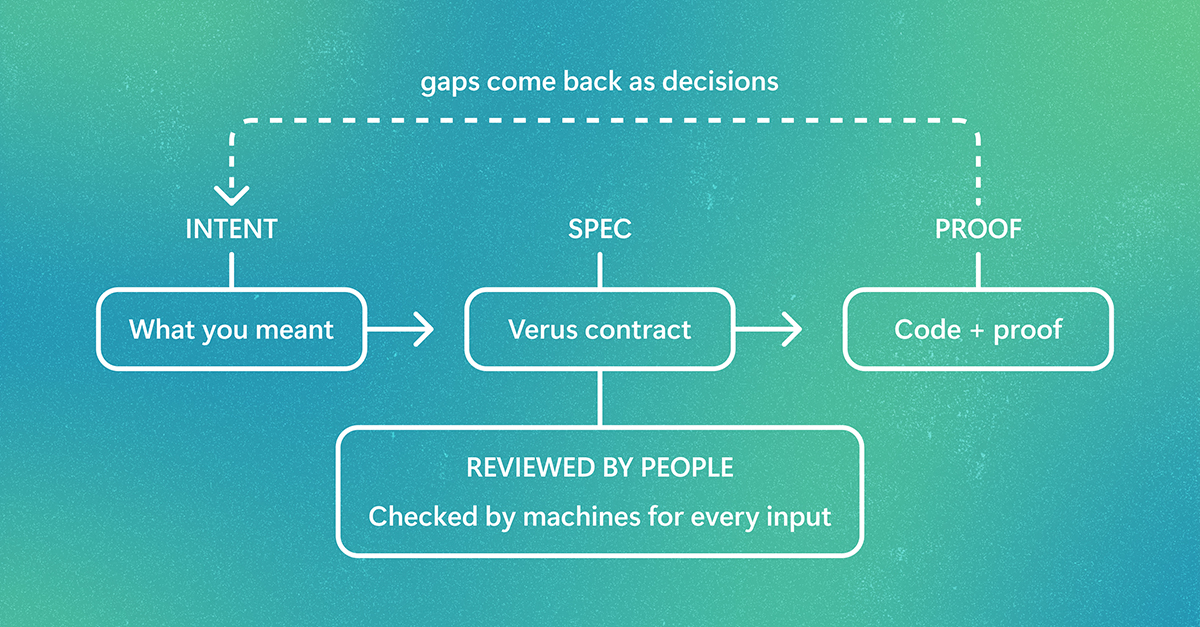
AI agents can generate code at a scale that’s hard for humans to review line-by-line. PDD Kit helps ensure the code is doing what the developer intended by creating formal specifications and testing against them. It converts developer intent into a Verus specification, proves AI-generated code meets it for every input, and uses tests where proofs aren't practical. Developers review intent, not every line. The post Formally verifying agent-written full-stack web apps with PDD Kit appeared first o…