Thinking to recall: How reasoning unlocks parametric knowledge in LLMs
Generative AI
More from the blog

Empty shelves or lost keys? Recall is the bottleneck for parametric factuality
Generative AI

Thinking of ACE? We Can Do It with Fewer Tokens
A Blog post by IBM Research on Hugging Face
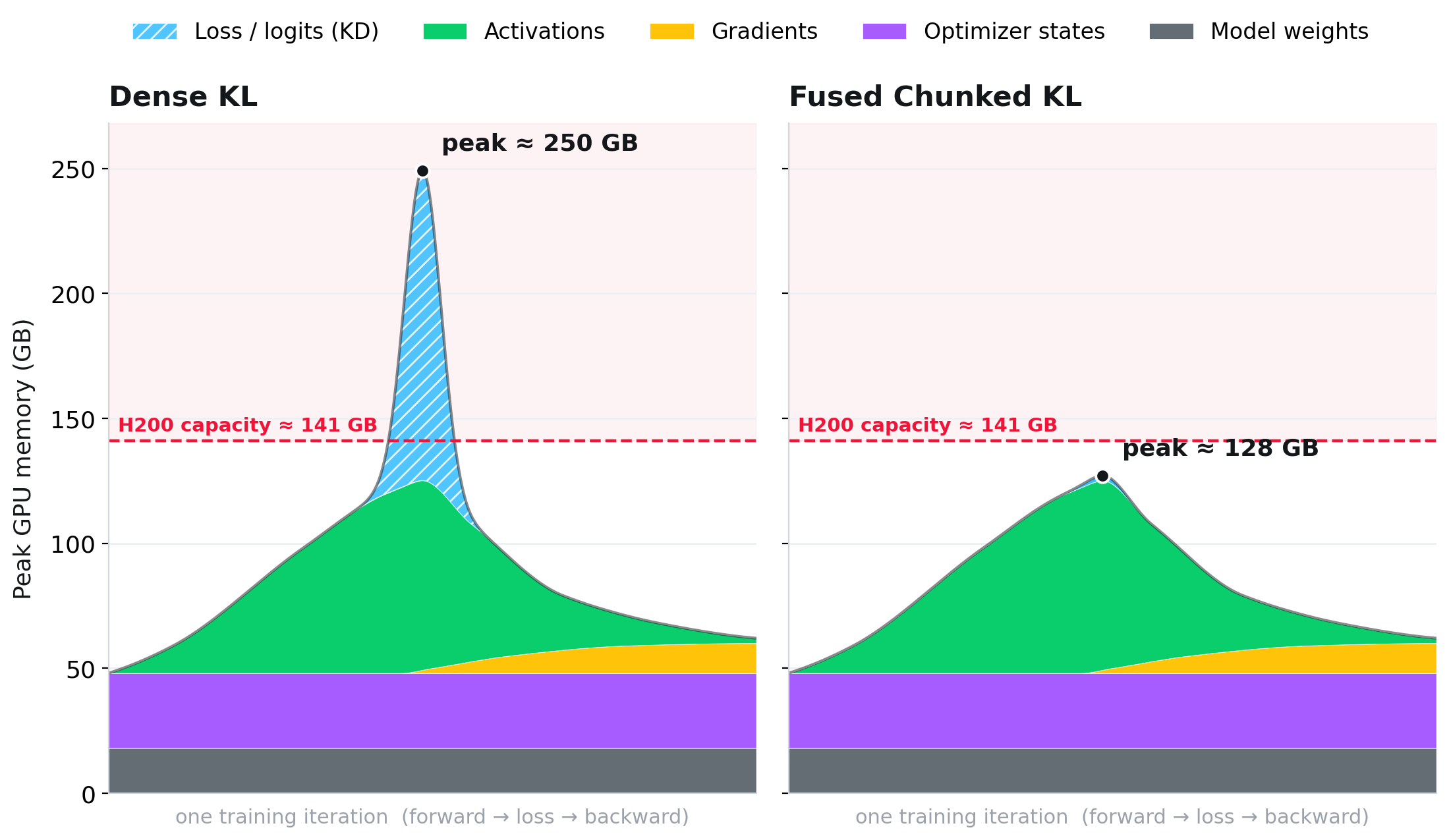
Making Knowledge Distillation Cheap Enough to Run at Scale
A Blog post by Multiverse Computing on Hugging Face
Related papers
Artificial Intelligence for Real-Time Cyber Threat Classification and Emerging Threat Detection: A Structured Review of Methods, Datasets, Challenges, and Research Directions
The reviewed literature indicates that AI-based methodologies often demonstrate superior detection capabilities for intricate and previously unseen attack patterns compared to traditional methods; however, direct performance comparisons are complicated due to discrepancies in datasets, experimental designs, and evaluation protocols.
The deflated-Welch statistic: a closed-form, guaranteed-level test for heteroscedastic one-way ANOVA. (T_BB, m01a): Methods, confidence-set-geometry development, derivations, novelty, and reporting standard): reproducibility deposit
The deflated-Welch statistic: a closed-form, guaranteed-level test for heteroscedastic one-way ANOVA William J. Dwyer, MD, MPH, FAAP — Department of Mathematics and Statistics, University of Massachusetts Lowell. ORCID 0009-0004-0855-7222. Concept DOI (always resolves to the latest version): 10.5281/zenodo.21908169. What this is The reproducibility deposit for the deflated-Welch statistic T_BB, a closed-form, guaranteed-level test for heteroscedastic one-way ANOVA (the Behrens–Fisher problem for k ≥ 3 groups). Welch's test becomes liberal under skew and unstable variance weights at small samples; T_BB = Q(s²)·exp(−R) keeps the ordinary group means and buys a guaranteed level by deflating the Welch quadratic by a Berger–Boos scale-inflation radius R. Three operating points are provided: a fixedcalibrated radius (κ_s), a design-adaptive near-guarantee radius (closed-form polygamma Cornish–Fisher with a finite-nkurtosis guard), and a fully proved smallest-eigenvalue radius R_eig (Gaussian, extended under bounded kurtosis). What the deposit contains Manuscript (author + anonymized) and a derivations supplement (DA1–DA13) plus a long-form derivations companion, covering: why Welch fails under skew in closed form; the Berger–Boos deflation and its exact worst-case radius; the polygamma-cumulant Cornish–Fisher radius with saddlepoint-exact normal backbone; the excess-kurtosis tail term with its finite-n upper-confidence guard; the imbalance correction; the fully proved smallest-eigenvalue radius (with the k-group multiplicity fix, free-β optimization, and the proved-under-bounded-kurtosis widening); and the k-sample Behrens–Fisher null distribution. Interactive demonstrator rerun_cochran/honest_anova.html — computes raw-mean Welch, the fixed / adaptive / proved T_BB radii, the estimand-changing transform routes, and the full routing receipt in the browser, reproducing the deposited Python. Its engine is extracted as a standalone Node module (m01A_anova_engine.js) and checked cell-by-cell against Python across an 84-design taxonomy (verify_anova_engine_taxonomy.py/.js, max |Δp| = 0.00000). Reproducibility scripts (rerun_cochran/, rerun/) — every reported number traces to a named, deterministically-seeded script (size/power/surface, the calibration and information-limit decompositions, the proved-radius verification, the imbalance calibration, the skew-router branch, and the figures). Real-data evidence — anova_flip_scan.py scans 2,783 public one-way layouts (254 datasets): guaranteed T_BBwithholds ~41% of Welch-significant calls, concentrated where the weight-instability screen fires, and never manufactures significance (Table 7 / Figure 15). Figures and the deterministic deposit builder (fixed timestamps → stable md5). All evaluation is simulation-based; the one empirical component is the public-dataset scan, which uses only openly distributed data. Code is released under the MIT License; text and figures under CC BY 4.0. Version history (consolidated changelog) Published version DOIs are marked ✅; the concept DOI above always resolves to the latest. Staged versions were rolled into the next published one unless noted. v1.0.77 ✅ 10.5281/zenodo.22167690 (2026-08-30): CSDA guide-for-authors conformance — abstract trimmed to 247 words (from 284), keywords cut to 7 (from 11), the withholding highlight shortened to ≤85 characters, and the arXiv PDF/source regenerated. No change to methods, results, figures, or code. v1.0.76 ✅ 10.5281/zenodo.22167536 (2026-08-30) — AI-disclosure heading aligned to Elsevier. The manuscript's declaration heading is now "Declaration of generative AI and AI-assisted technologies in the manuscript preparation process" (was "Use of generative AI"); the disclosure body is unchanged. Prepared alongside an Elsevier-compliant cover-letter variant and an EM suggested-reviewer sheet (both kept outside the deposit). docx/pdf rebuilt; deterministic md5 refreshed. v1.0.75 ✅ 10.5281/zenodo.22167304 (2026-08-30) — Submission-sharpening pass. Graphical abstract + Elsevier Highlights; figures and tables renumbered into reading order with per-table Source clauses; the validity–power frontier (Figure 8) now carries the proved R_eig operating point (100% validity, size-adjusted power 0.613, merge_tbb_proved_frontier.py); new Section 7 "Recovering power by design" + Table 8 (rc_anova_power_by_design.py); and a live required-n calculator in honest_anova.html (per-group and total n for 80% power, "power now @ total n"), with a numeric-heading CSS fix and the engine re-verified against Python at 0.00000. v1.0.74 ✅ 10.5281/zenodo.22165892 (2026-08-29) — Proved-under-bounded-kurtosis radius (DA12.6). The proved non-normal widening now keys on excess kurtosis, √(1 + κ̂·(n−1)/(2n)), from the exact Var(s²/σ²) = 2/(n−1) + κ/n, so symmetric heavy tails (Student-t) are covered where the old skew form √(1 + 0.75·skew²) under-covered; tbbProvedswitched to the kurtosis form across the demonstrator, engine, and Python truth (re-verified JS-vs-Python at 0.00000); new rc_anova_kurtosis_proof.py + deep-dive. v1.0.73 ✅ 10.5281/zenodo.22165709 (2026-08-29) — Reconstructed & verified demonstrator engine (standalone Node module + taxonomy verifier, max |Δp| = 0.00000 across 84 designs; Yuen zero-variance fix; T_BB-routed presets both directions); series-impact deep-dive (the corrected R_eig k-group multiplicity gap also reaches m03 and m01t). v1.0.72 (2026-08-29) — Title set to "The deflated-Welch statistic…"; corrected + optimized proved radius R_eig (β/k multiplicity fix + β-optimization, DA12); real-data Welch-vs-T_BB flip scan (2,783 layouts; Table 7 / Figure 15) + demonstrator imbalance-factor fix; long-form derivations companion. v1.0.71 / v1.0.70 (2026-08-21) — Zhang normal-reference comparator benchmarked on the efficiency frontier (valid on only 24% of designs, in the calibrated-liberal cluster); k = 2 adaptive-radius case-study fold (design-scaling vs shape-keying distinction). v1.0.69 ✅ 10.5281/zenodo.22035826 (2026-08-20) — HTML R1/R2 presentation pass + Figure 9 adaptive per-cluster label merge. v1.0.68 ✅ 10.5281/zenodo.22033737 (2026-08-20) — Companion consolidation into a single six-column Table 6; Figures 11–14 harmonized into one story. v1.0.67 / v1.0.65 / v1.0.60 (2026-08-19/20) — Guarded-reference naming-collision fix; the 40,000-replication expanded-frontier pin (Table 3 + Figure 8) with the symmetric-heteroscedastic skew-router branch; the mean-preserving lightened-R_eig do-not-use fallback. v1.0.59 ✅ 10.5281/zenodo.21995320 (2026-08-18) — Reporting standard + honest_anova.html demonstrator re-aligned to the current T_BB methods paper. v1.0.57 ✅ 10.5281/zenodo.21986847 (2026-08-17) — Reviewer-comprehension pass (multi-paragraph abstract, contributions list, trimmed captions); proved radius R_eig added as a Table 3 scorecard row; corner tail-index correction (N−k)/2 (low-order moments exist in every deployed design). v1.0.56–v1.0.49 (2026-08-16) — The k-sample Behrens–Fisher corner-distribution program: two-moment scaled-χ² corner reference, derived corner cumulants, the secular-eigenvalue law + closed CGF + power-law tail, consolidated into derivations DA13 with a prior-art/novelty audit. v1.0.48 ✅ 10.5281/zenodo.21963458 (2026-08-16) — The unifying λ(z) correction (a smooth instability-keyed deflation strength). v1.0.45 ✅ 10.5281/zenodo.21962965 (2026-08-16) — Atomic sparsity index + bootstrap-t edge hardening + shape-aware pooled standardized-residual bootstrap (SA-PSRB); multivariate transfer to m03. v1.0.44–v1.0.41 (2026-08-16) — Shape-moment re-injection order (skew is the sweet spot), validated and hardened pooled standardized-residual bootstrap, atomic weight-noise probes. v1.0.40 ✅ 10.5281/zenodo.21961667 (2026-08-16) — Log-domain weight-stabilization probe (negative for stabilization; clarifies the size-adjusted oracle ceiling); includes the oracle-power gap decomposition (≈92% conservatism, ≈8% estimation). v1.0.37 ✅ 10.5281/zenodo.21961327 (2026-08-16) — Residual-bootstrap qualification of the shoot-out + the first proved Gaussian smallest-eigenvalue radius R_eig (DA12, the p = 1 specialization of the m03 theorem). v1.0.36 (2026-08-15) — Figure 11 T_BB-region colour fix (amber, matching the routing figures). v1.0.27 ✅ 10.5281/zenodo.21908170 — Earlier published baseline of the deposit. Provenance: every number traces to a named, deterministically-seeded script listed in the manuscript Declarations; the demonstrator engine reproduces the deposited Python to max |Δp| = 0.00000 across the taxonomy verification. License. Code and scripts in the deposit are released under the MIT License; text and figures under CC BY 4.0. Reuse is permitted with attribution to the author and citation of the concept DOI above. How to cite. Dwyer, W. J. The deflated-Welch statistic: a closed-form, guaranteed-level test for heteroscedastic one-way ANOVA. Reproducibility deposit, Zenodo. https://doi.org/10.5281/zenodo.21908169
AI and Bullshit
It is argued that both AI and bullshitters are untrustworthy informants, and for similar reasons, it is natural to describe AI’s informational outputs as bullshit, as it signals their distinctive kind of epistemic deficiencies, which they share with bullshit.
Adaptive Repayment Optimisation for SME Lending: A Stochastic Programming Framework with Generative AI Explanation
The Adaptive Repayment Optimisation Engine is introduced, a novel framework that applies constrained stochastic optimisation to the design of loan repayment schedules for small and medium-sized enterprises (SMEs) and contributes to the operations research literature by bridging stochastic programming, explainable AI, and financial regulation in a novel application domain.