
TokenEconomizer: Learning from Experience to Make AI Coding Agents More Efficient
AI coding agents are increasingly help developers fix bugs and build features largely on their own, but every interaction with their models consumes tokens. In each session, an agent sends instructions, tool descriptions, and session history to its model. Most efforts to reduce this cost focus on individual tasks. Yet developers return to the same […] The post TokenEconomizer: Learning from Experience to Make AI Coding Agents More Efficient appeared first on Microsoft Research.
More from the blog
Hugging Face and OpenRouter join forces to make open-weight models easy to run
 GPT-Lab
· gpt-lab.eu
Nov 13, 2026
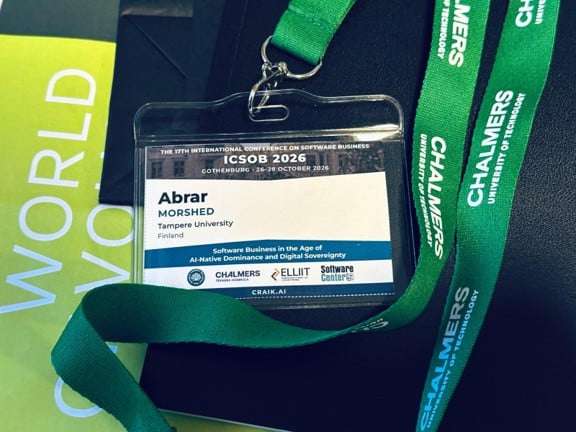
TenderIntell at ICSOB 2026: Three Days in Gothenburg
At ICSOB 2026 in Gothenburg, we presented TenderIntell, our work on multi-agent support for tendering. This post looks back at the conference, the idea behind a panel of three AI reviewers who score each proposal independently, and why evaluating agents reliably is the question we keep coming back to. The post TenderIntell at ICSOB 2026: Three Days in Gothenburg appeared first on GPT-Lab.

Microsoft Research Focus – Edition #98
What's new in research at Microsoft? Host Anson Ho explores the latest, including AI-powered universal translation, a breakthrough in a 31-year-old mathematics challenge, and advances making AI coding agents faster and more efficient. The post Microsoft Research Focus – Edition #98 appeared first on Microsoft Research.
Introducing Gemini 4 Hydrogen
Today, we’re introducing Gemini 4 Hydrogen, our daily driver for agentic workflows
Related papers
Time for AI (Ethics) Maturity Model Is Now
It is argued that AI software is still software and needs to be approached from the software development perspective, and whether the focus should be on AI ethics or the quality of an AI system, called a maturity model for the development of AI systems is discussed.
Anomaly detection in smart power grids with graph-regularized MS-SVDD: a multimodal subspace learning approach
A generalized Multimodal Subspace Support Vector Data Description model with graph-embedded regularization is proposed, illustrating how relational and structural information can be systematically embedded into one-class models, enabling robust learning under complex, high-dimensional, and multimodal conditions.
Blockchain-Enabled Artificial Intelligence and AI Agents for Secure Data Sharing and Cybersecurity Applications
This paper presents a meta-synthesis that draws together four constituent studies covering adversarial machine learning, AI-powered anomaly detection in cloud environments, automated vulnerability patching by multi-agent large language model (LLM) pipelines, and the broader landscape of securing AI systems across their...
ProphDR: An Interpretable Deep Learning Model for Predicting Cancer Drug Response via Multi-Omics and Cross-Attention Mechanisms
ProphDR is an interpretable deep learning framework that integrates multiomics data and drug structural information using a hierarchical attention mechanism, and generates biologically interpretable attention maps that highlight key pharmacophores and resistance-related genes consistent with established mechanisms in N...