Reliable clinical deployment of deep medical image models is hindered by distribution shifts across scanners, sites, and acquisition protocols. Existing domain generalization (DG) methods often focus on style or intensity diversification, but they can still leave networks dependent on domain-specific texture correlatio...
Ahmed Sharshar, Asif Hanif, Naveen Kumar Kummari et al.· 0 citations
Autonomous driving systems have become a central focus of intelligent transportation research, with End-to-End Learning and Modular Architectures offering two prominent design paradigms for their implementation. E2E Learning uses deep learning algorithms to map raw sensory inputs directly to driving actuators, providin...
Multimodal large language models (MLLMs) are increasingly used as automated judges for instruction-based image editing and as reward signals for model training. However, systematically auditing whether these judges are influenced by cues irrelevant to editing quality is challenging because visual interventions may them...
Trajectory crossing remains a critical bottleneck in Flow Matching (FM), and previous works typically view these crossings from a theoretical optimization perspective causing velocity averaging. They attempt to address it indirectly by post-hoc distillation or endpoint coupling, without explicitly regulating the interm...
Zi-Qi Jiang, Zhen-Qi He, Long Chen· 0 citations
Reach audiences
Advertise in front of researchers, engineers, and readers.
An optical character recognition (OCR) can scan a paper and extract text using technology, making people's jobs easier. While various OCR systems are available in the software industry, finding a reliable equivalent solution for Bangla takes much work. When it comes to handwritten texts, the situation is much more unus...
A Data-Strategy-Platform taxonomy is introduced that conceptualizes training as an interdependent system and surveys recent advances across data-centric pipelines, learning paradigms, and training infrastructures, and analyze their interplay in shaping model performance, robustness, and deployability.
Cheng-Kai Xu, Yi-Ming Cui, Jia-Qi Liu et al.· IEEE transactions on intelli...· 5 citations
Within-model ablations, which keep the encoder and the rest of the architecture fixed and vary only the gaze history, show that the differential formulation removes the systematic saccade bias that persists even with an absolute gaze-history prior.
A plug-in, SmoothOperator (SmoothOP), which sets the smoothing coefficient of each sample from its prominence, an embedding-space signal measuring how clearly the sample's own class stands out against its strongest competing class, integrates into four existing spherical representation learning methods at minimal train...
A novel personalized FL framework (denoted as FedMAD) for RS image classification problems that allows the global optimization process to suppress conflicting client updates originating from heterogeneous data distributions while enhancing the contribution of clients with consistent adaptation behaviors.
SemanTok is introduced, a flexible video tokenizer that feeds frozen DINO features into its encoder and adds lightweight heads that reconstruct them from each retained token prefix alone, and performs well in both reconstruction and generation.
Mikhail Dereviannykh, Vikram Voleti, Simon Donné et al.· 0 citations
The segmentation of anatomical structures in medical images and particularly in MRI scans, is essential for clinical diagnosis and monitoring disease progression. While Deep Learning (DL) architectures, such as U-Net and its extensions are very effective in medical image segmentation tasks, they often struggle with pre...
Eirini Cholopoulou, Dimitrios E. Diamantis, Dimitris K. Iakovidis· 0 citations
Across three vision-language model architectures (LLaVA-1.5-7B, Qwen2.5-VL-7B, InternVL3-8B), we report a universal negative finding for mid-layer interpretability. On POPE -- the benchmark common to all three -- the mid layers encode the ground-truth answer in 68-91% of errors, yet this signal is not causally active f...
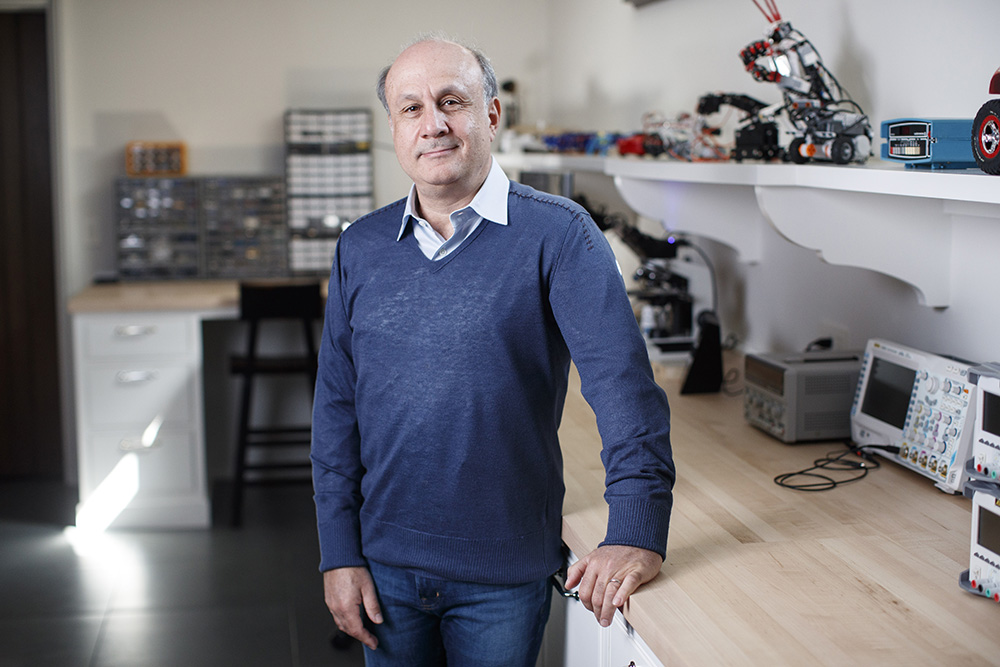
Professor Paris Smaragdis develops computers with superhuman hearing for applications like speech recognition, music understanding, and environmental monitoring.
Exploring how generative AI could make machine vision more accessible to businesses. The post GenEye in a Box: Making Machine Vision Something You Can Just Ask For appeared first on GPT-Lab.
Jennifer Neville did not want to go into computer science—but that’s exactly where she landed. Neville discusses the starts and stops that led to her professional sweet spot and her work identifying “surprising failures” making it hard for AI to handle complexity. The post What AI gets wrong and what failure teaches us appeared first on Microsoft Research.
Computer scientist, entrepreneur, and philanthropist will collaborate with the MIT Schwarzman College of Computing to advance AI and scientific discovery.
We use cookies to run the site and, with your consent, for analytics and to show ads.
See our Cookie Policy.