World action models (WAMs) have emerged as a promising paradigm for robotic control by jointly predicting future visual dynamics and actions from an initial observation and instruction. However, existing WAMs struggle with long-horizon prediction, as generating dense video rollouts is highly inefficient. Some recent WA...
Fei Zhang, Zhao-Chong An, Duncan P. Frost et al.· 1 citation
Vision-Language Models (VLMs) enable video annotation at scale, but costs accumulate quickly: processing a typical 60-second short-form video at one frame per second requires millions of tokens. To reduce costs, researchers rely on heuristics such as sampling a subset of frames, compressing videos into image grids, or...
Recent diffusion and autoregressive models have substantially improved text-to-video generation, yet producing coherent long-form story videos with consistent characters and aligned audio remains challenging. Existing methods often suffer from narrative drift, unstable character identity, weak cross-scene continuity, a...
Ting Huang, Biao Wu, Rong-Hao Chen et al.· 0 citations
Adaptive Tversky Policy Optimization (ATPO) is proposed, a reinforcement learning framework for Multi-label Video Safety Detection (Multi-VSD), which introduces the Adaptive Tversky Reward (ATR), which dynamically adjusts false-positive and false-negative penalties during training to enable controllable precision-recal...
Guang-Yu Yang, Jing-Biao Mei, Ming-Shen Sun et al.· 0 citations
Reach audiences
Advertise in front of researchers, engineers, and readers.
Remote sensing vision-language models are increasingly expected to support open-ended reasoning over Earth Observation data and a variety of tasks. Most recent progress in this area has been driven by remote-sensing-specific architectural designs, often introducing new encoders, alignment modules, or task-specific fusi...
Stefan Maria Ailuro (INSAIT, Sofia University "St. Kliment Ohridski"), Mario Markov (INSAIT et al.· 0 citations
Transformers are AI's workhorse but their computational cost becomes prohibitive when processing long sequences. We target long-horizon streaming vision and robotics applications, where it is particularly impractical to store and maintain a history of observations. Recurrent Transformers address this limitation by main...
Philippe Weinzaepfel, Christian Wolf, Mert B\"ulent Sariyildiz et al.· 0 citations
Vision Transformers (ViTs) learn rich visual-semantic representations through all-to-all self-attention among patch tokens. However, this design implicitly assumes that direct pairwise patch interactions are necessary for effective representation learning. In this work, we challenge this assumption and show that repres...
Alan Z. Song, Yinjie Chen, Mu Nan et al.· 0 citations
Anatomical mesh segmentation requires models that operate directly on irregular surface geometry while remaining robust to changes in coordinate pose across meshes of varying resolution. Existing task-specific mesh and point-cloud methods are not equivariant, and can degrade sharply under test-time perturbation, for ex...
In diffusion transformers, a class label or a text prompt is embedded once, and the same condition is reused at every denoising step. We ask whether predicted embeddings can serve as this condition instead. Next-Embedding Predictive Autoregression (NEPA) trains a Transformer to predict the next continuous embedding in...
Adverse conditions such as rain, snow, fog, and dust remain challenging for camera-based perception in autonomous driving. We study multi-class weather recognition from street-view images under domain shift, where most available training data come from non-street-view sources that differ markedly from real driving scen...
Hossein Maghsoumi, George Atia, Yaser P. Fallah· 0 citations
Wildfires pose severe risks to human life, ecosystems, and property. This study presents a machine learning approach for wildfire detection from GOES ABI imagery. A CatBoost model was trained on a large dataset with thousands of ABI images and over 300,000 matching VIIRS fire detections. An evaluation on a separate dat...
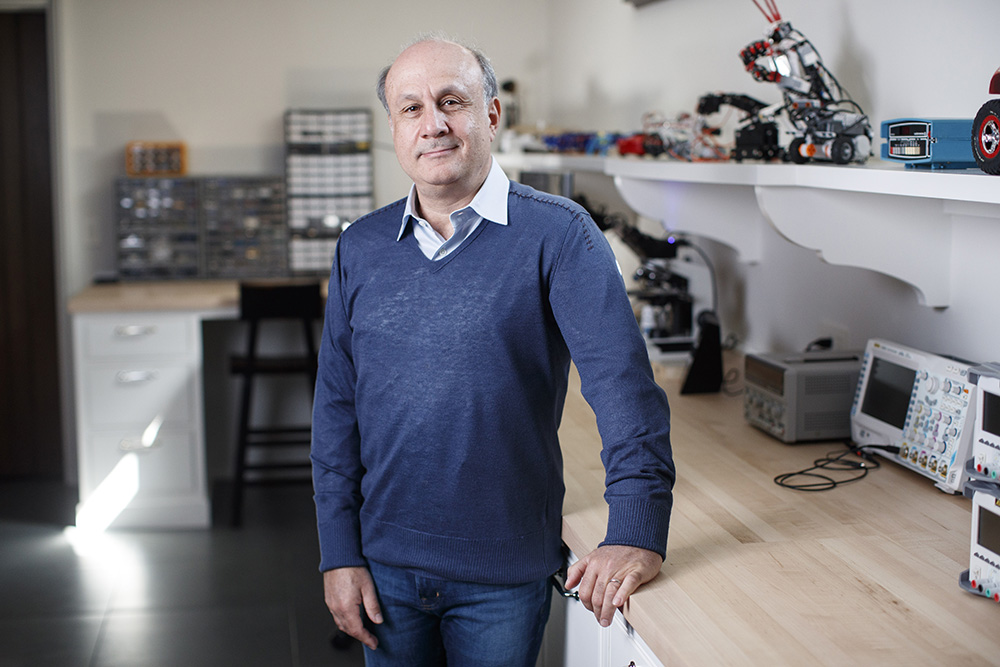
Professor Paris Smaragdis develops computers with superhuman hearing for applications like speech recognition, music understanding, and environmental monitoring.
Exploring how generative AI could make machine vision more accessible to businesses. The post GenEye in a Box: Making Machine Vision Something You Can Just Ask For appeared first on GPT-Lab.
Jennifer Neville did not want to go into computer science—but that’s exactly where she landed. Neville discusses the starts and stops that led to her professional sweet spot and her work identifying “surprising failures” making it hard for AI to handle complexity. The post What AI gets wrong and what failure teaches us appeared first on Microsoft Research.
Computer scientist, entrepreneur, and philanthropist will collaborate with the MIT Schwarzman College of Computing to advance AI and scientific discovery.
We use cookies to run the site and, with your consent, for analytics and to show ads.
See our Cookie Policy.