This is the first systematic evaluation of UQ methods applied to a foundation model for semantic segmentation and highlights both the promise and the current limitations of uncertainty-aware foundation models, pointing to the need for future work that jointly optimizes accuracy, robustness, and efficiency for real-worl...
S. Landgraf, Joceline Hinz, M. Ulrich· ISPRS Annals of the Photogra...· 0 citations
A local traditional OCR pipeline is introduced that can be iteratively fine-tuned on the target manuscript at the layout-level and the appearance-level, causing iterative reduction in human annotation effort, which is expensive and time-consuming as it requires historical domain expertise.
This paper proposes Temporally Decomposable Image Representations (TDIR), a representation learning algorithm that decomposes historical photographs into separate date and content components through orthogonal subspaces, and defines and proves the conditions under which such a decomposition is achievable.
Adrià Molina Rodríguez, O. R. Terrades, J. L. Canet· 0 citations
OmniHandwritingOCR provides a challenging testbed for diagnosing language, content, structural, and visual-grounding failure modes of multimodal models in handwritten OCR scenarios.
Zinuo Guo, Min Zhang, Bo Jiang· 0 citations
Reach audiences
Advertise in front of researchers, engineers, and readers.
MR-IQA-2 is introduced, an actor-editor-judge framework that operationalizes reasoning-editing-reflection that achieves competitive rating alignment with humans and uses fine-grained credit assignment to decouple reasoning and rating supervision.
Yuan Li, You-Yuan Lin, Chenhui Chu et al.· 0 citations
Strong sensitivity to the training prior, data-efficiency of moment-based heads, and representation dependence of Gaussian shift metrics, motivating (prior, encoder, head)-level reporting and stronger analytical baselines for AIGI transfer are quantified.
Shashank Kotyan, Makoto Shing, Yuki Imajuku et al.· 0 citations
Precise segmentation of the optic disc and cup is critical for the early detection and diagnosis of glaucoma. However, achieving consistently high performance across datasets while maintaining low computational requirements remains a significant challenge. In glaucoma detection, low-computation methods are crucial for...
Soumili Ghosh, Debapriya Roy, Aryan Das et al.· 0 citations
This work introduces SparsePR, which combines Response-Coupled Partitioning with Probe-Fitted Residual Reconstruction and consistently reduces attention-reconstruction error across four heterogeneous video generation and world models.
P. Taghavi, Reza Langari, Gaurav Pandey· 1 citation
A unified adaptation-restoration design consistently outperforms entropy-based adaptation, RAG, and perplexity-based generation over long adaptation horizons, where baselines without restoration progressively degrade while TTSD-FAR remains consistent.
Muhammad Haseeb Aslam, A. Koerich, Marco Pedersoli et al.· 0 citations
This work proposes a principled VLM TTA method called \algname, and theoretically reveals that the InfoNCE loss can be neatly reformulated as a Wasserstein OT formulation, thereby unifying the objectives of the inference and adaptation of VLMs to achieve their mutual benefits.
Qi Yu, Zhichen Zeng, Katherine Tieu et al.· 0 citations
Two distinct effects are reported: paired-example FedAvg partially recovers the missing-ECG gap, while validation-selected completion is a task-specific classifier-logit correction rather than literal ECG recovery.
Fine-grained wildlife re-identification remains a challenging area in research. Current state-of-the-art approaches apply a detection and re-identification pipeline. We propose a one-stage end-to-end detection and re-identification model that performs identity searching within the latent space. We adopt DINOv2 for robu...
Mufhumudzi Muthivhi, Jiahao Huo, T. V. van Zyl et al.· 0 citations
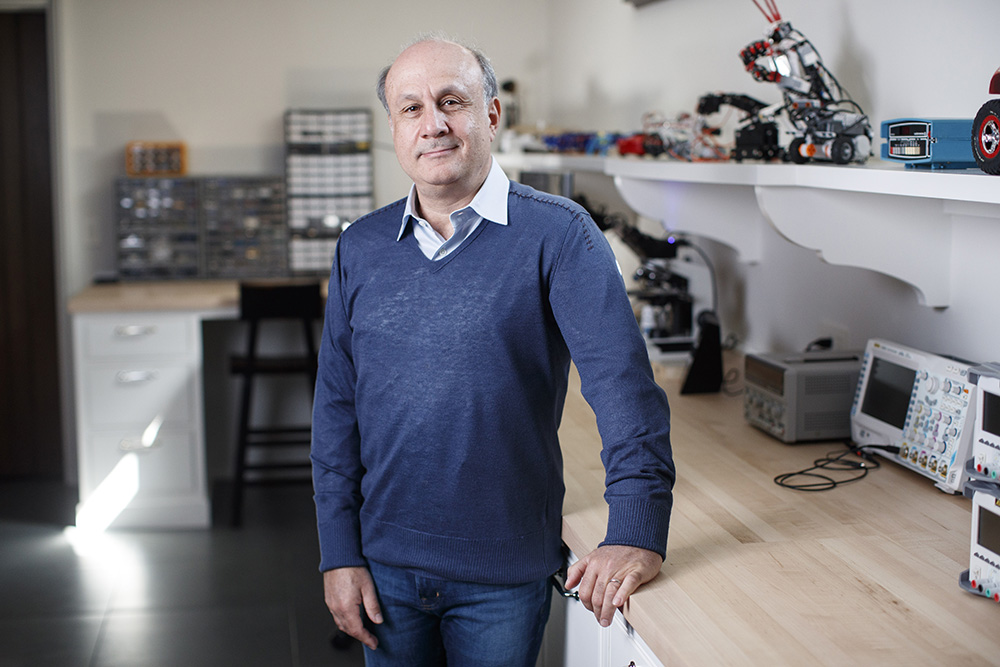
Professor Paris Smaragdis develops computers with superhuman hearing for applications like speech recognition, music understanding, and environmental monitoring.
Exploring how generative AI could make machine vision more accessible to businesses. The post GenEye in a Box: Making Machine Vision Something You Can Just Ask For appeared first on GPT-Lab.
Jennifer Neville did not want to go into computer science—but that’s exactly where she landed. Neville discusses the starts and stops that led to her professional sweet spot and her work identifying “surprising failures” making it hard for AI to handle complexity. The post What AI gets wrong and what failure teaches us appeared first on Microsoft Research.
Computer scientist, entrepreneur, and philanthropist will collaborate with the MIT Schwarzman College of Computing to advance AI and scientific discovery.
We use cookies to run the site and, with your consent, for analytics and to show ads.
See our Cookie Policy.