We present Gen Through the Lens, a camera-controllable image-to-video generation framework that synthesizes videos from a given reference image while enabling realistic and physically consistent camera operations. Unlike previous models that treat camera motion as abstract conditioning or rely on a single coordinate sy...
Shuai Li, Jinxu Xiang, Xinyuan Li et al.· 0 citations
Predictive video representations do not by themselves specify how a multimodal system should handle missing sensors. We transfer frozen V-JEPA2 features to a set of heterogeneous sensors comprised by RGB video, depth video, and radar time series. A shared fusion model uses modality queries, fixed sensor slots, and expl...
The introduction of long chain-of-thought (CoT) reasoning and external tools has substantially improved the performance of multimodal large language models (MLLMs) on general and reasoning tasks. However, existing fast-slow reasoning paradigms mainly regulate textual reasoning length, while visual computation introduce...
Quan-Lin Chen, Xiu-Wei Chen, Kun Xiang et al.· 0 citations
Parametric Computer-Aided-Design (CAD) modeling from human intent remains challenging, particularly during the conceptual design stage, where design goals are expressed through incomplete and unstructured modalities (e.g., hand-drawn sketches and textual descriptions). In this work, we rethink the human intent-to-CAD p...
ELECT, which instead settles cross-frame identity before final rendering through a language-guided scene-entity mapping and stationary anchors elected from the model's own drafts, shows that long-horizon consistency need not require increasingly expensive inter-frame conditioning as stories grow.
Mehrajul Abadin Miraj, M. Hasan, M. Farzana et al.· 0 citations
World models and video understanding models are increasingly deployed in dynamic visual environments, yet their robustness to physical adversarial threats remains largely underexplored. We study whether a single physical adversarial texture can mislead the victim model across different real-world scenarios where observ...
Song Xia, Meiwen Ding, Chenqi Kong et al.· 0 citations
The inherent variability of fMRI responses across trials encourages a generative view of the stimulus-to-response mapping. Prior generative encoders often operate in compressed latent spaces and condition predominantly on semantic features, which provide limited low-level cues for early visual cortex. We propose StimFl...
Bui Van Hung, Dang Thanh Vu, Hoang-Son Vo et al.· 0 citations
Recently, AutoRegressive Visual Generation (ARVG) models have emerged as a competitive paradigm for high-quality image synthesis. However, their substantial computational and memory demands make them difficult to deploy on resource-constrained edge devices. Post-Training Quantization (PTQ) provides a promising solution...
Xinmeng Liu, Xianglong Yan, Kaicheng Yang et al.· 0 citations
We present Co-DSL, a framework in which users and LLMs co-design reusable spatial concepts for layout generation. In the first stage, our system allows users to create a library of personalized operations. To add a concept, a user provides a description, which the LLM converts into an initial implementation. The user c...
R. Kenny Jones, Jiajun Wu, Maneesh Agrawala· 0 citations
The accuracy of detecting protein crystals for fluorescence microscopy images is very critical for high throughput and automated systems. Although the trace fluorescent labeling method could highlight protein crystals, reflection and emission from the fluorescence dye is not always due to crystal regions. Therefore, th...
Truong X. Tran, Marc L. Pusey, Ramazan S. Aygun· 0 citations
Depth estimation and Gaussian reconstruction share a need for multi-scale feature processing, yet use different prediction interfaces and training objectives. Whether a decoder's internal computation can be optimized once and reused across these systems remains a structural design question. Search over primitive config...
Traffic sign recognition plays a crucial role in the development of autonomous cars to reduce the accident rate and promote road safety. It has been a necessity to address traffic signs that are affected significantly by the environment as well as poor real-time performance for deep-learning state-of-the-art algorithms...
Reem Abdel-Salam, Rana Mostafa, Ahmed H. Abdel-Gawad· 0 citations
Exploring how generative AI could make machine vision more accessible to businesses. The post GenEye in a Box: Making Machine Vision Something You Can Just Ask For appeared first on GPT-Lab.
Jennifer Neville did not want to go into computer science—but that’s exactly where she landed. Neville discusses the starts and stops that led to her professional sweet spot and her work identifying “surprising failures” making it hard for AI to handle complexity. The post What AI gets wrong and what failure teaches us appeared first on Microsoft Research.
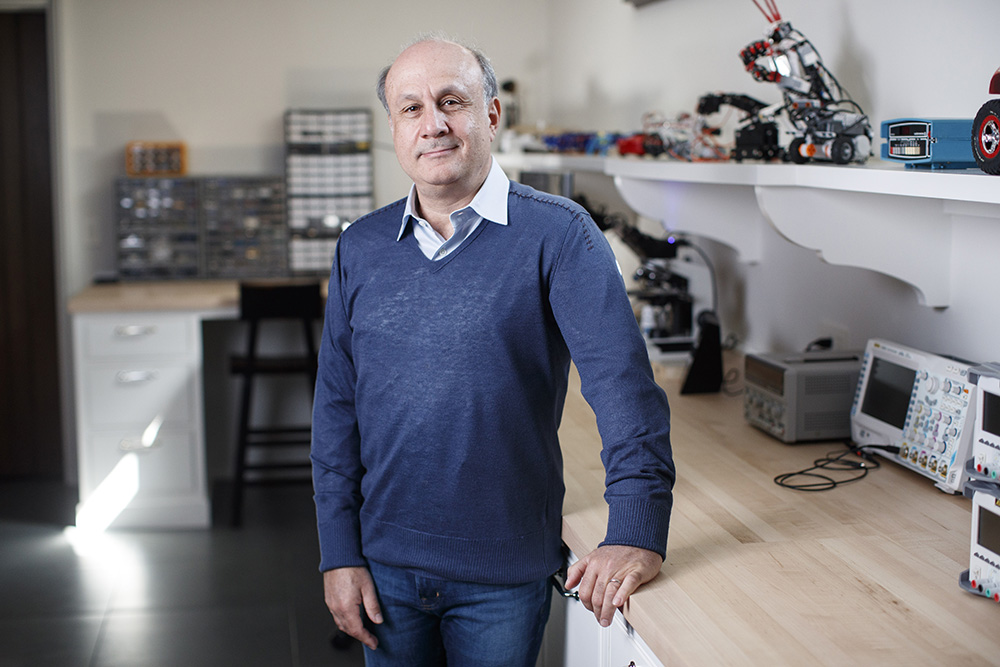
Computer scientist, entrepreneur, and philanthropist will collaborate with the MIT Schwarzman College of Computing to advance AI and scientific discovery.