Multimodal skin lesion classification combines clinical images with patient metadata to improve diagnostic accuracy. However, complete metadata available during training may be only partially accessible at deployment, and resource-constrained settings additionally require computational efficiency. We address these chal...
Anirban Barua, Md Mahir Abrar Khan, Ayman Iktidar et al.· 0 citations
Recovering executable CAD programs from 3D meshes is challenging due to the compositional nature of CAD construction and the interaction between discrete modeling choices and continuous parameters. Many learning-based methods predict complete programs in a single pass and rely predominantly on sketch-extrude representa...
This work addresses the task of controllable interior image editing, where the goal is to turn artificial light sources on or off while preserving the scene geometry, object placement, materials, and visual identity of the original image.
Petr Golenderov, Dmitry Mazyar, Natalia Sovpel et al.· 0 citations
Modern artificial intelligence (AI) systems are powered by foundation models. This paper presents a new set of foundation models, called Llama 3. It is a herd of language models that natively support multilinguality, coding, reasoning, and tool usage. Our largest model is a dense Transformer with 405B parameters and a...
Most successful self-supervised learning methods are trained to align the representations of two independent views from the data. State-of-the-art methods in video are inspired by image techniques, where these two views are similarly extracted by cropping and augmenting the resulting crop. However, these methods miss a...
Adri\`a Recasens, Pauline Luc, Jean-Baptiste Alayrac et al.· 0 citations
Nighttime lights from NASA's Black Marble product suite capture thermal and light emission signals from anomalous events including fires, volcanic eruptions, and gas flaring. Existing detection approaches rely primarily on thermal bands, limiting sensitivity to weaker signals. We propose a novel machine learning framew...
Proactive AI assistants continuously observe a user's activity and decide whether to provide new guidance or remain silent. They should provide appropriate guidance for the task, determine when to provide the next guidance based on task progress, and adjust the guidance level to the user's expertise and needs. Supporti...
Jin-Seop Lee, TaeYeon Won, SeongJun Jung et al.· 0 citations
Prior audio-visual self-supervised learning methods rely on mechanisms such as EMA target encoders, prediction heads, reconstruction decoders, and contrastive losses. We introduce LeAVJEPA, the first audio-visual encoder trained under LeJEPA's collapse-free objective. A single early-fusion Vision Transformer processes...
B. Robson, Santeri Mentu, Wen-Shuai Zhao et al.· 0 citations
Learned feature representations in neural networks often contain structure beyond that directly used by the final task output. We study this structure using $\textit{passive probes}$ that apply fixed, untrained, property-independent projections to representations as they evolve during training. We motivate this approac...
Ultrasound is widely used, but acquisition quality is heavily dependent on the operator's knowledge and expertise. With demand for examinations outpacing the supply of trained sonographers, operator-guidance systems aim to close this gap by instructing a less trained user how to move the probe toward a target view. In...
Noortje I. P. Schueler, Hans van Gorp, Ruud J. G. van Sloun· 0 citations
Reward post-training of flow models either reweights the model's own samples under a KL penalty or a frozen reference, often for thousands of updates, or backpropagates the reward and moves every sample without checking that the move is worth its size. We introduce MEND, a reinforcement learning method built on proxima...
Shreshth Saini, N. Birkbeck, Yi-Lin Wang et al.· 0 citations
This work shows numerically how FM and OT can differ in routing while remaining close in cost, and constructs a routing-aware training coupling that yields a directionally consistent improvement in generation over a cost-matched, cost-only counterpart.
Professor Paris Smaragdis develops computers with superhuman hearing for applications like speech recognition, music understanding, and environmental monitoring.
Exploring how generative AI could make machine vision more accessible to businesses. The post GenEye in a Box: Making Machine Vision Something You Can Just Ask For appeared first on GPT-Lab.
Jennifer Neville did not want to go into computer science—but that’s exactly where she landed. Neville discusses the starts and stops that led to her professional sweet spot and her work identifying “surprising failures” making it hard for AI to handle complexity. The post What AI gets wrong and what failure teaches us appeared first on Microsoft Research.
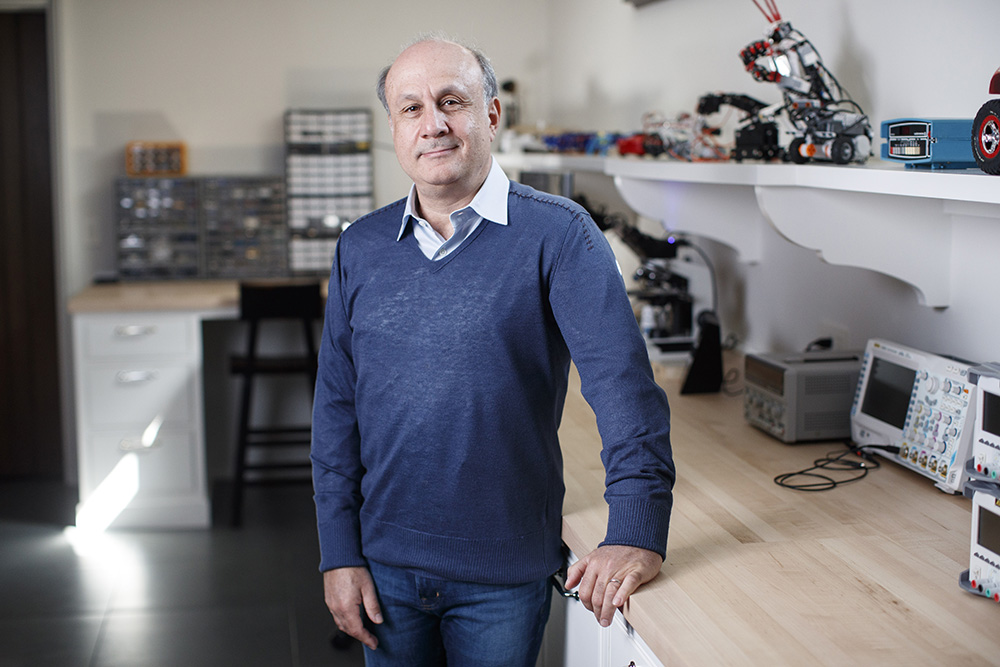
Computer scientist, entrepreneur, and philanthropist will collaborate with the MIT Schwarzman College of Computing to advance AI and scientific discovery.
We use cookies to run the site and, with your consent, for analytics and to show ads.
See our Cookie Policy.