Cleaned OpenStreetMap-derived walk, bike, and car networks for Switzerland (plus a cross-border buffer for realistic frontier-cell routing), with per-edge calibrated travel durations. These are the networks used to compute the companion accessibility metrics dataset: https://doi.org/10.5281/zenodo.21410968. Contents 1)...
Marco Miotti, Arnór B. Elvarsson, Yves M. Räth et al.· Zenodo (CERN European Organi...· 0 citations
Description This repository contains the derived audio features, statistical results, robustness analyses, and Python source code accompanying: Long-Term Changes in Multiband Stereo Characteristics of Grammy-Nominated Popular Music Recordings (1995–2026) The study analyzes 536 Grammy-nominated recordings from 1995–2026...
Jooyoung Kim· Zenodo (CERN European Organi...· 0 citations
From the prime sequence, a free scale constant, and a selection predicate, we prove three things. The selected polytope is the 4-simplex Σ4Σ4. The Hessian of its squared volume at the regular point is (l6/2304)(−5I+2A)(l6/2304)(−5I+2A), with spectrum +7,−3,−9+7,−3,−9 and signature (+1,−9)(+1,−9). Every S5S5-invariant...
Version 1.0 of this record claimed that the octahedral-void network of the BCC Planck foam has nearest-neighbour spacing shorter than the bubble spacing, and that voids therefore propagate at c_V = c√(3/2) ≈ 1.22c, supplying a finite-speed mechanism for Bell non-locality. That result is withdrawn. Two errors are identi...
Luke Martin· Zenodo (CERN European Organi...· 0 citations
Reach audiences
Advertise in front of researchers, engineers, and readers.
A stable spin one half particle with unit electric charge and one Dirac unit of magnetic charge is examined at 1.86 TeV, with a 3 TeV monopole as a second benchmark. In the ATLAS barrel it reaches the electromagnetic calorimeter only if its initial velocity exceeds 0.45c at central rapidity and 0.62c at the edge of the...
Robert Bruce Ware· Zenodo (CERN European Organi...· 0 citations
A stable spin one half particle with unit electric charge and one Dirac unit of magnetic charge is examined at 1.86 TeV, with a 3 TeV monopole as a second benchmark. In the ATLAS barrel it reaches the electromagnetic calorimeter only if its initial velocity exceeds 0.45c at central rapidity and 0.62c at the edge of the...
Robert Bruce Ware· Zenodo (CERN European Organi...· 0 citations
Cost-driven interest in running large language models (LLMs) on non-mainstream silicon outpaces the maturity of the surrounding software stacks. This paper uses one such platform, the AMD BC-250 (a repurposed cryptocurrency-mining board with a GFX1013 "Cyan Skillfish" accelerated processing unit (APU), 16 GB of unified...
Artur Andrzejczak· Zenodo (CERN European Organi...· 0 citations
On-device multimodal small language models are emerging as a practical foundation for privacypreserving edge intelligence, enabling devices to interpret and generate language while processing
images, audio, video, sensor streams, and contextual signals without continuous cloud
dependence. Their deployment can reduce da...
Stanley Nwakamma· WORLD JOURNAL OF INNOVATION...· 1 citation
Cost-driven interest in running large language models (LLMs) on non-mainstream silicon outpaces the maturity of the surrounding software stacks. This paper uses one such platform, the AMD BC-250 (a repurposed cryptocurrency-mining board with a GFX1013 "Cyan Skillfish" accelerated processing unit (APU), 16 GB of unified...
Artur Andrzejczak· Zenodo (CERN European Organi...· 0 citations
The $k$-th power of a simple graph $G$, denoted $G^k$, is the graph with vertex set $V(G)$ where two vertices are adjacent if they are within distance $k$ in $G$. We investigate the zero forcing number of graph powers. Powers of graphs are much denser and generally not encompassed by existing results on zero forcing of...
A. Abiad, Mary Flagg, Sina Ghasemi Nezhad et al.· 0 citations
A logical measurement reads out protected information, and the noise it survives sets how much a quantum computation can absorb. Gauging builds one from a graph on the measured qubits, one extra qubit on each edge, turning a global operator into local parity checks. Its tolerance splits in two: the distance of the code...
We study bootstrap percolation with independent vertex thresholds taking values one and two, with threshold-one probability $(1-c/d)/d$ for fixed $c>0$. The seed set is chosen uniformly among sets of a prescribed deterministic size, independently of the graph and thresholds. We prove threshold statements at fixed relat...
A new computational approach reveals how cells communicate to assemble into tissues. This could accelerate stem cell engineering, improve disease models, and inform therapies.
Microsoft Research Blog· microsoft.comOct 15, 2026
Zero-knowledge proofs can verify computing results without rerunning workloads or exposing sensitive data. Magnetar helps bring them into the mainstream with support for standard programming languages, major speed gains, and quantum-resistant security. The post Proof-based general-purpose computing with Magnetar appeared first on Microsoft Research.
MIT News · Artificial Intelligence· news.mit.eduOct 8, 2026
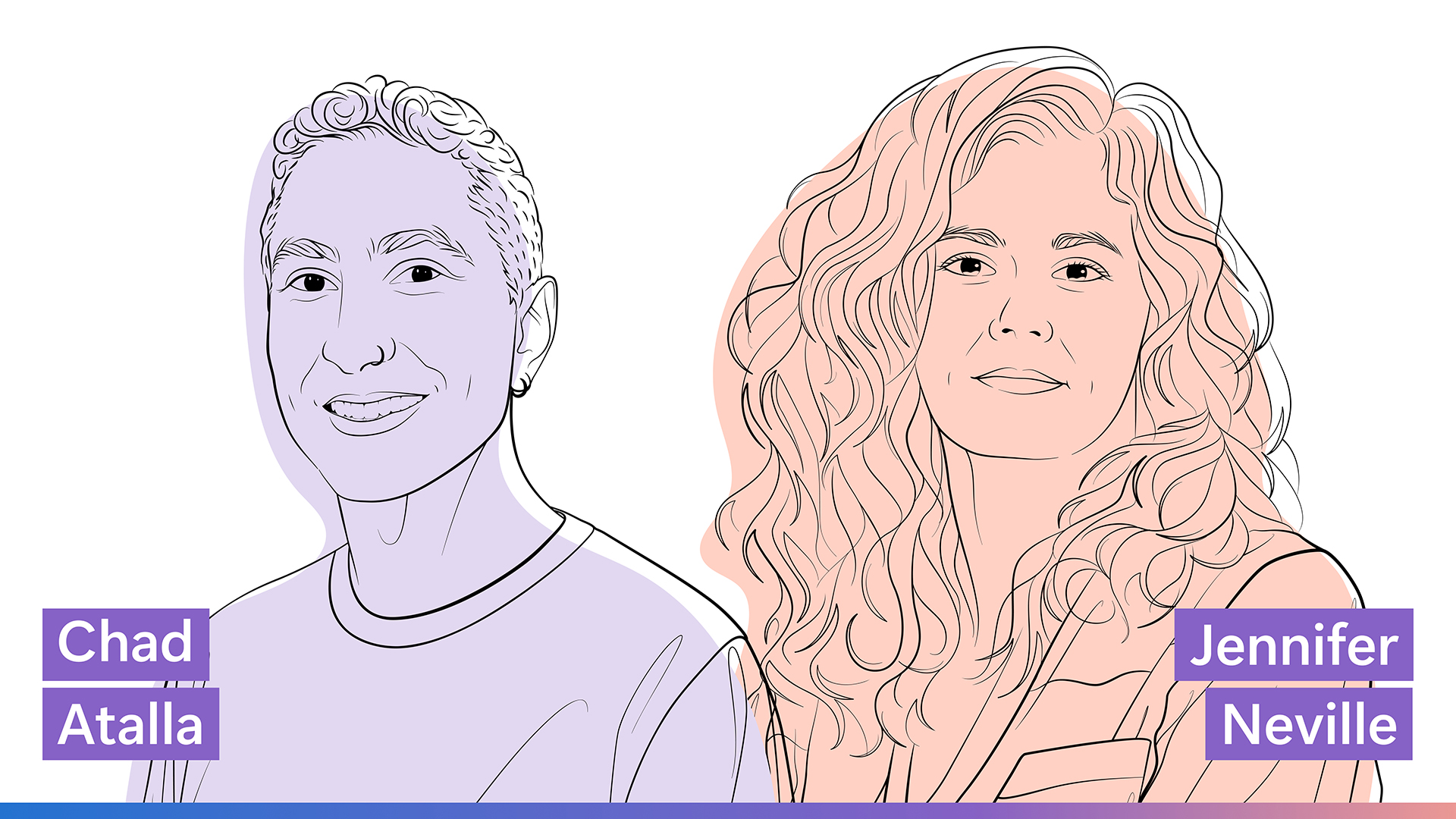
Jennifer Neville did not want to go into computer science—but that’s exactly where she landed. Neville discusses the starts and stops that led to her professional sweet spot and her work identifying “surprising failures” making it hard for AI to handle complexity. The post What AI gets wrong and what failure teaches us appeared first on Microsoft Research.
We use cookies to run the site and, with your consent, for analytics and to show ads.
See our Cookie Policy.