The Positive Queue is introduced as a positive counterpart to Reddit's modqueue: a dedicated space for moderators to discover contributions and behaviors they want to encourage and positively reinforce, and conceptualize positive moderation as recognition infrastructure that shapes what moderators notice, whose judgmen...
Charlotte Lambert, Agam Goyal, Eunice Mok et al.· 0 citations
HCI often draws on users' articulated needs and expectations to explore design opportunities for emerging technologies. Yet, these accounts are shaped by how technologies take form over time. We examine this dynamic through a two-phase interview study of enterprise AI in a project-based software development organizatio...
Qing Xiao, Xinlan Emily Hu, Mark E. Whiting et al.· 0 citations
The results suggest that differences in both experience with values and professional domain can impact how values are translated into designs, and that while software engineers did not misunderstand the principles, theologians had a broader understanding.
L. Conwill, Megan K. Levis, Karla A. Badillo-Urquiola et al.· 3 citations
This work positions children as active participants in the search process, framing it as a scaffolded learning experience rather than a simple retrieval task.
D. M. Tobia, Hrishita Chakrabarti, M. S. Pera et al.· 0 citations
Reach audiences
Advertise in front of researchers, engineers, and readers.
Background-adaptive contrast enhancement thus becomes part of the object's compositing properties, reducing the design and maintenance of separate color variants, and is implemented in the same WebGL pipeline, with no sustained additional runtime observed.
MedVA is presented, an end-to-end neuro-symbolic agentic system for medical volume visualization that addresses limitations through three complementary agents and provides more complete, clinically grounded ROI specifications than MLLM-only reasoning.
Haill An, Suhyeon Kim, Min-Jun Kang et al.· 0 citations
As conversational AI systems increasingly operate in sensitive domains, the central challenge shifts from usability to trust calibration, ensuring that users rely on systems neither too much nor too little. Systems that provide advice or interpretations risk encouraging inappropriate reliance, particularly when users p...
R. Hassan, Nahla Aboromi, Naomi Unkelos-Shpigel· 0 citations
This work introduces the CAST framework to connect measurement choices with person-specific models of exposure, behavior, physiology, and experience and proposes four synchronized measurement modules linking mobile and wearable data with self-reports and intervention responses.
D. Grüning, Jasper Doeninghaus, Zina Efchary et al.· 0 citations
Existing Parsons problem tools primarily focus on correctness, indicating whether a student solved a problem, but providing limited visibility into the underlying problem-solving process. We address this gap by introducing Pulla, a Parsons problem tool that instruments programming assignments to capture fine-grained in...
Daniel Prol, Juho Leinonen, A. Hellas et al.· 0 citations
An in-the-wild study of task planning using time-stamped logs of 24,265 tasks from 957 users of a widely used daily planner app, observed over six weeks alongside self-reported surveys to support evaluating planning tools across the task lifecycle.
Srija Halder, I. Zimmermann, Linnea Körte et al.· 0 citations
The findings inform timely, comprehensible support and reassuring social presence in simulated dental VR; they concern the complete package rather than individual modules or clinical effectiveness.
Zhu Guo, Jun-Jie Zhao, Hao-Fan He et al.· 0 citations
Durable skills, such as collaboration, creativity and critical thinking, are instrumental to success in the modern workforce. Yet, measuring these skills remains a persistent challenge. Moreover, because what is not measured is often not taught, these skills are often overlooked in mainstream educational curricula. Des...
Amir Globerson, A. Keeling, Anisha Choudhury et al.· 0 citations
AI agents can generate code at a scale that’s hard for humans to review line-by-line. PDD Kit helps ensure the code is doing what the developer intended by creating formal specifications and testing against them. It converts developer intent into a Verus specification, proves AI-generated code meets it for every input, and uses tests where proofs aren't practical. Developers review intent, not every line. The post Formally verifying agent-written full-stack web apps with PDD Kit appeared first o…
Professor Paris Smaragdis develops computers with superhuman hearing for applications like speech recognition, music understanding, and environmental monitoring.
MIT News · Artificial Intelligence· news.mit.eduOct 23, 2026
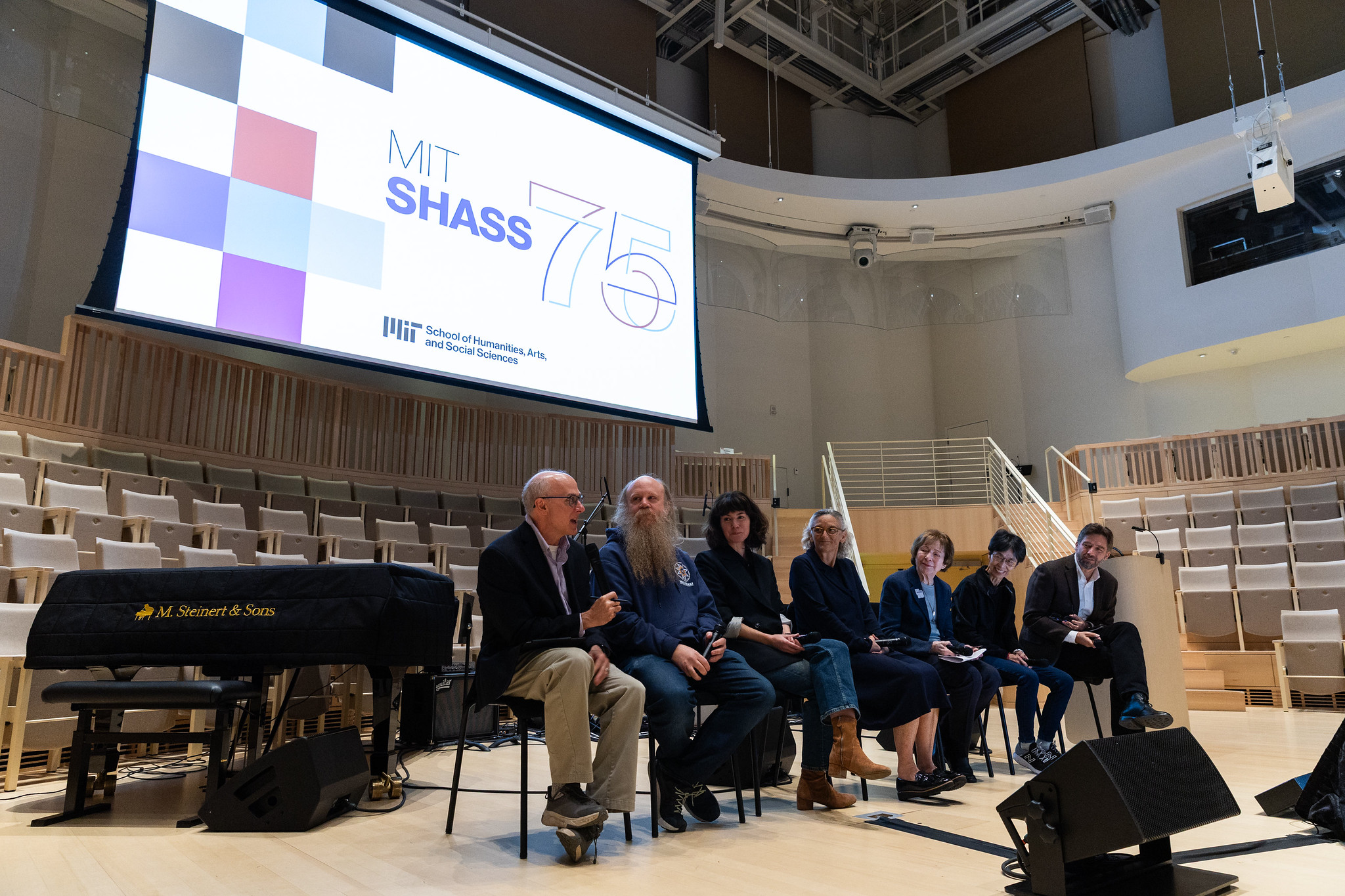
During the School of Humanities, Arts, and Social Sciences’ 75th Anniversary Symposium, President Sally Kornbluth said “MIT has never needed your particular insight and guidance more than we do now.”
MIT News · Artificial Intelligence· news.mit.eduOct 23, 2026
Assistant Professor Benjamin Lindquist studies how engineers deliberately injected randomness into early AI, giving rise to deep-learning models that sometimes hallucinate.
MIT News · Artificial Intelligence· news.mit.eduOct 22, 2026
“X-Hinges” helps design and 3D print items like lamps and gloves with an interactive twist: automatically embedded sensors that perceive and adaptively respond to human contact.
We use cookies to run the site and, with your consent, for analytics and to show ads.
See our Cookie Policy.