Most knowledge of graphical perception comes from behavioral studies. Understanding from a neural perspective is much more limited due in part to neuroimaging studies'expensiveness and difficulty to conduct. In this paper, we evaluate whether Meta's Tribe V2 neural encoding model can recover neural contrasts from a vis...
Botto is often described as a decentralized autonomous artist, but its authorship cannot be located in image generation alone. This paper examines Botto as an agentic curatorial system in which generation, ranking, voting, feedback, and minting form a recursive loop. Drawing on Botto's documentation and prior accounts...
AI model updates and service withdrawals can disrupt relationships with AI companions, but research has largely examined individual platform events. Less is known about users' responses when multiple providers implement shared national regulations. We examine users' reactions and collective contestation surrounding Chi...
Yunhao Yuan, Kejia Zhang, Yuqi Niu et al.· 0 citations
Can interacting with someone from 1930, with no knowledge of what happened after, influence a person's perception of the past? People reason about the present against a picture of the past without observing it. The past is reconstructed from memory and testimony, but this reconstruction has been filtered through everyt...
Hiromu Yakura, Robin Schimmelpfennig, Ezequiel Lopez-Lopez et al.· 0 citations
Reach audiences
Advertise in front of researchers, engineers, and readers.
Online handwriting captured on digitizing tablets yields hundreds of kinematic, temporal, spatial, and dynamic features. These features are rarely organized into interpretable, reusable constructs, and, although standardized tests norm the handwritten product, no openly available instrument places a child's handwriting...
It is discussed how HCI might engage more carefully with such contested concepts, and it is warned that without pluralistic understanding, academic discourse risks a spiral of silence.
The findings show that avatar-based representations improved collaborator awareness and attentional guidance over cursor cues, while excessive embodiment introduced occlusion, distraction, and additional workload.
A dynamic cognitive organization framework is proposed that shifts analysis from construct-level change to relational organization anchored in the person's current task-cognitive state under sustained AI participation, and proposes a path-specific recursive principle whereby interaction outcomes, costs, and experiences...
This paper considers the viewer's immediate interaction with a source artifact and generative AI, and examines what becomes consequential when the viewer's sensemaking takes communicative form, including communicative commitment, the legibility of transformations and source relationships, and the literacy required to i...
It was found that both AI summaries and user reviews influenced participants' opinions, with negative summaries having a larger effect than positive ones and negative summaries having a larger effect than positive ones.
Wang Claire, Agam Goyal, Frederick Choi et al.· 0 citations
Foundational frameworks in visualization have operationalized literacy as an individual competency, measured through chart-comprehension tasks. This focus raises a question: why has measurement become the dominant frame for understanding literacy? Rather than asking whether literacy should be measured, we ask how measu...
It is argued that the value of micro-RCTs for educational AI lies not in replacing definitive evaluation with small studies, but in enabling a rapid, cumulative evaluation architecture in which randomised estimates can be generated, replicated and updated as technologies and their implementation evolve.
W. Harrison, Rahil Khowaja, E. Dobson et al.· 0 citations
AI agents can generate code at a scale that’s hard for humans to review line-by-line. PDD Kit helps ensure the code is doing what the developer intended by creating formal specifications and testing against them. It converts developer intent into a Verus specification, proves AI-generated code meets it for every input, and uses tests where proofs aren't practical. Developers review intent, not every line. The post Formally verifying agent-written full-stack web apps with PDD Kit appeared first o…
Professor Paris Smaragdis develops computers with superhuman hearing for applications like speech recognition, music understanding, and environmental monitoring.
MIT News · Artificial Intelligence· news.mit.eduOct 23, 2026
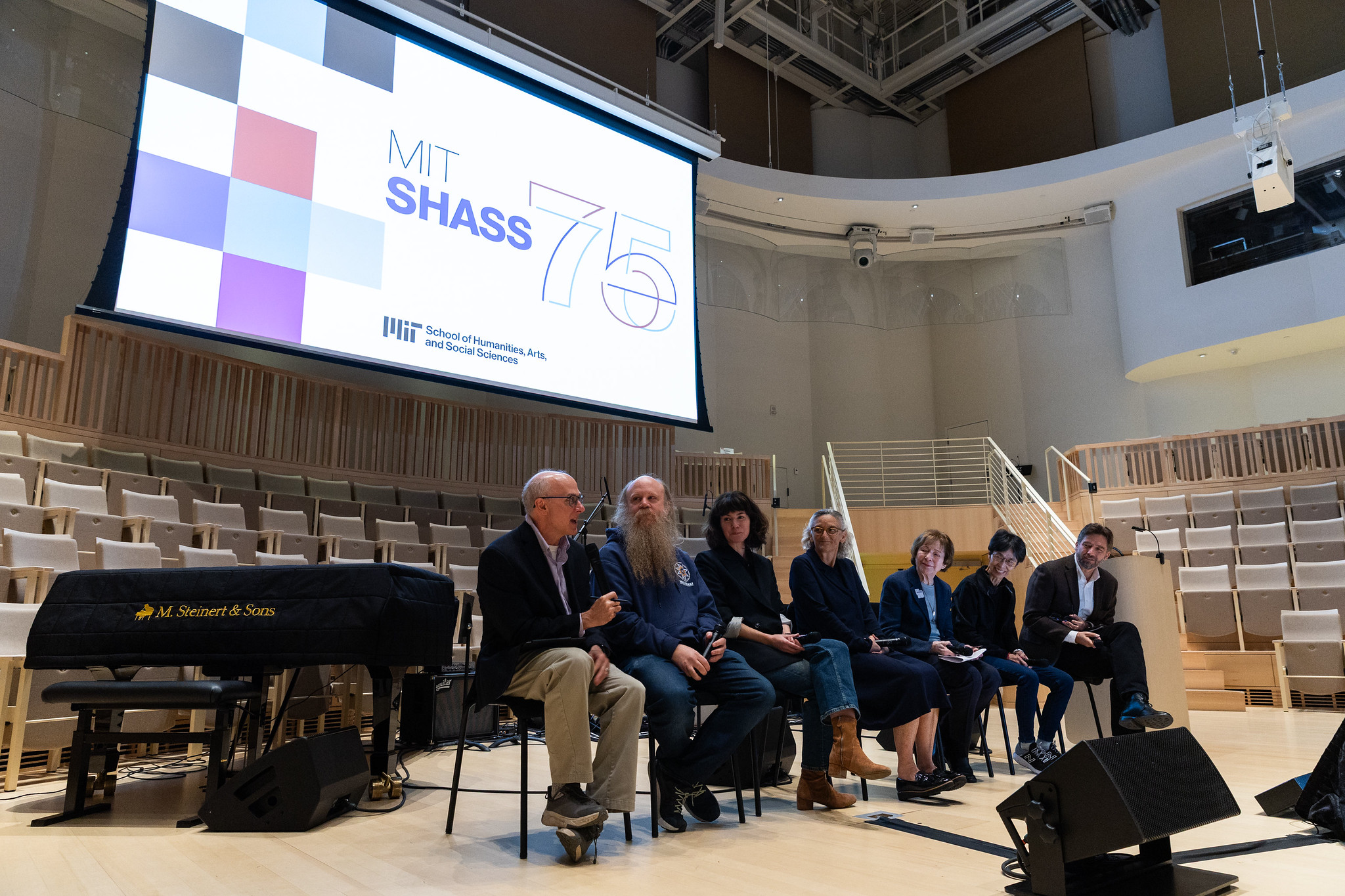
During the School of Humanities, Arts, and Social Sciences’ 75th Anniversary Symposium, President Sally Kornbluth said “MIT has never needed your particular insight and guidance more than we do now.”
MIT News · Artificial Intelligence· news.mit.eduOct 23, 2026
Assistant Professor Benjamin Lindquist studies how engineers deliberately injected randomness into early AI, giving rise to deep-learning models that sometimes hallucinate.
MIT News · Artificial Intelligence· news.mit.eduOct 22, 2026
“X-Hinges” helps design and 3D print items like lamps and gloves with an interactive twist: automatically embedded sensors that perceive and adaptively respond to human contact.
We use cookies to run the site and, with your consent, for analytics and to show ads.
See our Cookie Policy.