This work provides a conceptual foundation for governance-aware, adaptable, and AI-first software engineering methods by proposing a metamodel that treats autonomy not as a fixed property of an actor, but as a derived, situation-dependent authority assignment determined by task, context, and collaboration pattern.
Mahade Hasan, M. Hasan, Zhe-Ying Zhang et al.· 0 citations
This study examines the structural dynamics of Truth Social, a politically aligned social media platform, during two major political events: the U.S. Supreme Court's overturning of Roe v. Wade and the FBI's search of Mar-a-Lago. Using a large-scale dataset of user interactions based on re-truths (platform-native repost...
Student-generated metaphors about mathematics can provide insights into students'attitudes, beliefs, identities, and experiences, but expert human assessment through thematic coding of these semantically complex metaphor responses is labor-intensive and difficult to scale. This study examines whether Low-Rank Adaptatio...
Liang Zhang, Stephen Hwang, Yue Ma et al.· 0 citations
Religion is an important part of many people's lives, with reading from religious texts being among the most common and important regular practices. Modern technology has changed the way this religious reading takes place, but the interaction of technology with religious reading has not been studied in detail. In this...
Teancum Price, Musa Blake, J. Prather et al.· 0 citations
Reach audiences
Advertise in front of researchers, engineers, and readers.
Immersive video differs from conventional flat 2D video in that it is experienced as 180-degree stereoscopic video on a head-mounted display, thereby eliciting bodily and spatial subjective experience. Previous studies have shown that viewing and interpersonal distance affect Presence; however, it remains insufficientl...
Koichi Toida, H. Hiranuma, Shimpei Miura et al.· arXiv.org· 3 citations
Earinter, a commodity-earbud-based closed-loop system that integrates in-the-wild sensing, real-time reasoning, and theory-grounded just-in-time (JIT) intervention to regulate eating pace during daily meals, is presented.
Jun Fang, Ka I. Chan, Xiyuxing Zhang et al.· Proceedings of the ACM on In...· 1 citation
This work understands robots in public spaces not in terms of autonomy or intelligence, but as a relational capacity, which implies designing robots not in the authors' image or for their utility, but grounded in their needs in being and becoming together.
Victor Tuan Vu Pham, Judith Dörrenbächer, Thomas H. Weisswange et al.· 0 citations
A Kinematics-Aware Decoupled Learning Network for robust 3D hand pose estimation and a task-decoupled hierarchical multitask framework, which separates 2D joint localization from depth estimation and incorporates a dedicated multitask learning strategy for depth regression.
Jun Lu, Zhen-Ming Chen, Lin Chen et al.· 0 citations
The Causal Context-Gated Forecaster (CCGF), which encodes a 60-frame pre-dropout history of gaze and head pose and combines it with DINOv3 scene features and evaluates two scene conditions: Live, in which the scene representation continues to update during tracker loss, and Frozen, in which the final pre-dropout repres...
This work investigated post-task workflows: editable, graph-based representations of an agent's completed execution that improve their understanding and error detection over a prompt-only condition, and found that validation succeeded mainly when users cross-checked across multiple evidence sources.
Ze-Kun Wu, Xin-Ru Wang, R. Pang et al.· 0 citations
Scholars have long proposed third-party middleware as an alternative to centralized algorithmic feeds: feeds built and distributed by independent feed creators. This vision saw no large-scale instantiation until Bluesky, a decentralized microblogging platform, introduced custom feeds in 2023. Although central to the mi...
This work introduces earables as a direct, hands-free control platform for neurosurgery using tooth-click input and develops a real-time recognition pipeline whose classifier achieved a median macro F1-score of 98.6% under leave-one-subject-out cross-validation.
Jonas Hummel, Maximilian Burzer, Clara Sayffaerth et al.· 0 citations
AI agents can generate code at a scale that’s hard for humans to review line-by-line. PDD Kit helps ensure the code is doing what the developer intended by creating formal specifications and testing against them. It converts developer intent into a Verus specification, proves AI-generated code meets it for every input, and uses tests where proofs aren't practical. Developers review intent, not every line. The post Formally verifying agent-written full-stack web apps with PDD Kit appeared first o…
Professor Paris Smaragdis develops computers with superhuman hearing for applications like speech recognition, music understanding, and environmental monitoring.
MIT News · Artificial Intelligence· news.mit.eduOct 23, 2026
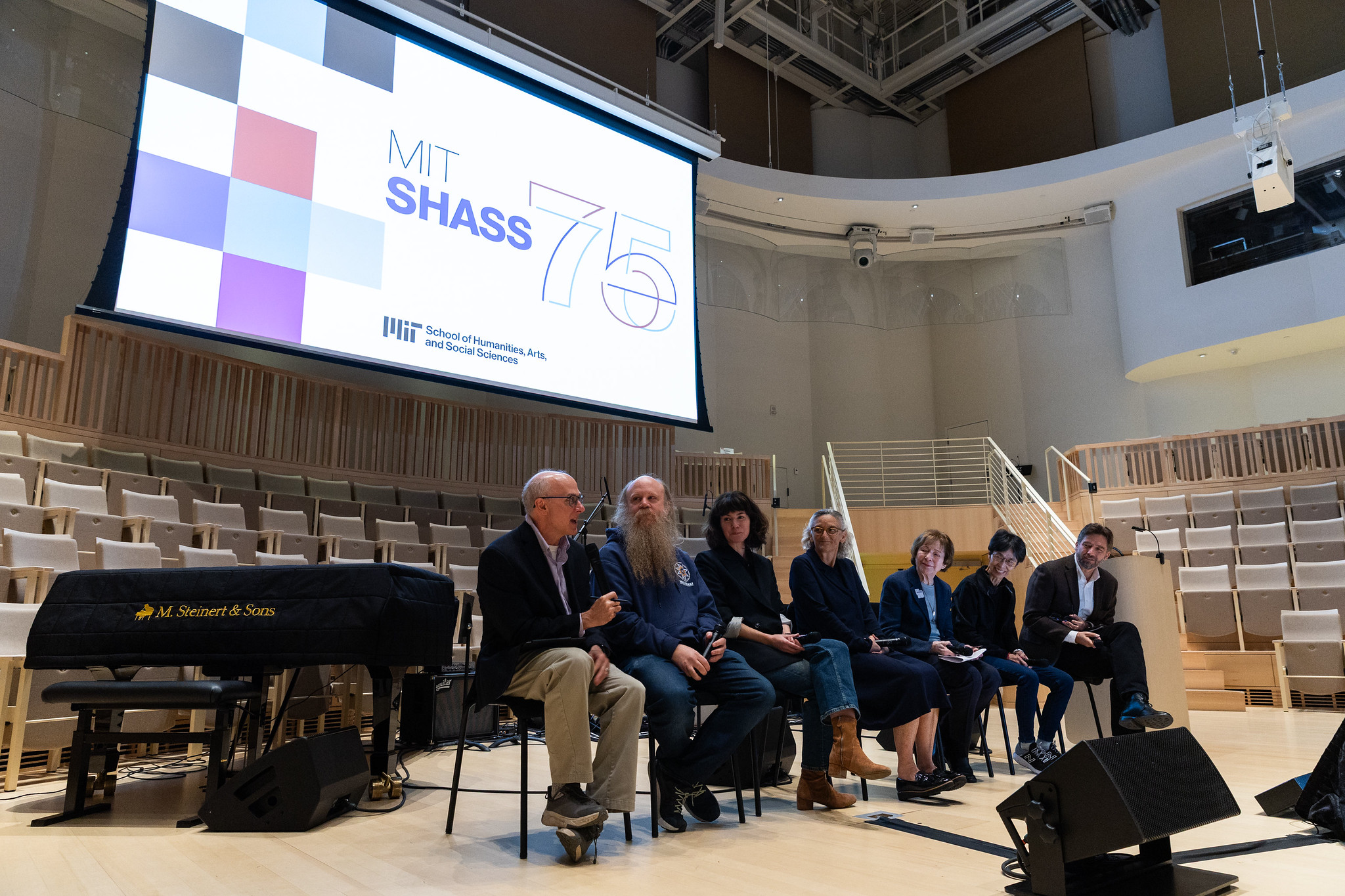
During the School of Humanities, Arts, and Social Sciences’ 75th Anniversary Symposium, President Sally Kornbluth said “MIT has never needed your particular insight and guidance more than we do now.”
MIT News · Artificial Intelligence· news.mit.eduOct 23, 2026
Assistant Professor Benjamin Lindquist studies how engineers deliberately injected randomness into early AI, giving rise to deep-learning models that sometimes hallucinate.
MIT News · Artificial Intelligence· news.mit.eduOct 22, 2026
“X-Hinges” helps design and 3D print items like lamps and gloves with an interactive twist: automatically embedded sensors that perceive and adaptively respond to human contact.
We use cookies to run the site and, with your consent, for analytics and to show ads.
See our Cookie Policy.