A large-scale study of CTA usage based on thousands of users in-the-wild unveils new understandings of user-CTA interaction flows, user intents, user intents, user conversational traits, and behavioral factors associated with user satisfaction.
Rafael Ferreira, Diogo Tavares, Diogo Glória-Silva et al.· 0 citations
This work investigates how students evaluate the accuracy, appropriateness, and assumptions in GenAI-generated analogies, and their perceptions of interest-personalized versus generic technical explanations, and describes interest-personalized analogies as more engaging or memorable than generic technical explanations.
This work mine the full commit histories of five public AI-skill repositories, a purposive sample of AI-tooling organizations, and a purposive sample of AI-tooling organizations from October 2025 to June 2026, and codes each edit with pre-registered governance, operation, and trigger-evidence codebooks.
The model abstracts how agents coordinate and co-regulate their cognitive cycles, providing a basis for analysing distributed cognition and designing cognitively interoperable human-AI systems.
Kolitha Kottagaha W.M, J.A.C. Bokhorst, B. Gaffinet et al.· 0 citations
Reach audiences
Advertise in front of researchers, engineers, and readers.
A methodological framework for autonomous, AI-based harvesting of cultural knowledge from the open web, designed to expand corpus coverage while intensifying per-entry data depth is presented, including the architectural guarantee that the machine never overwrites human contributions.
EmoMed is a multimodal medical consultation agent that adapts its responses based on users' emotional states while maintaining clinical accuracy, demonstrating that emotionally adaptive responses consistently outperform neutral baseline across evaluation dimensions, without compromising clinical accuracy.
I. Nasonov, Nikita Glazkov, Ivan Makovetskiy et al.· Lecture Notes in Computer Sc...· 0 citations
TEAM-Design is proposed, a rule that gives every task two replay probabilities, one per baseline, and it is proved that the rule solves this budgeted design problem, and that drawing the replays at random from recorded probabilities still controls the chance of wrongly declaring that the workflow beats both.
Artificial intelligence is usually analysed as a productivity technology, a labour-market shock, or a governance problem. This article argues that its deeper political significance may arise from a fourth channel: ontological displacement. Ontological displacement occurs when a technology weakens the socially recognise...
Kwan Hong TAN· Zenodo (CERN European Organi...· 0 citations
Inspired by the workflows of expert choreographers, CustomDance introduces a novel paradigm to AI-assisted choreography through three interconnected stages that highlights the significant creative utility and empowering potential of the authors' AI-assisted choreography paradigm, but also outperforms competitive baseli...
Xu-Long Tang, Kaixing Yang, Xiaohu Guo et al.· 0 citations
The potential of augmented reality head-mounted displays (AR-HMDs) to address the gap in coordination by facilitating the active maintenance of shared understanding regarding tasks, patient state, responsibilities, and ongoing clinical activity is investigated.
It is argued for shifting the field's focus from methods to models, along two complementary lines: existing tools let us characterize and compare what different models represent and compute, and whether a model can actually be understood by the humans who rely on it.
Julien Colin, Nuria Oliver, Thomas Serre· 0 citations
Thermal feedback can enrich immersive interaction, but thermoelectric devices often change temperature too slowly to match interactive timing. We present TherMosaic, a spatiotemporal thermal feedback approach that accelerates perceived temperature transitions by leveraging two perceptual mechanisms: spatial summation a...
Zining Zhang, Jiasheng Li, Myungin Lee et al.· 0 citations
AI agents can generate code at a scale that’s hard for humans to review line-by-line. PDD Kit helps ensure the code is doing what the developer intended by creating formal specifications and testing against them. It converts developer intent into a Verus specification, proves AI-generated code meets it for every input, and uses tests where proofs aren't practical. Developers review intent, not every line. The post Formally verifying agent-written full-stack web apps with PDD Kit appeared first o…
Professor Paris Smaragdis develops computers with superhuman hearing for applications like speech recognition, music understanding, and environmental monitoring.
MIT News · Artificial Intelligence· news.mit.eduOct 23, 2026
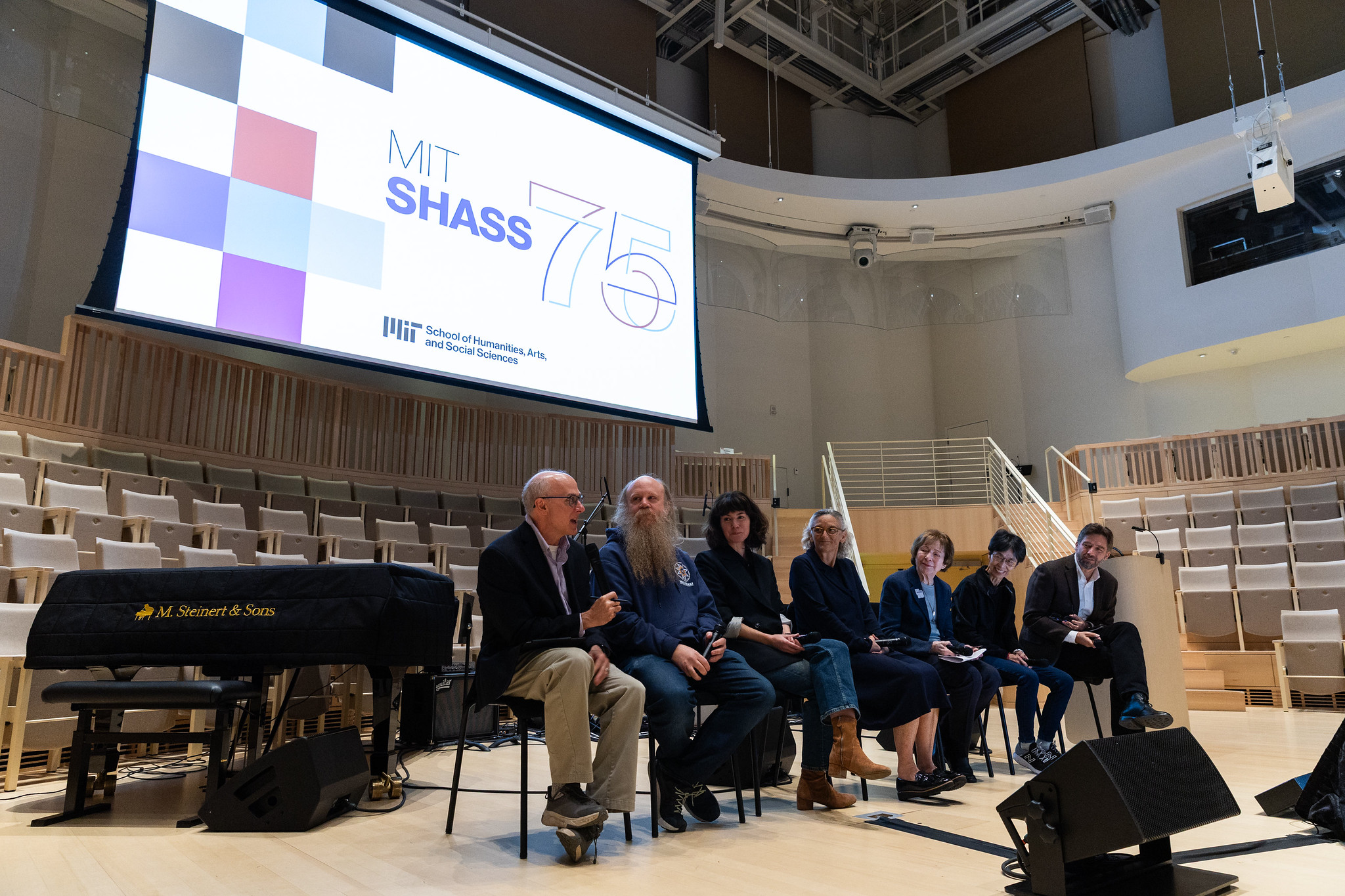
During the School of Humanities, Arts, and Social Sciences’ 75th Anniversary Symposium, President Sally Kornbluth said “MIT has never needed your particular insight and guidance more than we do now.”
MIT News · Artificial Intelligence· news.mit.eduOct 23, 2026
Assistant Professor Benjamin Lindquist studies how engineers deliberately injected randomness into early AI, giving rise to deep-learning models that sometimes hallucinate.
MIT News · Artificial Intelligence· news.mit.eduOct 22, 2026
“X-Hinges” helps design and 3D print items like lamps and gloves with an interactive twist: automatically embedded sensors that perceive and adaptively respond to human contact.
We use cookies to run the site and, with your consent, for analytics and to show ads.
See our Cookie Policy.