3D Gaussian avatars support fast rendering, however, their real-time animation is often challenged by the costly neural inference. We address this bottleneck and show that the animation of pretrained avatar models can be closely approximated by a linear combination of identity-independent blendshapes. Building on this...
Ramazan Fazylov, Stamatis Lefkimmiatis, Ivan Laptev· 0 citations
Quadrupedal locomotion requires balancing conflicting objectives such as command tracking, stability, and energy efficiency, yet conventional reinforcement learning (RL) hardcodes these priorities into a fixed scalar reward at training time. We present PROMO (Preference-Conditioned Multi-Objective Reinforcement Learnin...
Amr Mousa, Rifny Rachman, Neil Karavis et al.· 0 citations
Analytical charts in multimodal deep research encode quantitative claims, requiring every visualized value to be faithfully grounded in supporting evidence. Unlike retrieved images that mainly provide contextual information, charts require numerical fidelity: visualized values should not only match retrieved evidence q...
Yuxin Yue, Yingchen Zhang, Ruqing Zhang et al.· 0 citations
Complex problem solving depends on acting effectively and understanding how a system works. AI advice may support these outcomes unequally. Two preregistered experiments compared participants managing a simulated clothing factory with and without an LLM advisor. Across studies, AI-supported participants reported greate...
Robin Welsch· 0 citations
Reach audiences
Advertise in front of researchers, engineers, and readers.
This work presents three delegation episodes in which epistemic engagement proved practicable while remaining auditable, one public record where a recommendation was withdrawn on its own stated terms, and one failure case illustrating oversight that requires no reasons for its discretionary choices.
ABDA-NL adds a natural-language interface to ABDA, a system for argument-based discussion using ASPIC- knowledge bases under grounded semantics. Users see which conclusions are accepted, rejected, or undecided, open an interactive rendering of the grounded discussion game to learn why, explore what-if alternatives by s...
Shawn Bowers, Martin Caminada, Hao-Yang Liu et al.· 0 citations
Eliciting detailed and actionable software requirements from end-users is a critical phase in the iterative development of a software product or application. To ensure the feedback collected is detailed and actionable, software teams can leverage the laddering interview technique. While effective for ensuring granular...
Manjushree B. Aithal, Alexander Kotz, J. Mitchell· 0 citations
The rapid development of AI-driven tools, particularly large language models (LLMs), is reshaping professional writing. Still, key aspects of their adoption such as language support, ethics, and long-term impact on writers' voice and creativity remain underexplored. In this work, we carried out a questionnaire (N = 301...
Drawing on a multimodal corpus of public accounts, commentary, and representations from 2023 to 2026, two complementary concepts are contributed: the covert triad names a structural reconfiguration: a relationship that appears dyadic but operates triadically, with AI visible only to the partner who deploys it.
Extended interaction with large language models (LLMs) has been linked to the reinforcement of delusional beliefs, attracting clinical and public concern. Yet most empirical work evaluates model safety in brief interactions, which may not reflect how harms develop through sustained dialogue. Five LLMs were tested acros...
Luke Nicholls, Robert Hutto, Zephrah Soto et al.· 0 citations
Findings show that alt text written solely by DSO professionals has lower quality than alt text written with AI assistance, while AI assistance also helped DSO professionals write alt text more quickly and with greater confidence; however, they reported inefficacy in interactions with the AI.
Muhammad Raees, Yugo Iwamoto, Konstantinos Papangelis et al.· arXiv.org· 1 citation
AI agents can generate code at a scale that’s hard for humans to review line-by-line. PDD Kit helps ensure the code is doing what the developer intended by creating formal specifications and testing against them. It converts developer intent into a Verus specification, proves AI-generated code meets it for every input, and uses tests where proofs aren't practical. Developers review intent, not every line. The post Formally verifying agent-written full-stack web apps with PDD Kit appeared first o…
Professor Paris Smaragdis develops computers with superhuman hearing for applications like speech recognition, music understanding, and environmental monitoring.
MIT News · Artificial Intelligence· news.mit.eduOct 23, 2026
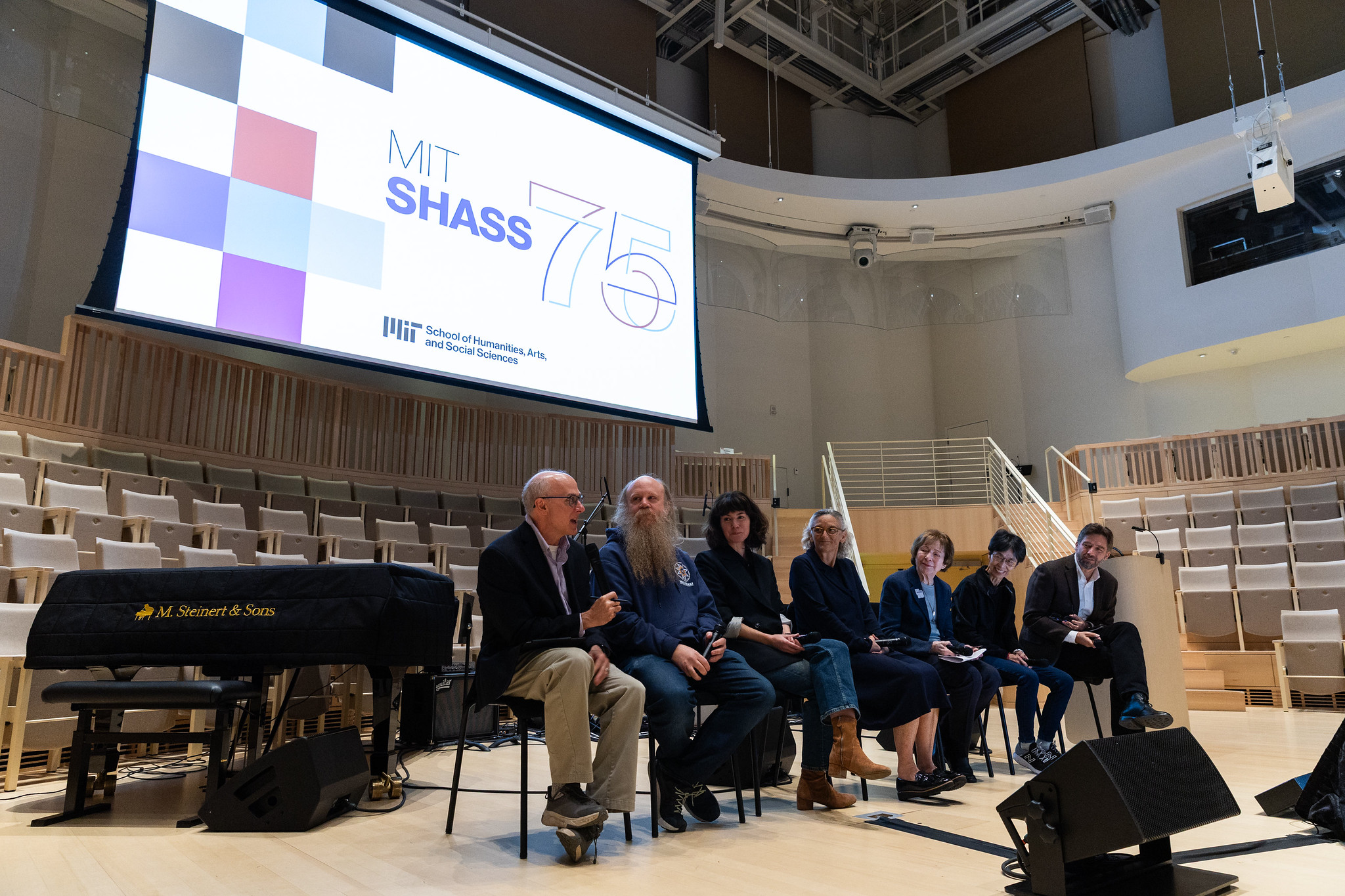
During the School of Humanities, Arts, and Social Sciences’ 75th Anniversary Symposium, President Sally Kornbluth said “MIT has never needed your particular insight and guidance more than we do now.”
MIT News · Artificial Intelligence· news.mit.eduOct 23, 2026
Assistant Professor Benjamin Lindquist studies how engineers deliberately injected randomness into early AI, giving rise to deep-learning models that sometimes hallucinate.
MIT News · Artificial Intelligence· news.mit.eduOct 22, 2026
“X-Hinges” helps design and 3D print items like lamps and gloves with an interactive twist: automatically embedded sensors that perceive and adaptively respond to human contact.
We use cookies to run the site and, with your consent, for analytics and to show ads.
See our Cookie Policy.