How students interact with artificial intelligence (AI) systems in educational settings may determine whether that interaction supports or displaces critical thinking. This paper introduces two contributions. The first is the Three Paths of Student-AI Interaction, a typological framework identifying three qualitatively...
Critique in design education depends on interpreting work in progress, articulating intentions and translating feedback into revisions. This technical report presents Critsly, an artefact-aware AI critique workspace, and StudioCrit, its architecture-studio research mode. Critsly combines a visual board, design-intentio...
The growing complexity in home energy management (HEM) demands advanced systems that guide occupants toward informed energy decisions reflecting their background, preferences, and context. Large language model (LLM)-integrated HEM systems (HEMS) have demonstrated promise, but previous studies relied on single-turn or s...
This work evaluates 10 JSON-style visualization DSLs with 41 tasks across 3 LLMs, then assess the generated specifications with JSON and rendering checks, and qualitative coding of failed cases.
Hang Chang, Andrew M. Mcnutt, Katherine E. Isaacs· 0 citations
Reach audiences
Advertise in front of researchers, engineers, and readers.
A review of indexed contributions from 2007 to 2026 finds that platform mentions shift from blogs toward Twitter and, more recently, Reddit, and how AI-mediated interactions complicate these questions is discussed.
The construction of most supervised learning datasets revolves around collecting multiple labels for each instance, then aggregating the labels to form a type of "true" label. We question the wisdom of this pipeline by developing a (stylized) theoretical model of this process and analyzing its statistical consequences,...
Topological Data Analysis (TDA) offers novel methods for understanding temporal dynamics in complex systems, yet its application in information systems design faces a fundamental challenge: how should systems present analytical outputs when interpretation frameworks are still developing? This paper reports on the devel...
UMAP achieves scalable layout optimization through stochastic negative sampling. However, this stochasticity can lead to unstable embeddings across reruns and downstream reuse, as the estimated repulsive forces depend on the ordering of sampling events. We present ibUMAP, a coherent field-based alternative that evaluat...
Bin Chen, Yu-Meng Xue, Patrick Paetzold et al.· 0 citations
Inferring human engagement from gameplay video is important for game design and player-experience research, yet it remains unclear whether vision--language models (VLMs) can infer such latent psychological states from visual cues alone. Using the GameVibe Few-Shot dataset across nine first-person shooter games, we eval...
Ziyi Wang, Qizan Guo, Rishitosh Singh et al.· 0 citations
Dialogue with a large language model can lead a person to insight: a sudden change in how they understand a problem. This perspective asks how model activity relates to insight as a dialogue unfolds. I propose that part of the intelligence expressed in dialogue arises from two interacting recurrences: each generated to...
Large language model (LLM) chatbots are increasingly reaching users through messaging platforms (e.g. WhatsApp). However, these systems remain largely proprietary and opaque, while academic research has focused on narrow, domain-specific assistants. This leaves open questions about how people use general-purpose LLMs a...
Hiba Eltigani, Rukhshan Haroon, Asli Kocak et al.· 0 citations
Large language models (LLMs) are increasingly shaping how information is created and disseminated, from companies using them to craft persuasive advertisements, to election campaigns optimizing messaging to gain votes, to social media influencers boosting engagement. These settings are inherently competitive, with sell...
AI agents can generate code at a scale that’s hard for humans to review line-by-line. PDD Kit helps ensure the code is doing what the developer intended by creating formal specifications and testing against them. It converts developer intent into a Verus specification, proves AI-generated code meets it for every input, and uses tests where proofs aren't practical. Developers review intent, not every line. The post Formally verifying agent-written full-stack web apps with PDD Kit appeared first o…
Professor Paris Smaragdis develops computers with superhuman hearing for applications like speech recognition, music understanding, and environmental monitoring.
MIT News · Artificial Intelligence· news.mit.eduOct 23, 2026
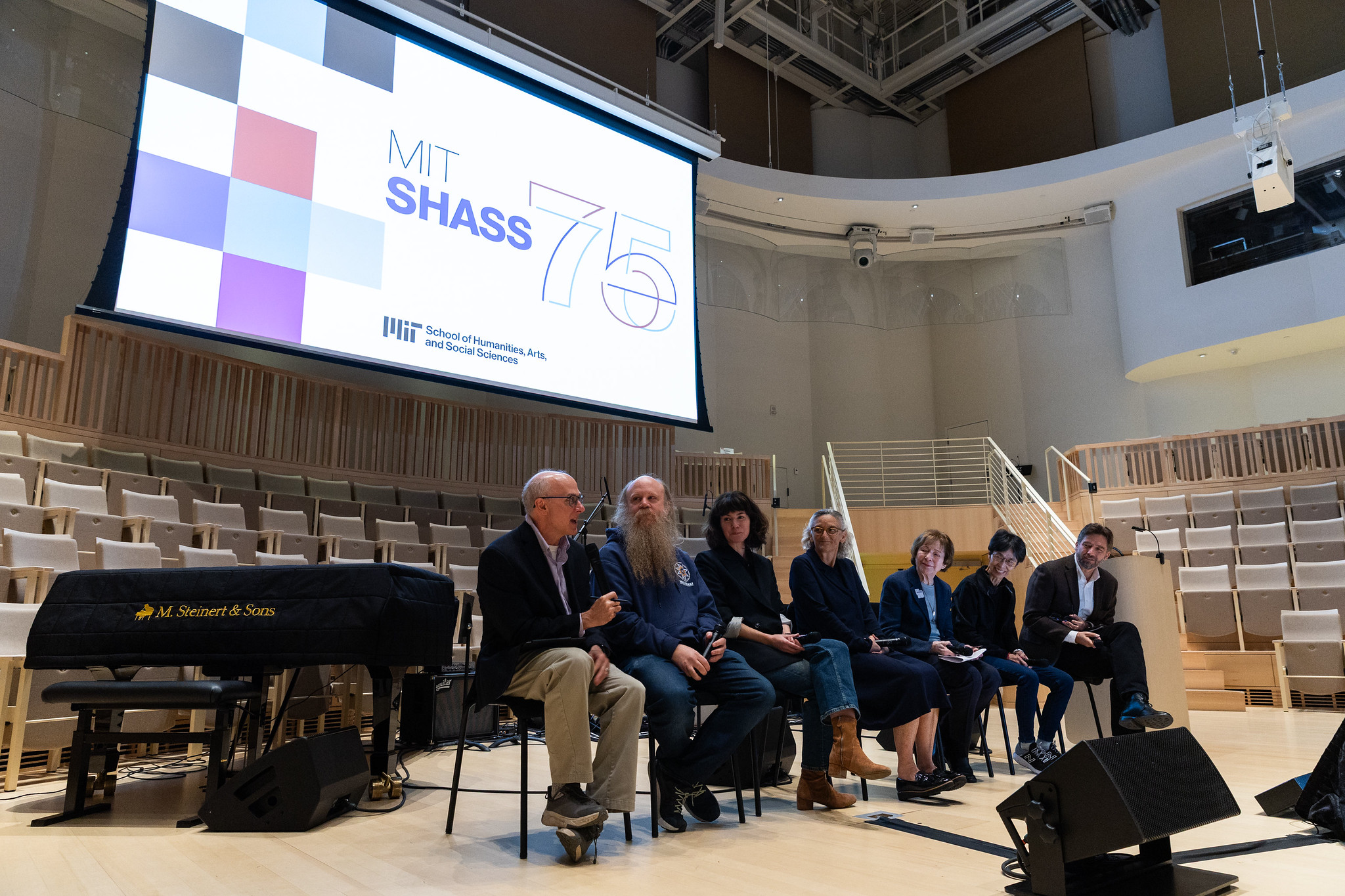
During the School of Humanities, Arts, and Social Sciences’ 75th Anniversary Symposium, President Sally Kornbluth said “MIT has never needed your particular insight and guidance more than we do now.”
MIT News · Artificial Intelligence· news.mit.eduOct 23, 2026
Assistant Professor Benjamin Lindquist studies how engineers deliberately injected randomness into early AI, giving rise to deep-learning models that sometimes hallucinate.
MIT News · Artificial Intelligence· news.mit.eduOct 22, 2026
“X-Hinges” helps design and 3D print items like lamps and gloves with an interactive twist: automatically embedded sensors that perceive and adaptively respond to human contact.
We use cookies to run the site and, with your consent, for analytics and to show ads.
See our Cookie Policy.