Randomized neural networks enable fast and analytically tractable training by fixing the input to hidden layer parameters at random and learning the output weights in closed form; however, their performance critically depends on a single uninformed draw of hidden units. This one shot and task uninformed feature construction often leads to redundant representations and suboptimal utilization of model capacity. To address this limitation, we propose a simple and broadly applicable residual guided procedure that greedily constructs the hidden layer using a closed form residual decrease criterion. At each stage, we (i) generate a pool of random candidate units, (ii) score each candidate by the exact reduction it induces in the ridge regularized objective, (iii) select the top k units, and (iv) refit the readout in closed form using the standard design with direct input links. This procedure yields a progressive training process with a guaranteed monotonic decrease of the training objective. The method is model agnostic: only the candidate generation is architecture specific, while the scoring selection refitting loop is shared across models. Extensive experiments on 71 benchmark datasets from the UCI repository, covering both binary and multiclass classification tasks, demonstrate that the proposed residual-guided models consistently outperform their baseline counterparts in terms of accuracy, stability, and overall ranking performance.
Entropic optimal transport (EOT) has been shown to offer a computationally tractable approximation to exact optimal transport. However, the standard Sinkhorn-Knopp algorithm has two main limitations. First, given discrete measures with $N$ points, each iteration requires $O(N^2)$ operations, which restricts its use on large-scale datasets (e.g. $N\geq10^4$). Second, it uses the independent coupling as a reference measure for regularisation. This assigns mass to high-cost transport edges at moderate regularisation strengths. We propose SinkSLOT, which addresses both limitations by putting forth the expected sliced lifted transport plan as a natural way to sparsify the Gibbs kernel with a non-independent prior coupling. We prove that: 1) SinkSLOT converges; 2) with $L$ slices, each resulting sparse Sinkhorn iteration costs $O(LN)$; and 3) the resulting objective is a divergence requiring no debiasing. Experiments on synthetic benchmarks show that SinkSLOT delivers substantial speedups over state-of-the-art dense and sparse EOT methods. We also demonstrate the applicability of the proposed divergence in a gradient flow experiment. The code is publicly available at https://github.com/cai4cai/SinkSLOT.
Ian Hsieh, Soumya Snigdha Kundu, Tom Vercauteren et al.· 0 citations
A literature-guided, patient-independent comparison of ten BCG feature groups using a 512-sensor capacitive pressure mat recorded simultaneously with respiratory polygraphy in 155 patients undergoing in-hospital evaluation for obstructive sleep apnea shows that a compact, interpretable subset of the full feature library achieves clinically relevant performance under patient-independent validation and provides an empirical basis for feature selection in future BCG systems.
Israel Campero Jurado, Zoe Bousraou, Lara Benning et al.· 0 citations
Predictive Process Monitoring (PPM) models are increasingly deployed in dynamic environments where concept drift causes the underlying process distribution to shift over time. While recent work has moved toward online continual learning, existing methods train compact, task-specific networks entirely from scratch, leaving a persistent cold-start problem. Foundation Models (FMs) offer a compelling solution to this problem, but their continual fine-tuning in the process mining domain remains unexplored. We propose COMPASS (Continual Online foundation Model-based PPM with Adaptive SubSpaces), the first framework for online continual fine-tuning of FMs for PPM. COMPASS adapts loss-plateau drift detection to autonomously identify task boundaries in event streams and maintains a unified knowledge subspace including both pre-trained and task-specific directions. We evaluate our approach on nine event streams covering synthetic and real-world concept drift scenarios, across task-free and task-aware settings with multiple backbones and with consistent hyperparameter tuning across all methods. Our approach outperforms three SOTA non-FM competitors and two update strategy baselines, with particularly strong gains on streams exhibiting recurrent drift and complex, long-running cases, while incurring acceptable computational overhead compared to the non-FM competitors.
Sjoerd van Straten, Marwan Hassani· 0 citations
Reach audiences
Advertise in front of researchers, engineers, and readers.
Predictive Process Monitoring (PPM) enables organizations to forecast future process behavior, such as the next activity and remaining time of ongoing cases. In practice, three conditions cause existing methods to degrade, namely data scarcity, high process entropy and distributional shift. While Foundation Models (FMs), especially Large Language Models (LLMs), offer a new paradigm through broad sequential reasoning, adapting them to multi-task PPM under these conditions remains an open challenge. Existing FM-based approaches either lack mechanisms for handling distributional shift or rely on direct regression heads that can be structurally misaligned with continuous time prediction tasks. This paper introduces D-TAIA (Domain-aware Training and Attention-based Inference Architecture), a framework for a joint next activity and remaining time prediction task via parameter-efficient fine-tuning of an FM backbone. Our approach combines domain-aware triplet loss (DATL) pre-training with FAISS-based nearest neighbor retrieval for remaining time prediction, and adopts the TAIA inference strategy to preserve pre-trained sequential reasoning during fine-tuning. Evaluated across four real-world event logs, D-TAIA consistently shows SOTA or competitive performance compared to a fine-tuned LLM and a recurrent neural network baseline. Ablation studies confirm that techniques from NLP and computer vision can be transferred effectively to PPM with only a 10M-parameter backbone, though component contributions vary by dataset entropy.
Sjoerd van Straten, Christine Jacob, Marwan Hassani· 0 citations
The experiments show that CATTLE can learn generalized context from a single source data set and is rank-wise and statistically superior to nine state-of-the-art baselines, including machine learning, deep learning, and transfer learning methods using large-scale pre-trained models.
K. F. Akhter, Ibna Kowsar, Manar D. Samad· 0 citations
HARTS is the first system to demonstrate arbitrary-rollout-tree prefix-sharing speedups on a real hybrid-attention model, and its numerical differences are comparable to baseline self-rerun variation, and its reward trend is similar to the baseline over the first 120 steps of SWE-bench training.
Bo-Yuan Meng, Pei-Hua Bao, Hong Liu et al.· 0 citations
A generative modeling framework for characterizing EV energy consumption under real-world operating conditions, providing an essential foundation for uncertainty-aware fleet planning in large-scale operational settings is demonstrated.
H. Ramesh, André Snoeck, Chyi-Fu Hong et al.· 0 citations
AdaRDiff is proposed, a generalized differencing approach that uses learnable weights to simplify the series through weighted differencing with previous time instants, and attains state-of-the-art forecast accuracy across eight benchmarks spanning electricity, weather, traffic, and energy, at negligible parameter cost.
Morad Laglil, Younes Hlal, Marouane El Hadari et al.· 0 citations
Generalized Gibbs Ensemble Weighting is developed, a probabilistic framework that treats forecasting models as experts and assigns ensemble weights using a Gibbs-style exponential transformation of normalized predictive loss and produces a family of related methods, including Stable Gibbs weighting, Directional Gibbs-NCL, and Symmetric Gibbs-NCL.
Prasen R. Nuthanakaluva, Nava K. Gaddam· 0 citations
A systematic comparison of four classical machine learning architectures, support vector machines, artificial neural networks, convolutional neural networks, and long short-term memory networks against their quantum counterparts against their quantum counterparts characterize the trade-offs between classical and quantum approaches under realistic, resource-constrained conditions and provide a benchmark for future studies on actual quantum hardware.
Tariq Mahmood, Z. Abidin, Itzel Luviano Soto et al.· 0 citations
Hanneke, Moran, Shlimovich and Yehudayoff (COLT 2025) posed the following open problem. A selector sees a finite dataset $D \subseteq \mathbb{R}^d \times \mathbb{R}$, picks at most $n$ examples together with nonnegative weights, and hands the weighted least squares objective to the minimum-norm ERM. Writing $F_w(d,n)$ for the worst-case ratio between the loss of the returned predictor on all of $D$ and the optimal loss, they proved $F_w(d,n)=\infty$ for $n<d$, $F_w(d,d)=d+1$ and $F_w(d,n)=1$ for $n \ge 2d$, and asked for the value in the open regime $d<n<2d$. We determine this value in several cases. For every $d$ we prove $F_w(d,2d-1)=1+1/d$, which confirms a claim stated without proof in the original note. We further prove $F_w(3,4)=5/3$ and $F_w(4,5)=2$, the two smallest cells not covered by the endpoint formula. For every intermediate budget $n=d+k$ we prove the lower bound $F_w(d,d+k) \ge 1+\Gamma_{d,k}$, where $\Gamma_{d,k}$ is an explicit harmonic quantity over balanced partitions, and we show that this bound is the exact minimax value over the class of datasets whose whitened gradient systems carry an orthogonal circuit-block structure. All three exact values match $1+\Gamma_{d,k}$, and we conjecture that equality holds throughout the open regime. The upper bound proofs run on a common geometric spine: a rigidity theorem for positive spanning configurations of loss gradients, classifications and structural reductions of small positive bases in $\mathbb{R}^3$ and $\mathbb{R}^4$, and a dimension-free extremal-basis argument that converts sign-cone geometry into five-point selections. We also give explicit counterexamples showing that several shorter routes fail, and constructive polynomial-time selection algorithms for all proved cases.
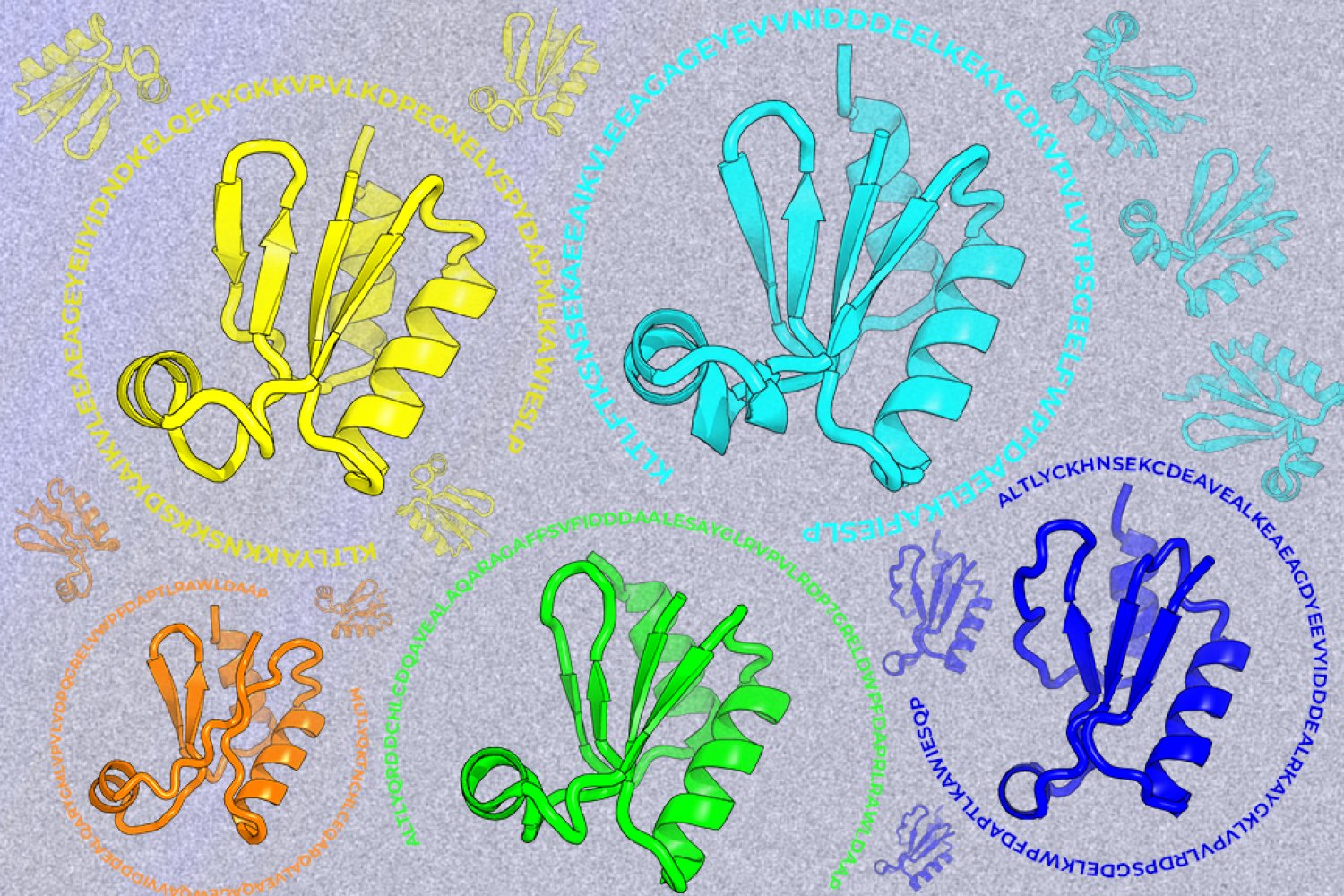
A new machine-learning framework aims to improve the success rate of computational protein design while moving away from results that reproduce sequences found in nature.
MIT News · Artificial Intelligence· news.mit.eduAug 24, 2026
A new method for surgically removing training examples from a model reveals that as datasets grow, the link between what a model learns and what it produces dissolves.