This note argues that, at the level of trajectory generation and action-value updating, the distinction between Monte Carlo Tree Search and MC control is largely terminological.
Battery health prognostics is a core function in battery management systems (BMSs), yet long-horizon health forecasting from BMS signals remains challenging due to operating-condition dependency and sensor noise. In this paper, we propose PhyMamba, a two-stage physics-modulated Mamba framework that integrates electrochemical aging into sequence modelling. PhyMamba does not require explicit identification of internal aging parameters, which often relies on intrusive measurements. In stage-1, a lightweight Mamba encoder first processes BMS signals and produces a latent representation that is transformed via an aging parameterization module, into physics-informed aging features. In stage-2, a customized Mamba forecasting backbone performs multi-cycle prediction, where physics is tightly integrated to regulate the model's internal temporal updates toward degradation-consistent evolution. Experiments on three public datasets under multiple forecast horizons show that PhyMamba achieves the best aggregated performance, with an overall mean error reduction of 31.8% compared with a diverse range of baselines. PhyMamba also offers an optimized accuracy-efficiency trade-off, which supports practical deployment for robust battery health prognostics.
Sara Sameer, Yunyi Zhao, Wei Zhang et al.· 0 citations
A novel framework of temporal memory-aware Online Test-Time Adaptation on Dynamic Graphs, named DGOTTA, to effectively adapt well-trained DGNNs during test time and significantly improves generalization under diverse distribution shifts and multiple model architectures is proposed.
This study proposes a novel framework to estimate parameters for reproducing target multicellular patterns using an agent-based model (ABM). Two major challenges in multicellular ABMs are estimating cell-level parameters (agent-specific variables) and quantitatively evaluating the topological characteristics of multicellular arrangements under stochastic cell proliferation and death. To address these challenges, we integrate two approaches: Betti vectors and inverse surrogate modeling. The Betti vectors obtained through topological data analysis can consistently represent features of a wide range of multicellular spatial configurations. The inverse surrogate modeling enables direct inference of the corresponding ABM parameters from the target patterns. We validated the proposed framework using zebrafish pigment pattern formation, a representative model of pattern formation driven by multicellular interactions. The results demonstrate that our framework successfully estimates ABM parameters and outperforms conventional methods such as PointNet++. Notably, the proposed method, which used only 10% of the training data, outperformed PointNet++, which used 100% of the data, across all evaluation metrics.
Kenji Komiya, Andrew Kailiang Jin, Ryo Nishikimi et al.· 0 citations
Reach audiences
Advertise in front of researchers, engineers, and readers.
Multimodality translation (e.g., text-to-image) is a core generative AI task. However, existing approaches (1) follow generative paths that do not directly represent the source modality, limiting the flexibility of some sampling algorithms; and (2) are unidirectional, preventing inversion (e.g., image-to-text). We propose BIT: Bidirectional Image-Text Diffusion Bridges. In contrast to previous approaches, BIT starts directly from text and interpolates into images, providing (1) a source-aware generative path that enables diverse and flexible sampling algorithms; and (2) an endpoint-conditioned process that can be traversed from image to text, providing a unified, bidirectional generative framework. BIT is derived through stochastic calculus, yielding SDE forms amenable to simulation and tractable loss functions that scale to high dimensions. Our experiments show that BIT is competitive with denoising-diffusion and deterministic-flow baselines, and outperforms them on several vision--language and natural-science evaluations.
Gabe Guo, Elon Litman, Thanawat Sornwanee et al.· 0 citations
The Hypergraph Adaptive waveLet Operator (HALO), which lifts the domain to a hypergraph and learns in its spectral wavelet domain, achieves best or near-best accuracy among frequency-, transformer-, DeepONet-, state-space-, and graph-based baselines and sustains stable multi-step rollouts.
R. Sarkar, Venkataramana Runkana, Souvik Chakraborty· 0 citations
This work introduces FeatureFormer, a neural performance predictor that incorporates explicit node-wise encodings of FLOPs, parameter counts, and memory proxies within a gated graph attention architecture and presents NNEQ, a new large-scale energy consumption dataset that enables unified evaluation of latency and energy prediction.
Matthew Grenier, William Hammer, Andrew Heuer et al.· 0 citations
Short-term load forecasting (STLF) provides essential information for numerous applications in modern power systems. However, accurate STLF often relies on fine-grained smart-meter data from distributed users, raising increasing concerns about data privacy. Federated learning (FL) has therefore emerged as a promising privacy-preserving paradigm for STLF. Nevertheless, this paper reveals structured heterogeneity in clients'load data. Specifically, clients exhibit different responses to exogenous factors and distinct temporal load profiles, which can degrade forecasting performance in FL. To mitigate these issues, this paper studies the role of model initialization in federated STLF, and proposes two initialization strategies from global and local perspectives. For global model initialization, when auxiliary public load data are available, a pretrained initialization strategy is developed to initialize the global model before federated training, thereby reducing client drift during the training process. For local model initialization, we propose SLIAvg, a sequential local initialization strategy that promotes a more consistent training process by allowing participating clients to start from progressively adapted models within each communication round. Since the proposed strategies only modify the initialization process, they are compatible with most existing FL frameworks and privacy-enhancing techniques. Experiments on real smart-meter data with two representative forecasting architectures demonstrate that the proposed strategies effectively improve forecasting performance, as evidenced by reduced client drift, improved convergence behavior, and lower forecasting errors.
Jia-Ning Chen, Vajiheh Farhadi, Yan Li et al.· 0 citations
This framework separates temporal alignment, plasticity, forgetting, and bounded rehearsal in recurrent sequence models, together with numerically stable positive-decay renormalization, to remain competitive in language modeling and improve length extrapolation on variable-digit addition.
Yi-Fan Zhang, Steve Ta, Jasper Zhang et al.· 0 citations
Overall, it is found that probing is an effective means to catch a range of different tool-calling errors, including errors arising from using an argument that has the wrong value but the correct type, which might not be recorded by standard logging frameworks.
Eric C. Yeats, Brendan Kennedy, Loc Truong et al.· 0 citations
A supervised energy-distance distillation method is introduced that compresses a multi-step diffusion teacher into a single-step student by aligning student forecasts with teacher samples and ground-truth observations and preserves skill for extreme events.
Yiming Yang, Valentin Brekke, James Briant et al.· 0 citations
Biological heterogeneity in Alzheimer's Disease (AD) poses a critical diagnostic challenge, particularly for traditional linear methods that fail to capture non-linear neural dynamics. To address this, we propose a diagnostic framework utilizing the Large Brain Model (LaBraM), pretrained on over 2,500 hours of EEG data. By integrating these high-dimensional latent embeddings with a non-linear Random Forest classifier, our approach effectively isolates robust disease markers. Under a rigorous subject-independent 5-fold cross-validation protocol, the method achieves an ROC-AUC of 89.36% +/- 3.49%, PR AUC of 81.45% +/- 4.43%, and Balanced Accuracy of 82.44% +/- 4.34% in distinguishing dementia patients from healthy controls. Notably, this performance uses only 8-second EEG segments, surpassing traditional spectral baselines, including band-power and parameterized oscillatory features (FOOOF). Post-hoc occlusion analysis confirms the model captures clinically validated biomarkers, specifically occipital-frontal Alpha and Theta rhythm degradation. Additional neurophysiological alignment analysis demonstrated that higher LaBraM-predicted dementia probability significantly correlated with worse cognitive performance, greater clinical severity, increased theta and alpha relative power, and higher aperiodic exponent. These findings demonstrate that deep latent representations extract clinically relevant signatures from noisy signals, enabling precise, rapid, and data-efficient diagnosis.
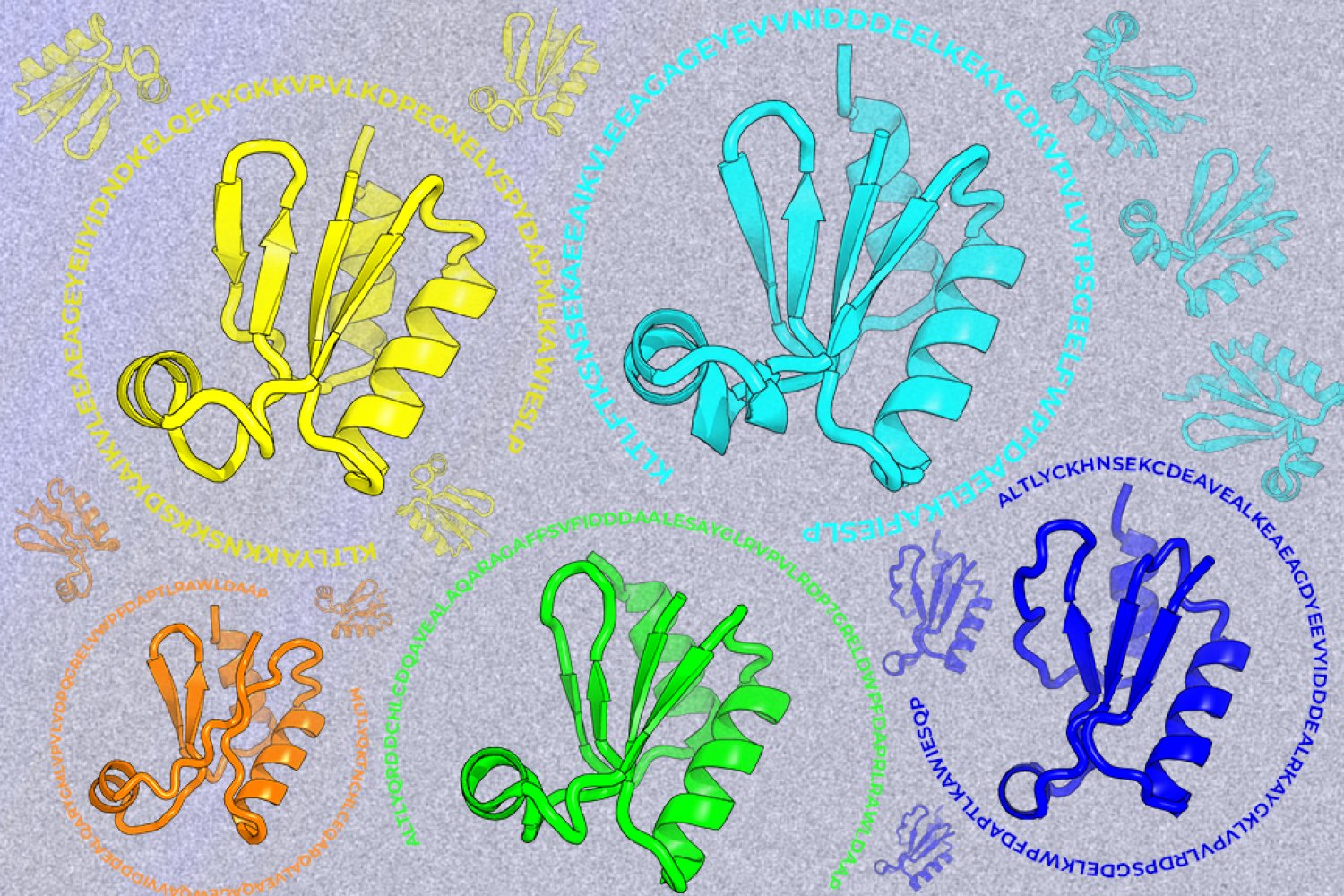
A new machine-learning framework aims to improve the success rate of computational protein design while moving away from results that reproduce sequences found in nature.
MIT News · Artificial Intelligence· news.mit.eduAug 24, 2026
A new method for surgically removing training examples from a model reveals that as datasets grow, the link between what a model learns and what it produces dissolves.