This work introduces a 98% automated pipeline to produce high-quality Quranic datasets and presents a novel ASR-based approach for pronunciation error detection utilizing the authors' custom Quran Phonetic Script (QPS) to encode Tajweed rules (unlike the IPA standard for Modern Standard Arabic).
Abdullah Abdelfattah, Mahmoud I. Khalil, Hazem M. Abbas· arXiv.org· 1 citation
Attention is widely understood as an associative memory, but that description alone does not predict how the memory will behave. Predictive theories do exist, but in the literature on animal learning. We show that the state updates of the major linear-attention families are term-for-term identical with named models from a century of animal learning theory: linear attention implements Hebbian contiguity, DeltaNet implements Rescorla--Wagner error correction, and decay variants such as RetNet implement contiguity with a stimulus trace. This dictionary turns conditioning phenomena into testable statements about the in-context behavior of linear transformers, while distinguishing algebraic consequences from empirical measurements. Algebraically, it yields an exact closed form for Kamin blocking, verified in simulation to $<10^{-7}$ across five learning rates. Empirically, it predicts a dissociation that survives training on generic in-context association: error-correcting attention exhibits cue competition, whereas contiguity-based attention does not. A single state also has two capacity regimes, with measured scaling exponents of 1.22 for faithful retrieval and 1.89 for identification, consistent with linear and near-quadratic predictions. Across the full head grid, retrieval error is governed primarily by total state size rather than its partition across heads, indicating that heads provide capacity rather than redundant copies. We also prove no spontaneous recovery for the analyzed single-state recurrences under cue-orthogonal retention trials; with a never-presented-cue control and probes within the trained positional range, we likewise find no recovery in trained models. Finally, we introduce PH-attention, a Pearce--Hall-inspired rule with an explicit feature-indexed associability state that yields cue-dependent learning rates and is absent from the token-computed gates we compare.
This paper designs Markov decision processes (MDPs) for different combinatorial problems and proposes to train conditional GFlowNets to sample from the solution space and demonstrates that GFlowNet policies can efficiently find high-quality solutions.
Dinghuai Zhang, H. Dai, Esmeralda S. Whitammer et al.· Advances in Neural Informati...· 59 citations· ⚡8
This survey reviews representative Transformer-based autonomous driving models and organizes them by task role, sensing configuration, and architectural design and analyzes how efficiency constraints reshaping model design choices in practice affects deployability, robustness, and safety.
J. Zhong, Zheng Liu, Xiangshan Chen· 21 citations
Reach audiences
Advertise in front of researchers, engineers, and readers.
RecourseBench is the first benchmark to explicitly ground recourse evaluation in structured claim verification and mathematically rigorous reproducibility standards, all while featuring the largest collection of state-of-the-art recourse algorithms (27 in total).
Zahra Khotanlou, Hashir Ahmed, Cheng Tan et al.· arXiv.org· 0 citations
Large language models deployed as agents over large tool catalogs face a critical tool-retrieval bottleneck. As embedding-based retrieval approaches rely on compact encoders that may under-capture specialized tool semantics, parametric tool retrieval addresses this by encoding each tool as a virtual token appended to the LLM vocabulary, fine-tuned in two stages (memorization then retrieval SFT) to use the LLM as a retriever, achieving strong performance on standard ToolBench retrieval benchmarks. Yet these benchmarks use verbose, fully-specified queries, and their evaluation applies constrained decoding that restricts outputs to valid token paths, neither reveals whether the model actually understands its tools. We introduce \textbf{ToolSense}, an open-source LLM-powered diagnostic framework that takes any tool catalog as input and automatically generates three benchmarks: a Realistic Retrieval Benchmark (RRB) with queries at three ambiguity tiers, an MCQ probing benchmark, and a QA probing benchmark. Applying ToolSense to ToolBench (~47k tools) and evaluating five parametric model training configurations reveals a knowledge-retrieval dissociation: on RRB queries, several configurations collapse by ~50-64 percentage points compared to fully-specified ToolBench benchmarks, falling below the embedding-model baseline. Additionally, despite strong retrieval performance, some models score near-random on factual probes, suggesting a knowledge-retrieval dissociation. We open-source the ToolSense framework and the ToolBench diagnostic benchmarks at https://github.com/SAP/toolsense.
Ashutosh Hathidara, Sai Shruthi Sistla, Sebastian Schreiber et al.· 0 citations
D3-Gym is introduced, the first automatically constructed dataset with verifiable environments for scientific Data-Driven Discovery, and how D3-Gym environments can serve as a testbed for studying agentic optimization loops such as Autoresearch on real scientific workflows.
Hanane Nour Moussa, Yi-Fei Li, Zhuo-Yang Li et al.· arXiv.org· 0 citations
In this single-model intervention, preference alignment suppresses MRI-referencing behavior but reduces the augmented-condition advantage, leaving the underlying issue unresolved, and results caution against reading surface metric gains as evidence of true multimodal integration.
Tendon-driven hands are anthropomorphic, and moving the actuators off the joints is what makes a hand of this capability affordable to build. Two effects produce that saving. Routing force through a cable removes the requirement that a motor fit inside the joint it drives, so smaller and cheaper motors suffice, and one motor can drive several joints through a single cable, so fewer motors are needed. They are also harder to learn on than a direct-drive hand. The underactuated transmission that produces the saving is itself difficult to represent in a simulator, and the joints one cable drives are not independently commandable. We present Aero Hand Open, a tendon-driven anthropomorphic hand that is released simulation-ready. Three things ship with it. A simulation model reproduces the cable transmission itself. An identified actuation map connects that model to the motor commands in both directions, including the three-way coupling of the thumb. A reinforcement learning package trains policies for the hand. Together they let a policy be trained entirely in simulation and run on the hand with no fine-tuning and no state estimation. We release the mechanical design, the simulation model, the identified mapping, the training environment and the deployment stack.
Nan Wang, Mohit Yadav, Jonathan Wulff et al.· 0 citations
A general framework for synthetic-augmented inference across a population of related tasks is developed, which characterizes synthetic augmentation by the number of synthetic observations and their weight and specifies a size-weight frontier that specifies, for each weight, the largest synthetic sample size for which all smaller sizes attain the target task-marginal coverage.
Neural-network optimization in 2025-2026 is no longer well described as a succession of new Adam variants. The design space has expanded from coordinates to matrices and layers, from fixed training horizons to policies over time, and from mathematical update rules to state representations that must survive sharding and low-precision computation. This survey organizes recent optimizers and training optimization methods along four largely independent axes: temporal estimation, update geometry, horizon management, and representation and systems. It connects the spectral normalization of Muon, the historical matrix statistics of Shampoo and SOAP, adaptive and hybrid matrix methods, memory-efficient optimizers, schedule-free training, small-batch corrections, and quantized optimizer states. The central empirical conclusion is deliberately non-triumphal: matrix-aware methods represent a genuine advance, but there is no context-independent replacement for AdamW. Rankings change with model scale, data-to-parameter ratio, batch size, schedule, parameter partition, tuning budget, and whether the target metric is tokens, FLOPs, wall-clock time, or memory. The practical consequence is a compositional view of optimizer design and a stricter protocol for evaluating optimizer claims.
A code world model accepted by a sampling gate can be exactly right on everything the gate can see and arbitrarily wrong beyond it. We characterize what a certified model can know, and what its errors can cost, when the omission is an annular freeze mode enclosing an unreachable interior. The gate quotient makes the question precise: acceptance-with-certainty determines the model exactly on the reachable query set; beyond reach is gauge. On a minimal ring instrument we prove the extreme case (a wrong-topology filled-disc artifact unfalsifiable by any sampling gate and bitwise harmless at play) and measure, with LLM synthesis across three model families, how one knob (a channel of width gamma) walks the same artifact through three regimes: unfalsifiable-and-harmless, falsifiable-and-costly, and instantly falsified. Three principles organize the empirics. First, danger is topology relative to reach: a channel the planner can use collapses the blind model's exploitation (play cost 1.09 to ~0 over a knee at gamma ~ 0.1), while a hidden channel with the same first Betti number keeps it at full strength (1.12). Second, repair is parameter-bound and sensor-bound: no family recovers the region from outside evidence; from inside, models pose the right topology but cannot pin its parameters, and the posed topology tracks the guiding persistent-homology summary's wrong beta_1 (a sensor with a measured geometric resolution limit), not the truth. Third, mitigation must match the error's dimension and direction: point fences fail against the one-dimensional boundary, a dimension-matched persisted fence collapses exploitation to a two-lesson transient (0.999 to 0.058), and the dual freedom certificate collapses the invented-mode failure symmetrically (1.769 to 0.029). In n dimensions the shell makes misidentification near-certain while the danger stays fully exploitable: the two axes are independent.
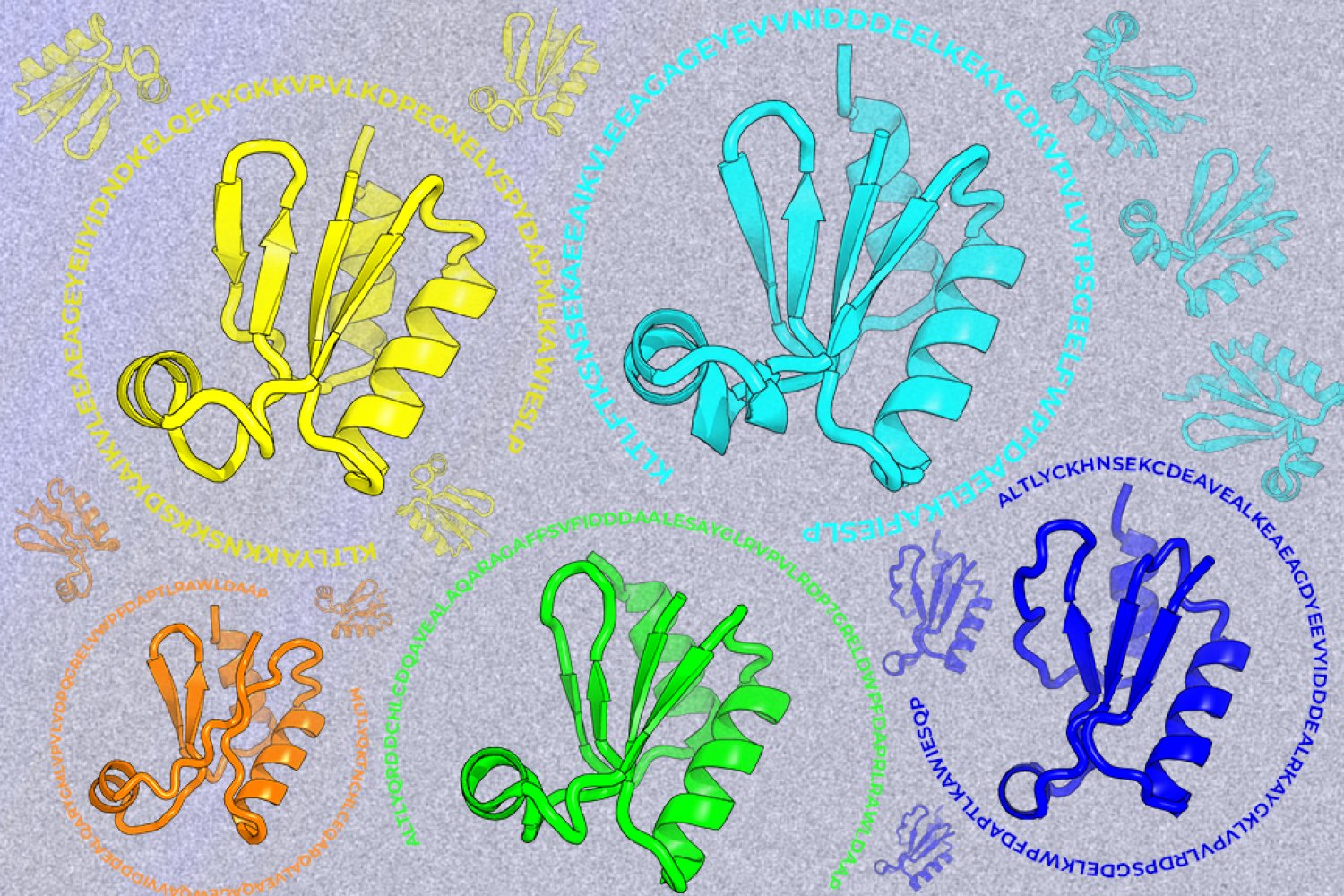
A new machine-learning framework aims to improve the success rate of computational protein design while moving away from results that reproduce sequences found in nature.
MIT News · Artificial Intelligence· news.mit.eduAug 24, 2026
A new method for surgically removing training examples from a model reveals that as datasets grow, the link between what a model learns and what it produces dissolves.